


Carbon dot-based inverse opal hydrogels with photoluminescence: dual-mode sensing of solvents and metal ions
Literature Information
Publication Date
2019-08-09
DOI
10.1039/C9AN01287G
Impact Factor
4.616
Authors
Yuhua Zhu, Jianying Wang, Xiang Zhu, Jun Wang, Lijie Zhou, Jinhua Li, Tao Mei, Jingwen Qian, Lai Wei, Xianbao Wang
View Original
Abstract
A dual-mode sensing platform, involving fluorescence and reflectance modes, has been demonstrated for highly sensitive and selective detection of solvents and metal ions based on carbon dot-based inverse opal hydrogels (CD-IOHs). In this work, CD-IOHs have been first synthesized via the typical templating technique. Two kinds of CDs, including solvent and Cu(II) ion sensitive CDs, have been incorporated into the matrix of IOHs during the co-polymerization of acrylic acid (AA) and 2-hydroxyethyl methacrylate (HEMA). The CD-IOHs not only appear green under daylight but also exhibit stable photoluminescence (PL) under UV light owing to the stop-band effect of photonic crystals and the quantum effect of CDs, respectively. By using these two optical phenomena, for solvent sensing, the CD-IOHs change their colors from green, yellow, and red to a semitransparent state and show good linear sensing with the ethanol content varying from 0 to 45% in reflectance mode, while their PL intensities exhibit a nonlinear detection trend: first an increase and then a decrease with the ethanol content in fluorescence mode. Remarkably, as for metal ion sensing, the CD-IOHs have high selectivity for Cu(II) ions via the specific PL quenching effect of Cu(II) ion sensitive CDs. Furthermore, the CD-IOHs show good linear detection in both modes and a wide linear detection range from 0.1 μM to 7 mM. Thus, high selectivity, colorimetric detection, a broad linear detection range, and dual-mode sensing can be realized using the CD-IOHs.
Recommended Journals

Green Chemistry

Photochemical & Photobiological Sciences

CrystEngComm

European Journal of Organic Chemistry

Faraday Discussions

Journal of Enzyme inhibition and Medicinal Chemistry

Physical Chemistry Chemical Physics

Molecular Diversity

Environmental Toxicology and Pharmacology

Mini-Reviews in Medicinal Chemistry
Related Literature
Analysis of the interfacial characteristics of BiVO4/metal oxide heterostructures and its implication on their junction properties
Sebastián Murcia-López, Andreas Klein, Roel van de Krol, Teresa Andreu, Joan Ramón Morante, Thierry Toupance, Wolfram Jaegermann
2019-01-29
Paper
DOI: 10.1039/C8CP07483F
Reconsideration of the relaxational and vibrational line shapes of liquid water based on ultrabroadband dielectric spectroscopy
Keiichiro Shiraga, Takashi Arikawa, Yuichi Ogawa
2018-10-08
Paper
DOI: 10.1039/C8CP04778B
Growth of nanodroplets on a still microfiber under flow conditions
Maaike Rump, Shantanu Maheshwari, Lei Bao
2018-06-18
Paper
DOI: 10.1039/C8CP02353K
Fundamental limitations of the time-dependent Stokes shift for investigating protein hydration dynamics
Esther Heid
2019-02-01
Paper
DOI: 10.1039/C8CP07623E
Tannic acid capped gold nanoparticles: capping agent chemistry controls the redox activity
Alex L. Suherman, Giorgia Zampardi, Hatem M. A. Amin, Neil P. Young, Richard G. Compton
2019-02-04
Paper
DOI: 10.1039/C9CP00056A
Infrared spectroscopic characterization of phosphate binding at the goethite–water interface
Stella Gypser, Peter Leinweber, Dirk Freese
2019-01-24
Paper
DOI: 10.1039/C8CP07168C
Structural and bonding properties of Cu3O3− and Cu3O4− clusters: anion photoelectron spectroscopy and density functional calculations
Xi-Ling Xu, Bin Yang, Zhi-You Wei, Guo-Jin Cao, Hong-Guang Xu
2018-07-23
Paper
DOI: 10.1039/C8CP03302A
Thermophysical properties of glyceline–water mixtures investigated by molecular modelling
Jörg Baz, Christoph Held, Jürgen Pleiss, Niels Hansen
2019-02-25
Paper
DOI: 10.1039/C9CP00036D
Electrical conductivity and oxygen diffusion behaviour of the (La0.8Sr0.2)0.95CrxFe1−xO3−δ (x = 0.3, 0.5 and 0.7) A-site deficient perovskites
Zonghao Shen, John A. Kilner, Stephen J. Skinner
2018-06-21
Paper
DOI: 10.1039/C8CP02797H
You might also like
Compound Q&A
What precautions should be taken when handling 4-(2-Furylmethyl)thiomorpholine 1,1-dioxide (CAS: 79206-94-3)?
When handling 4-(2-Furylmethyl)thiomorpholine 1,1-dioxide (CAS: 79206-94-3), it ...
79206-94-34-(2-Furylmethyl)thi...
Compound Q&A
What precautions should be taken when handling 4-Chloro-N-[2-(4-morpholinyl)ethyl]benzamide (CAS: 71320-77-9)?
When handling 4-Chloro-N-[2-(4-morpholinyl)ethyl]benzamide (CAS: 71320-77-9), it...
71320-77-94-Chloro-N-[2-(4-mor...
Compound Q&A
How should waste containing 2-[2-(2-Methoxyethoxy)ethoxy]ethyl 4-methylbenzenesulfonate (CAS: 62921-74-8) be handled?
Waste containing this compound (CAS: 62921-74-8) should be handled according to ...
62921-74-82-[2-(2-Methoxyethox...
Compound Q&A
How should waste containing (S)-Methyl 2-amino-3-cyclohexylpropanoate be handled?
Waste containing (S)-Methyl 2-amino-3-cyclohexylpropanoate should be collected i...
40056-18-6(S)-Methyl 2-amino-3...
Compound Q&A
How is 5-({4-[(2S,4R)-4-Hydroxy-2-methyltetrahydro-2H-pyran-4-yl]-2-thienyl}sulfanyl)-1-methyl-1,3-dihydro-2H-indol-2-one (CAS: 166882-70-8) typically synthesized?
This compound can be synthesized using a multi-step process involving the conjug...
166882-70-85-({4-[(2S,4R)-4-Hyd...
Compound Q&A
Are there alternatives to (2E)-3-(3,4-Dichlorophenyl)acrylic acid (CAS: 7312-27-8) in synthesis?
There are several alternatives to (2E)-3-(3,4-Dichlorophenyl)acrylic acid in syn...
7312-27-8(2E)-3-(3,4-Dichloro...
Compound Q&A
How should Ethyl 6-(2-nitrophenyl)imidazo[2,1-b][1,3]thiazole-3-carboxylate (CAS: 925437-84-9) be stored?
Ethyl 6-(2-nitrophenyl)imidazo[2,1-b][1,3]thiazole-3-carboxylate (CAS: 925437-84...
925437-84-9Ethyl 6-(2-nitrophen...
Compound Q&A
How should waste containing 2-(1,3-Thiazol-2-yl)ethanamine (CAS: 18453-07-1) be handled?
Waste containing 2-(1,3-Thiazol-2-yl)ethanamine (CAS: 18453-07-1) should be coll...
18453-07-12-(1,3-Thiazol-2-yl)...
Compound Q&A
How is Methyl 5-iodo-2-methylbenzoate (CAS: 103440-54-6) typically synthesized?
Methyl 5-iodo-2-methylbenzoate can be synthesized through the iodination of meth...
103440-54-6Methyl 5-iodo-2-meth...
Compound Q&A
How is 5-Chloro[1,2,4]triazolo[1,5-a]pyridine (CAS: 1427399-34-5) typically synthesized?
5-Chloro[1,2,4]triazolo[1,5-a]pyridine is commonly synthesized via the condensat...
1427399-34-55-Chloro[1,2,4]triaz...
Source Journal
Analyst

CiteScore:
7.8
Self-citation Rate:
5.6%
Articles per Year:
653
Analyst publishes analytical and bioanalytical research that reports premier fundamental discoveries and inventions, and the applications of those discoveries, unconfined by traditional discipline barriers.
Recommended Compounds
![4-Chloro-3-(trifluoromethyl)-1H-pyrrolo[2,3-b]pyridine structure](https://static.chemtradehub.com/structs/869/869335-75-1-a9d0.webp "4-Chloro-3-(trifluoromethyl)-1H-pyrrolo[2,3-b]pyridine structure")
4-Chloro-3-(trifluoromethyl)-1H-pyrrolo[2,3-b]pyridine
CAS Number:
869335-75-1
Molecular Formula:
C8H4ClF3N2
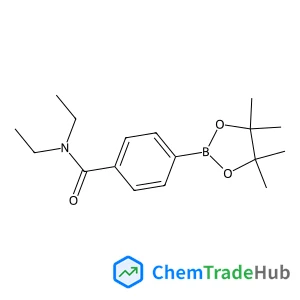
N,N-Diethyl-4-(4,4,5,5-tetramethyl-1,3,2-dioxaborolan-2-yl)benzamide
CAS Number:
325142-99-2
Molecular Formula:
C17H26BNO3
Recommended Suppliers





Disclaimer
This page provides academic journal information for reference and research purposes only. We are not affiliated with any journal publishers and do not handle publication submissions. For publication-related inquiries, please contact the respective journal publishers directly.
If you notice any inaccuracies in the information displayed, please contact us at support@chemtradehub.com. We will promptly review and address your concerns.