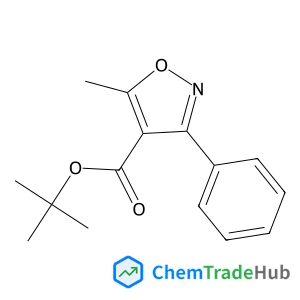
2-Methyl-2-propanyl 5-methyl-3-phenyl-1,2-oxazole-4-carboxylate
CAS Number:
211429-79-7
Molecular Formula:
C15H17NO3
Yu Kong, Rong Tan, Lili Zhao
Grafting L-proline on imidazolium-based ionic liquid (IL)-functionalized magnetic nanoparticles afforded a magnetically recoverable L-proline catalyst. Characterization technologies suggested the presence of an L-proline backbone, an IL linker, and a magnetic ferrite core in the catalyst. The resulting L-proline catalyst was efficient for direct asymmetric aldol reaction in water without the need for organic solvents and co-catalysts. Such efficiency is attributed to the fact that the IL moiety facilitated the accessibility of hydrophobic reactants to active sites in water and stabilized the formed enamine intermediate during the reaction. High activity (yield = 92%), diastereoselectivity (dr; 88/12) and enantioselectivity (ee; 85%) were obtained using 10 mol% of a catalyst for the reaction between cyclohexanone and 2-nitrobenzaldehyde within 12 h, where the pristine L-proline and IL-free counterpart were almost inactive. The catalyst was easily separated using a permanent magnet externally and can be reused several times without significant loss of activity.
M. Jalilur Rahman, Hideyuki Shimizu, Masashi Hasegawa, Masahiko Iyoda
DOI: 10.1039/C7QO00258K
He Zhang, Tongxiang Cao, Hejiang Luo, Lianfen Chen, Shifa Zhu
DOI: 10.1039/C9QO00045C
Kai Cheng, Guofang Wang, Mengting Meng, Chenze Qi
DOI: 10.1039/C6QO00634E
Zhou Zhou, Jin-Tao Yu, Yongnan Zhou, Yan Jiang, Jiang Cheng
DOI: 10.1039/C6QO00670A
Dominik Prenzel, Rolf W. Kirschbaum, Wesley A. Chalifoux, Robert McDonald, Michael J. Ferguson, Thomas Drewello
DOI: 10.1039/C6QO00648E
Misun Go, Heekyoung Choi, Ka Young Kim, Cheol Joo Moon, Yeonweon Choi, Hiroyuki Miyake, Shim Sung Lee, Sung Ho Jung, Myong Yong Choi, Jong Hwa Jung
DOI: 10.1039/C9QO00051H
Weilong Wu, Yun Xie, Pan Li, Xiuxiu Li, Yuanhua Liu, Xiu-Qin Dong
DOI: 10.1039/C6QO00810K
Ian Cheng-Yi Hou, Vijayendra Shetti, Shou-Ling Huang, Kun-Lin Liu, Chi-Yang Chao, Song-Cheng Lin, You-Jen Lin, Li-Yin Chen, Tien-Yau Luh
DOI: 10.1039/C7QO00087A
Jochen Kirres, Katharina Schmitt, Iris Wurzbach, Frank Giesselmann, Sabine Ludwigs, Mark Ringenberg, Angelika Baro, Sabine Laschat
DOI: 10.1039/C7QO00077D
Haijun Fan
DOI: 10.1039/C6QO00867D
When handling 4-Methyl-6-(trifluoromethyl)quinoline (CAS: 40716-16-3), safety go...
4-(3,5-Difluorophenyl)aniline is an aromatic organic compound with the CAS numbe...
5-{[4-(Trifluoromethyl)phenyl]sulfanyl}-1,2,3-thiadiazole-4-carboxylic acid can ...
The market for 4-Benzylaniline hydrochloride (CAS: 6317-57-3) is steadily growin...
[3-(Diethylsulfamoyl)phenyl]boronic acid is generally considered safe when handl...
3-Bromo-2,5-dimethoxyaniline is mainly used in the pharmaceutical and chemical i...
N-Methyl-1-(5-methyl-1H-indol-3-yl)methanamine (CAS: 915922-67-7) is subject to ...
This compound is primarily used in the pharmaceutical industry for the synthesis...
2-Methyl-2-propanyl [(1S,3R)-3-aminocyclohexyl]carbamate (CAS: 1298101-47-9) sho...
Ethyl 2-bromo-4,4,4-trifluorobutanoate (CAS: 367-33-9) is utilized in the pharma...

Green Chemistry provides a unique forum for the publication of innovative research on the development of alternative green and sustainable technologies. The scope of Green Chemistry is based on, but not limited to, the definition proposed by Anastas and Warner (Green Chemistry: Theory and Practice, P T Anastas and J C Warner, Oxford University Press, Oxford, 1998). Green chemistry is the utilisation of a set of principles that reduces or eliminates the use or generation of hazardous substances in the design, manufacture and application of chemical products. Green Chemistry is at the frontiers of this continuously-evolving interdisciplinary science and publishes research that attempts to reduce the environmental impact of the chemical enterprise by developing a technology base that is inherently non-toxic to living things and the environment. Submissions on all aspects of research relating to the endeavour are welcome. The journal publishes original and significant cutting-edge research that is likely to be of wide general appeal. To be published, work must present a significant advance in green chemistry. Papers must contain a comparison with existing methods and demonstrate advantages over those methods before publication can be considered. For more information please see this Editorial. Coverage includes the following, but is not limited to: Design (e.g. biomimicry, design for degradation/recycling/reduced toxicity…) Reagents & Feedstocks (e.g. renewables, CO2, solvents, auxiliary agents, waste utilization…) Synthesis (e.g. organic, inorganic, synthetic biology…) Catalysis (e.g. homogeneous, heterogeneous, enzyme, whole cell…) Process (e.g. process design, intensification, separations, recycling, efficiency…) Energy (e.g. renewable energy, fuels, photovoltaics, fuel cells, energy storage, energy carriers…) Applications (e.g. electronics, dyes, consumer products, coatings, pharmaceuticals, preservatives, building materials, chemicals for industry/agriculture/mining…) Impact (e.g. safety, metrics, LCA, sustainability, (eco)toxicology…) Green chemistry is, by definition, a continuously-evolving frontier. Therefore, the inclusion of a particular material or technology does not, of itself, guarantee that a paper is suitable for the journal. To be suitable, the novel advance should have the potential for reduced environmental impact relative to the state of the art. Green Chemistry does not normally deal with research associated with 'end-of-pipe' or remediation issues.
![6,7-Dihydro-5H-pyrrolo[1,2-a]imidazole-6-carboxylic acid structure](https://static.chemtradehub.com/structs/136/1369160-12-2-6524.webp "6,7-Dihydro-5H-pyrrolo[1,2-a]imidazole-6-carboxylic acid structure")