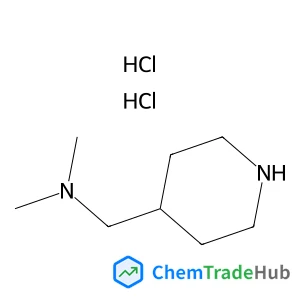
N,N-dimethyl(piperidin-4-yl)methanamine hydrochloride
CAS Number:
172281-72-0
Molecular Formula:
C8H20Cl2N2
The first page of this article is displayed as the abstract.
Zexing Cao
DOI: 10.1039/C9CP01370A
Xinyu Wang, Yang Hong, Man Wang, Gongming Xin, Yanan Yue, Jingchao Zhang
DOI: 10.1039/C8CP07881E
Atiya Banerjee, Jindal K. Shah
DOI: 10.1039/C9CP01538H
Yao Nian, Xiaoyan Li, Yan Wang, Wei Li, Pewee Datoo Kolubah
DOI: 10.1039/C9CP01151J
Nuno M. S. Almeida, Filip Pawłowski, Joseph Vincent Ortiz, Evangelos Miliordos
DOI: 10.1039/C8CP07420H
Sanja Škulj, Mario Vazdar
DOI: 10.1039/C9CP01204D
Afshan Mohajeri, Nasim Hassani
DOI: 10.1039/C8CP07372D
Sławomir Pieprzyk, Marcus N. Bannerman, Arkadiusz C. Brańka, Maciej Chudak, David M. Heyes
DOI: 10.1039/C9CP00903E
Juan Carlos del Valle, Javier Catalán
DOI: 10.1039/C9CP00739C
Michel Dobrijevic
DOI: 10.1039/C9CP00798A
Ethyl 4-chlorothieno[2,3-b]pyridine-5-carboxylate (CAS: 59713-58-5) can be synth...
5-Methyl-1H-indole-3-carbaldehyde (CAS: 52562-50-2) is subject to various regula...
(1,3-Dimethyl-2,4-dioxo-1,2,3,4-tetrahydro-5-pyrimidinyl)boronic acid is a white...
Waste containing Sulfocostunolide A (CAS: 1016983-51-9) should be handled with c...
When handling Murraxocin (CAS: 88478-44-8), ensure proper personal protective eq...
Formvar (CAS: 63148-64-1) is an alkyd resin characterized by a high molecular we...
(S)-4-benzyl-2-((benzyloxy)methyl)morpholine is generally safe when handled with...
Methyl 1-(5-bromo-2-pyrimidinyl)cyclopropanecarboxylate (CAS: 1447607-69-3) is p...
2-Methyl-1-phenyl-1-propanamine hydrochloride (CAS: 24290-47-9) is generally con...
3-(4-Bromophenyl)-2-methylpropanoic acid is synthesized through a multi-step pro...

Physical Chemistry Chemical Physics (PCCP) is an international journal co-owned by 19 physical chemistry and physics societies from around the world. This journal publishes original, cutting-edge research in physical chemistry, chemical physics and biophysical chemistry. To be suitable for publication in PCCP, articles must include significant innovation and/or insight into physical chemistry; this is the most important criterion that reviewers and Editors will judge against when evaluating submissions. The journal has a broad scope and welcomes contributions spanning experiment, theory, computation and data science. Topical coverage includes spectroscopy, dynamics, kinetics, statistical mechanics, thermodynamics, electrochemistry, catalysis, surface science, quantum mechanics, quantum computing and machine learning. Interdisciplinary research areas such as polymers and soft matter, materials, nanoscience, energy, surfaces/interfaces, and biophysical chemistry are welcomed if they demonstrate significant innovation and/or insight into physical chemistry. Joined experimental/theoretical studies are particularly appreciated when complementary and based on up-to-date approaches.
![Imidazo[1,5-a]pyrazine structure](https://static.chemtradehub.com/structs/274/274-49-7-d749.webp "Imidazo[1,5-a]pyrazine structure")