












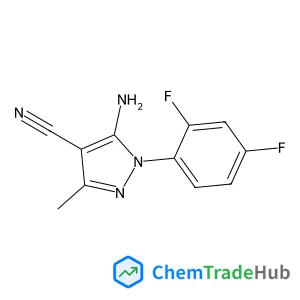
5-Amino-1-(2,4-difluorophenyl)-3-methyl-1H-pyrazole-4-carbonitrile
CAS Number:
1020057-92-4
Molecular Formula:
C11H8F2N4
Sanja Škulj, Mario Vazdar
We performed all-atom molecular dynamics simulations and calculated free energy profiles and apparent pKa values for neutral and anionic forms of single myristic (C14:0), palmitic (C16:0) and stearic (C18:0) fatty acid embedded in a DOPC bilayer and explicit water solvent. We showed that the neutral forms of the fatty acids are stabilized inside the bilayer by hydrogen bonding of a fatty acid carboxylic group with DOPC phosphate and carbonyl groups. In contrast to the neutral form, the anionic forms of the fatty acids are shifted towards the water–membrane interface and are instead stabilized by hydrogen bonding to interfacial water. By using umbrella sampling simulations, we calculated free energies of stabilization and revealed that the free energy of stabilization inside the bilayer increases with the chain length for both the neutral and deprotonated forms. On the other hand, the free energies of flip-flop of both the neutral and anionic forms are constant upon the prolongation of the fatty acid. Based on the free energy curves, we also calculated apparent fatty acid pKa,app values in the bilayer, which are 7.0, 7.2 and 6.3 for myristic, palmitic and stearic acid and are increased by several pKa units compared to the corresponding pKa values in water. By further analysis of the calculated curves we found that spontaneous protonation of fatty acid anions takes place in the bilayer interior at ca. 1.4 nm from the bilayer center for all studied fatty acids.
Joseph Baugh, Adetunji Alabi, Ahmed AlHajaj, Linda Zou, Robert A. W. Dryfe
DOI: 10.1039/C8TA09160A
Yue Zhao, Juan Bai, Xin-Ru Wu, Pei Chen, Pu-Jun Jin, Hong-Chang Yao, Yu Chen
DOI: 10.1039/C9TA05334D
Sarah Di Nonno, Roland Ulber
DOI: 10.1039/D1AN00025J
Clare A. Manderson, Heather McLiesh, Rico F. Tabor, Gil Garnier
DOI: 10.1039/D0AN01993C
Yongchao Huang, Yirui Lu, Ying Lin, Yanchao Mao, Gangfeng Ouyang, Shanqing Zhang
DOI: 10.1039/C8TA06565A
Madalina M. Barsan, Victor C. Diculescu
DOI: 10.1039/D0AN02426K
Ya Wang, Mengyao Li, Yuzhong Zhang
DOI: 10.1039/D1AN00029B
André A. Neves, Shaun Stairs, Heather Ireland-Zecchini, Kevin M. Brindle, Finian J. Leeper
DOI: 10.1039/C0SC00631A
Weidi Sun, Xue Han, Fengli Qu, Rong-Mei Kong, Zilong Zhao
DOI: 10.1039/D1AN00218J
Ethyl 4-chlorothieno[2,3-b]pyridine-5-carboxylate (CAS: 59713-58-5) can be synth...
5-Methyl-1H-indole-3-carbaldehyde (CAS: 52562-50-2) is subject to various regula...
(1,3-Dimethyl-2,4-dioxo-1,2,3,4-tetrahydro-5-pyrimidinyl)boronic acid is a white...
Waste containing Sulfocostunolide A (CAS: 1016983-51-9) should be handled with c...
When handling Murraxocin (CAS: 88478-44-8), ensure proper personal protective eq...
Formvar (CAS: 63148-64-1) is an alkyd resin characterized by a high molecular we...
(S)-4-benzyl-2-((benzyloxy)methyl)morpholine is generally safe when handled with...
Methyl 1-(5-bromo-2-pyrimidinyl)cyclopropanecarboxylate (CAS: 1447607-69-3) is p...
2-Methyl-1-phenyl-1-propanamine hydrochloride (CAS: 24290-47-9) is generally con...
3-(4-Bromophenyl)-2-methylpropanoic acid is synthesized through a multi-step pro...

Physical Chemistry Chemical Physics (PCCP) is an international journal co-owned by 19 physical chemistry and physics societies from around the world. This journal publishes original, cutting-edge research in physical chemistry, chemical physics and biophysical chemistry. To be suitable for publication in PCCP, articles must include significant innovation and/or insight into physical chemistry; this is the most important criterion that reviewers and Editors will judge against when evaluating submissions. The journal has a broad scope and welcomes contributions spanning experiment, theory, computation and data science. Topical coverage includes spectroscopy, dynamics, kinetics, statistical mechanics, thermodynamics, electrochemistry, catalysis, surface science, quantum mechanics, quantum computing and machine learning. Interdisciplinary research areas such as polymers and soft matter, materials, nanoscience, energy, surfaces/interfaces, and biophysical chemistry are welcomed if they demonstrate significant innovation and/or insight into physical chemistry. Joined experimental/theoretical studies are particularly appreciated when complementary and based on up-to-date approaches.
![4-[(1-Methyl-1H-pyrrol-2-yl)methylene]-1,3(2H,4H)-isoquinolinedione structure](https://static.chemtradehub.com/structs/110/1104546-89-5-a600.webp "4-[(1-Methyl-1H-pyrrol-2-yl)methylene]-1,3(2H,4H)-isoquinolinedione structure")




