












A new strategy to enhance low-temperature capacitance: combination of two charge-storage mechanisms
Literature Information
Publication Date
2013-10-25
DOI
10.1039/C3CP53747A
Impact Factor
3.676
Authors
Linghao Su, Liangyu Gong, Yang Zhao
View Original
Abstract
By combining two pseudocapacitance charge-storage mechanisms occurring on the electrode and in the electrolyte, respectively, the specific capacitance of NiO at −20 °C in an alkaline electrolyte containing Fe(CN)63−/Fe(CN)64− couple increases twice, superior to the level at room temperature.
Related Literature
Gas-phase synthesis of Mg–Ti nanoparticles for solid-state hydrogen storage
M. Calizzi, F. Venturi, M. Ponthieu, F. Cuevas, V. Morandi, T. Perkisas, S. Bals, L. Pasquini
2015-11-05
Paper
DOI: 10.1039/C5CP03092G
Accelerated nanoparticles synthesis in alcohol–water-mixture-based solution plasma
Tomohito Sudare
2015-10-27
Communication
DOI: 10.1039/C5CP05168A
Intermediate length scale organisation in tin borophosphate glasses: new insights from high field correlation NMR
G. Tricot, A. Saitoh, H. Takebe
2015-07-07
Paper
DOI: 10.1039/C5CP02095F
A simple analytical model for signal amplification by reversible exchange (SABRE) process
Danila A. Barskiy
2015-11-18
Communication
DOI: 10.1039/C5CP05134G
Resistive switching memory devices based on electrical conductance tuning in poly(4-vinyl phenol)–oxadiazole composites
Yanmei Sun, Fengjuan Miao, Rui Li, Dianzhong Wen
2015-10-08
Paper
DOI: 10.1039/C5CP05481H
Designing the topology of ion nano-channels in the mesophases of amphiphilic wedge-shaped molecules
J. J. Hernandz Rueda, X. Zhu, V. M. Nekipelov, M. Moeller
2015-10-26
Communication
DOI: 10.1039/C5CP05618G
Graphane versus graphene: a computational investigation of the interaction of nucleobases, aminoacids, heterocycles, small molecules (CO2, H2O, NH3, CH4, H2), metal ions and onium ions
Deivasigamani Umadevi, G. Narahari Sastry
2015-09-22
Paper
DOI: 10.1039/C5CP05094D
Interfacial electronic structure and charge transfer of hybrid graphene quantum dot and graphitic carbon nitride nanocomposites: insights into high efficiency for photocatalytic solar water splitting
Zuju Ma, Rongjian Sa, Qiaohong Li, Kechen Wu
2015-11-26
Paper
DOI: 10.1039/C5CP05847C
A theoretical study of O2 activation by the Au7-cluster on Mg(OH)2: roles of surface hydroxyls and hydroxyl defects
Weiliu Fan
2015-10-26
Paper
DOI: 10.1039/C5CP05591A
Programmable diode/resistor-like behavior of nanostructured vanadium pentoxide xerogel thin film
Zhenni Wan, Robert B. Darling, M. P. Anantram
2015-10-26
Communication
DOI: 10.1039/C5CP04755B
You might also like
Compound Q&A
How should waste containing 6-Chloro-5-(2'-hydroxy-3'-methoxy-4-biphenylyl)-3-(3-methoxyphenyl)-1H-pyrrolo[3,2-d]pyrimidine-2,4(3H,5H)-dione (CAS: 1346607-05-3) be handled?
Waste containing 6-Chloro-5-(2'-hydroxy-3'-methoxy-4-biphenylyl)-3-(3-methoxyphe...
1346607-05-36-Chloro-5-(2'-hydro...
Compound Q&A
What are the main uses of (3alpha,5alpha)-3-Hydroxypregnane-11,20-dione (CAS: 23930-19-0)?
(3alpha,5alpha)-3-Hydroxypregnane-11,20-dione is primarily used in the pharmaceu...
23930-19-0(3alpha,5alpha)-3-Hy...
Compound Q&A
What is the market or research trend for 4-Amino-6-chloro-2-pyridinecarboxylic acid (CAS: 546141-56-4)?
The market for 4-Amino-6-chloro-2-pyridinecarboxylic acid (CAS: 546141-56-4) is ...
546141-56-44-Amino-6-chloro-2-p...
Compound Q&A
Are there alternatives to (2-Benzoylethyl)trimethylammonium chloride (CAS: 24472-88-6) in synthesis?
Alternatives to (2-Benzoylethyl)trimethylammonium chloride (CAS: 24472-88-6) in ...
24472-88-6(2-Benzoylethyl)trim...
Compound Q&A
Is N-[4-Nitro-3-(trifluoromethyl)phenyl]acetamide (CAS: 393-12-4) safe?
N-[4-Nitro-3-(trifluoromethyl)phenyl]acetamide (CAS: 393-12-4) is generally safe...
393-12-4N-[4-Nitro-3-(triflu...
Compound Q&A
Are there alternatives to [(4R,5R,6S)-5-hydroxy-10-imino-3,7-dioxa-1,9-diazatricyclo[6.4.0.02,6]dodeca-8,11-dien-4-yl]methyl dihydrogen phosphate (CAS: 39679-56-6) in synthesis?
Alternative reagents such as other phosphates or similar functional groups can b...
39679-56-6[(4R,5R,6S)-5-hydrox...
Compound Q&A
Are there alternatives to N,N'-Bis(3-aminopropyl)-1,3-propanediamine (CAS: 4605-14-5) in synthesis?
There are alternatives to N,N'-Bis(3-aminopropyl)-1,3-propanediamine (CAS: 4605-...
4605-14-5N,N'-Bis(3-aminoprop...
Compound Q&A
What precautions should be taken when handling Aluminium trihexadecanoate (CAS: 555-35-1)?
When handling Aluminium trihexadecanoate, it is important to use appropriate per...
555-35-1Aluminium trihexadec...
Compound Q&A
What is (1,1-Dioxido-3-oxo-1,2-benzothiazol-2(3H)-yl)acetic acid (CAS: 52188-11-1)?
(1,1-Dioxido-3-oxo-1,2-benzothiazol-2(3H)-yl)acetic acid is a chemical compound ...
52188-11-1(1,1-Dioxido-3-oxo-1...
Compound Q&A
Are there alternatives to 5,5-dimethyloxolan-2-one (CAS: 3123-97-5) in synthesis?
Several alternatives to 5,5-dimethyloxolan-2-one (CAS: 3123-97-5) can be used in...
3123-97-55,5-dimethyloxolan-2...
Source Journal
Physical Chemistry Chemical Physics

CiteScore:
5.5
Self-citation Rate:
10.3%
Articles per Year:
3036
Physical Chemistry Chemical Physics (PCCP) is an international journal co-owned by 19 physical chemistry and physics societies from around the world. This journal publishes original, cutting-edge research in physical chemistry, chemical physics and biophysical chemistry. To be suitable for publication in PCCP, articles must include significant innovation and/or insight into physical chemistry; this is the most important criterion that reviewers and Editors will judge against when evaluating submissions. The journal has a broad scope and welcomes contributions spanning experiment, theory, computation and data science. Topical coverage includes spectroscopy, dynamics, kinetics, statistical mechanics, thermodynamics, electrochemistry, catalysis, surface science, quantum mechanics, quantum computing and machine learning. Interdisciplinary research areas such as polymers and soft matter, materials, nanoscience, energy, surfaces/interfaces, and biophysical chemistry are welcomed if they demonstrate significant innovation and/or insight into physical chemistry. Joined experimental/theoretical studies are particularly appreciated when complementary and based on up-to-date approaches.
Recommended Compounds
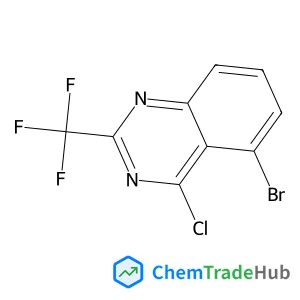
5-Bromo-4-chloro-2-(trifluoromethyl)quinazoline
CAS Number:
2089311-03-3
Molecular Formula:
C9H3BrClF3N2
Recommended Suppliers




Disclaimer
This page provides academic journal information for reference and research purposes only. We are not affiliated with any journal publishers and do not handle publication submissions. For publication-related inquiries, please contact the respective journal publishers directly.
If you notice any inaccuracies in the information displayed, please contact us at support@chemtradehub.com. We will promptly review and address your concerns.