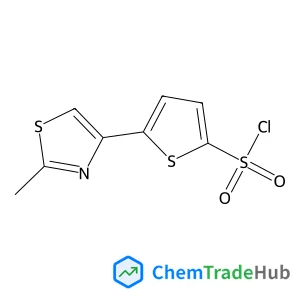
5-(2-Methyl-1,3-thiazol-4-yl)-2-thiophenesulfonyl chloride
CAS Number:
215434-25-6
Molecular Formula:
C8H6ClNO2S3
Deivasigamani Umadevi, G. Narahari Sastry
Graphane has emerged as a two-dimensional hydrocarbon with interesting physical properties and potential applications. Understanding the interaction of graphane with various molecules and ions is crucial to appreciate its potential applications. We investigated the interaction of nucleobases, aminoacids, saturated and unsaturated heterocycles, small molecules, metal ions and onium ions with graphane by using density functional theory calculations. The preferred orientations of these molecules and ions on the graphane surface have been analysed. The binding energies of graphane with these molecules have been compared with the corresponding binding energies of graphene. Our results reveal that graphane forms stable complexes with all the molecules and ions yet showing lesser binding affinity when compared to graphene. As an exemption, the preferential strong binding of H2O with graphane than graphene reveals the fact that graphane is more hydrophilic than graphene. Charge transfer between graphane and the molecules and ions have been found to be an important factor in determining the binding strength of the complexes. The effect of the interaction of these molecules and ions on the HOMO–LUMO energy gap of graphane has also been investigated.
Youzhi Xu, Max von Delius
DOI: 10.1039/D2CS00937D
Fang He, Shi-Zhang Qiao
DOI: 10.1039/D3CS00445G
Jun-Jie Fang, Zheng Liu, Yang-Lin Shen, Yun-Peng Xie, Xing Lu
DOI: 10.1039/D3SC04682F
Zhi-Mao Zhang, Junliang Zhang, Quan Cai
DOI: 10.1039/D3SC04335E
Yikuan Liu, Xiaona Liu, An Su, Chengtao Gong, Shenwei Chen, Liwei Xia, Chengwei Zhang, Xiaohuan Tao, Yue Li, Yonghe Li, Tulai Sun, Mengru Bu, Wei Shao, Jia Zhao, Xiaonian Li, Yongwu Peng, Yihan Zhu
DOI: 10.1039/D3CS00287J
Hanqing Fan, Xinglin Lu, Menachem Elimelech
DOI: 10.1039/D3CS00395G
Ning-Yu Huang, Yu-Tao Zheng, Di Chen, Zhen-Yu Chen, Chao-Zhu Huang, Qiang Xu
DOI: 10.1039/D2CS00289B
David E. Salazar Marcano, Nada D. Savić, Kilian Declerck, Shorok A. M. Abdelhameed, Tatjana N. Parac-Vogt
DOI: 10.1039/D3CS00195D
Hao-Yang Liu, Xiao Li, Zhi-Gang Wang
DOI: 10.1039/D3CS90101G
Waste containing 6-Chloro-5-(2'-hydroxy-3'-methoxy-4-biphenylyl)-3-(3-methoxyphe...
(3alpha,5alpha)-3-Hydroxypregnane-11,20-dione is primarily used in the pharmaceu...
The market for 4-Amino-6-chloro-2-pyridinecarboxylic acid (CAS: 546141-56-4) is ...
Alternatives to (2-Benzoylethyl)trimethylammonium chloride (CAS: 24472-88-6) in ...
N-[4-Nitro-3-(trifluoromethyl)phenyl]acetamide (CAS: 393-12-4) is generally safe...
Alternative reagents such as other phosphates or similar functional groups can b...
There are alternatives to N,N'-Bis(3-aminopropyl)-1,3-propanediamine (CAS: 4605-...
When handling Aluminium trihexadecanoate, it is important to use appropriate per...
(1,1-Dioxido-3-oxo-1,2-benzothiazol-2(3H)-yl)acetic acid is a chemical compound ...
Several alternatives to 5,5-dimethyloxolan-2-one (CAS: 3123-97-5) can be used in...

Physical Chemistry Chemical Physics (PCCP) is an international journal co-owned by 19 physical chemistry and physics societies from around the world. This journal publishes original, cutting-edge research in physical chemistry, chemical physics and biophysical chemistry. To be suitable for publication in PCCP, articles must include significant innovation and/or insight into physical chemistry; this is the most important criterion that reviewers and Editors will judge against when evaluating submissions. The journal has a broad scope and welcomes contributions spanning experiment, theory, computation and data science. Topical coverage includes spectroscopy, dynamics, kinetics, statistical mechanics, thermodynamics, electrochemistry, catalysis, surface science, quantum mechanics, quantum computing and machine learning. Interdisciplinary research areas such as polymers and soft matter, materials, nanoscience, energy, surfaces/interfaces, and biophysical chemistry are welcomed if they demonstrate significant innovation and/or insight into physical chemistry. Joined experimental/theoretical studies are particularly appreciated when complementary and based on up-to-date approaches.
![Benzyl 2-{[(tert-butoxy)carbonyl]amino}acetate structure](https://static.chemtradehub.com/structs/542/54244-69-8-6399.webp "Benzyl 2-{[(tert-butoxy)carbonyl]amino}acetate structure")