












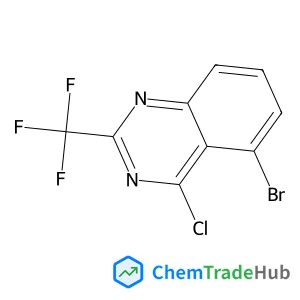
5-Bromo-4-chloro-2-(trifluoromethyl)quinazoline
CAS Number:
2089311-03-3
Molecular Formula:
C9H3BrClF3N2
Liyan Feng, Yuejie Liu, Jingxiang Zhao
Encouraged by the great promise of metal–nitrogen–carbon (M–N–C) materials in replacing Pt for catalyzing the oxygen reduction reaction (ORR), metal–P species were successfully introduced into carbon matrices in experiments and have exhibited high catalytic activity for the ORR. Here, by means of comprehensive density functional theory (DFT) computations, we investigated the origin and the mechanism of the ORR occurring on Fe– and Co–P-embedded graphenes. Our computations have revealed that the Fe– and Co–P4 moiety-embedded graphenes possess good stability and high chemical reactivity for O2 activation, thus facilitating the subsequent ORR steps, and a more efficient 4e pathway in both acidic and alkaline media is more energetically favorable. Furthermore, by analyzing the computed free energy profiles, the Fe–P4 species-embedded graphene is a more efficient electrocatalyst for the ORR in an alkaline medium than the Co–P4 species-embedded graphene. Our DFT computations will be useful for gaining deeper insight into the high activity of metal–P species.
Yikuan Liu, Xiaona Liu, An Su, Chengtao Gong, Shenwei Chen, Liwei Xia, Chengwei Zhang, Xiaohuan Tao, Yue Li, Yonghe Li, Tulai Sun, Mengru Bu, Wei Shao, Jia Zhao, Xiaonian Li, Yongwu Peng, Yihan Zhu
DOI: 10.1039/D3CS00287J
Hao-Yang Liu, Xiao Li, Zhi-Gang Wang
DOI: 10.1039/D3CS00138E
Preeti Chauhan, Ragendu V., Mohan Kumar, Rajib Molla, Surya Dev Mishra, Sneha Basa, Vishal Rai
DOI: 10.1039/D3CS00715D
Tatsuya Higaki, Jake C. Russell, Daniel W. Paley, Xavier Roy, Rongchao Jin
DOI: 10.1039/D3SC02753H
Jinmin Miao, Jiajun Dong, Yiming Miao, Yunpeng Bai, Zihan Qu, Brenson A. Jassim, Bo Huang, Quyen Nguyen, Yuan Ma, Allison A. Murray, Jinyue Li
DOI: 10.1039/D3SC04541B
Yonghua Liu
DOI: 10.1039/D3SC04688E
Andrew J. deMello, Maosheng Yao, Junji Cao
DOI: 10.1039/D3CS00417A
Xin He, Kai Zhang, Zhiqiang Zhu, Zhangfa Tong
DOI: 10.1039/D3CS00495C
DOI: 10.1039/D3CS00753G
Waste containing 6-Chloro-5-(2'-hydroxy-3'-methoxy-4-biphenylyl)-3-(3-methoxyphe...
(3alpha,5alpha)-3-Hydroxypregnane-11,20-dione is primarily used in the pharmaceu...
The market for 4-Amino-6-chloro-2-pyridinecarboxylic acid (CAS: 546141-56-4) is ...
Alternatives to (2-Benzoylethyl)trimethylammonium chloride (CAS: 24472-88-6) in ...
N-[4-Nitro-3-(trifluoromethyl)phenyl]acetamide (CAS: 393-12-4) is generally safe...
Alternative reagents such as other phosphates or similar functional groups can b...
There are alternatives to N,N'-Bis(3-aminopropyl)-1,3-propanediamine (CAS: 4605-...
When handling Aluminium trihexadecanoate, it is important to use appropriate per...
(1,1-Dioxido-3-oxo-1,2-benzothiazol-2(3H)-yl)acetic acid is a chemical compound ...
Several alternatives to 5,5-dimethyloxolan-2-one (CAS: 3123-97-5) can be used in...

Physical Chemistry Chemical Physics (PCCP) is an international journal co-owned by 19 physical chemistry and physics societies from around the world. This journal publishes original, cutting-edge research in physical chemistry, chemical physics and biophysical chemistry. To be suitable for publication in PCCP, articles must include significant innovation and/or insight into physical chemistry; this is the most important criterion that reviewers and Editors will judge against when evaluating submissions. The journal has a broad scope and welcomes contributions spanning experiment, theory, computation and data science. Topical coverage includes spectroscopy, dynamics, kinetics, statistical mechanics, thermodynamics, electrochemistry, catalysis, surface science, quantum mechanics, quantum computing and machine learning. Interdisciplinary research areas such as polymers and soft matter, materials, nanoscience, energy, surfaces/interfaces, and biophysical chemistry are welcomed if they demonstrate significant innovation and/or insight into physical chemistry. Joined experimental/theoretical studies are particularly appreciated when complementary and based on up-to-date approaches.
![1-(2-Chlorophenyl)-6-[(2S)-3,3,3-trifluoro-2-methylpropyl]-1,7-dihydro-4H-pyrazolo[3,4-d]pyrimidin-4-one structure](https://static.chemtradehub.com/structs/794/794568-91-5-0c34.webp "1-(2-Chlorophenyl)-6-[(2S)-3,3,3-trifluoro-2-methylpropyl]-1,7-dihydro-4H-pyrazolo[3,4-d]pyrimidin-4-one structure")
![2-Methyl-2-propanyl (2E)-5-chloro-2-[3-methoxy-4-(4-methyl-1H-imidazol-1-yl)benzylidene]pentanoate structure](https://static.chemtradehub.com/structs/122/1225232-42-7-ee03.webp "2-Methyl-2-propanyl (2E)-5-chloro-2-[3-methoxy-4-(4-methyl-1H-imidazol-1-yl)benzylidene]pentanoate structure")






