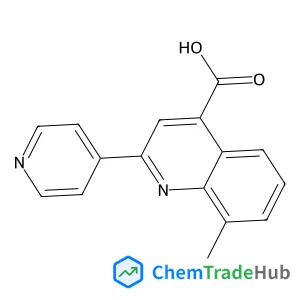
8-Methyl-2-pyridin-4-ylquinoline-4-carboxylic acid
CAS Number:
107027-42-9
Molecular Formula:
C16H12N2O2
Juan Corchado-García, Luis E. Betancourt, Carlos A. Vélez, Sanjaya D. Senanayake, Dario Stacchiola, Kotaro Sasaki, Maxime J.-F. Guinel, Yunyun Zhou, Chin Li Cheung, Carlos R. Cabrera
In this study we probe the electrocatalytic activity of Pt nanoparticles supported on ceria nanoparticles (NPs) and nanorods (NRs) in the ethanol oxidation reaction (EOR) in alkaline media. The goal of this study was to relate morphology, support structure and composition to the EOR catalytic activity by using in situ X-ray absorption fine structure (XAFS) studies. Cyclic voltammetry experiments showed that both ceria supported catalysts (NP vs. NR) had similar peak current densities at fast scan rates, however at slow scan rates, the ceria NR catalyst showed superior catalytic activity. In situ XAFS studies in KOH showed that both ceria supported catalysts had more electron density in their d-band (with the ceria NR having more electron density overall) than ceria – free Pt/Vulcan standard. However, in an ethanol solution the ceria NR catalyst had the least electron density. We propose that this change is due to the increased charge transfer efficiency between the ceria nanorod support and platinum. In the KOH solution, the increased electron density makes the platinum less electrophilic and hinders Pt–OH bond formation. In the EtOH solution, platinum's increased nucleophilicity facilitates the bond formation between Pt and the electron deficient carbon in ethanol which in turn withdraws the electron density from platinum and increases the white line intensity as observed in the XAS measurements.
Ziqi Yang, Chaoran Xu, Xianxian Zhou, Choon Wee Kee, Choon-Hong Tan
DOI: 10.1039/D3SC04397E
Marcus E. Graziotto, Clinton J. Kidman, Simon A. James, Hugh H. Harris
DOI: 10.1039/D3CS00509G
Ping Zhou, Maryam Nazari Haghighi Pashaki, Hans-Martin Frey, Andreas Hauser, Silvio Decurtins, Andrea Cannizzo, Thomas Feurer, Robert Häner, Shi-Xia Liu
DOI: 10.1039/D3SC03184E
Jiang Li, Dan Li, Yunke Ma, Shucun Zhou, Yu Wang, Daohong Zhang
DOI: 10.1039/D3CS00713H
Hao-Yang Liu, Xiao Li, Zhi-Gang Wang
DOI: 10.1039/D3CS90101G
Geoffrey I. N. Waterhouse, Siyu Lu
DOI: 10.1039/D2CS00993E
Ning-Yu Huang, Yu-Tao Zheng, Di Chen, Zhen-Yu Chen, Chao-Zhu Huang, Qiang Xu
DOI: 10.1039/D2CS00289B
Alexey A. Festa, Olga A. Storozhenko, Leonid G. Voskressensky
DOI: 10.1039/D3CS00366C
Waste containing 6-Chloro-5-(2'-hydroxy-3'-methoxy-4-biphenylyl)-3-(3-methoxyphe...
(3alpha,5alpha)-3-Hydroxypregnane-11,20-dione is primarily used in the pharmaceu...
The market for 4-Amino-6-chloro-2-pyridinecarboxylic acid (CAS: 546141-56-4) is ...
Alternatives to (2-Benzoylethyl)trimethylammonium chloride (CAS: 24472-88-6) in ...
N-[4-Nitro-3-(trifluoromethyl)phenyl]acetamide (CAS: 393-12-4) is generally safe...
Alternative reagents such as other phosphates or similar functional groups can b...
There are alternatives to N,N'-Bis(3-aminopropyl)-1,3-propanediamine (CAS: 4605-...
When handling Aluminium trihexadecanoate, it is important to use appropriate per...
(1,1-Dioxido-3-oxo-1,2-benzothiazol-2(3H)-yl)acetic acid is a chemical compound ...
Several alternatives to 5,5-dimethyloxolan-2-one (CAS: 3123-97-5) can be used in...

Physical Chemistry Chemical Physics (PCCP) is an international journal co-owned by 19 physical chemistry and physics societies from around the world. This journal publishes original, cutting-edge research in physical chemistry, chemical physics and biophysical chemistry. To be suitable for publication in PCCP, articles must include significant innovation and/or insight into physical chemistry; this is the most important criterion that reviewers and Editors will judge against when evaluating submissions. The journal has a broad scope and welcomes contributions spanning experiment, theory, computation and data science. Topical coverage includes spectroscopy, dynamics, kinetics, statistical mechanics, thermodynamics, electrochemistry, catalysis, surface science, quantum mechanics, quantum computing and machine learning. Interdisciplinary research areas such as polymers and soft matter, materials, nanoscience, energy, surfaces/interfaces, and biophysical chemistry are welcomed if they demonstrate significant innovation and/or insight into physical chemistry. Joined experimental/theoretical studies are particularly appreciated when complementary and based on up-to-date approaches.
![(3-{[4-(Aminomethyl)-6-(trifluoromethyl)-2-pyridinyl]oxy}phenyl)[(3R,4R)-3-fluoro-4-hydroxy-1-pyrrolidinyl]methanone structure](https://static.chemtradehub.com/structs/200/2007885-39-2-affc.webp "(3-{[4-(Aminomethyl)-6-(trifluoromethyl)-2-pyridinyl]oxy}phenyl)[(3R,4R)-3-fluoro-4-hydroxy-1-pyrrolidinyl]methanone structure")