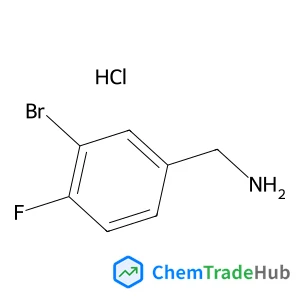
1-(3-Bromo-4-fluorophenyl)methanamine hydrochloride (1:1)
CAS Number:
202865-68-7
Molecular Formula:
C7H8BrClFN
Chunying Gao, Han Zhang, Ming Wu, Yang Liu, Yipan Wu, Xinlin Yang, Xizeng Feng
Monodisperse poly(ethylene glycol dimethacrylate-co-methacrylic acid) (P(EGDMA-co-MAA)) microspheres with two different diameters (69 and 160 nm) were facilely synthesized via distillation precipitation polymerization in neat acetonitrile, and these microspheres interacted with the amino groups of polyethyleneimine (PEI) chains though hydrogen-bonding as well as electrostatic interactions to form PEI-functionalized (P(EGDMA-co-MAA)). The successful modification of P(EGDMA-co-MAA) microspheres with PEI was confirmed by dynamic light scattering (DLS) and agarose gel electrophoresis. The in vitro gene transfection was evaluated by co-culturing human embryonic kidney (HEK) 293T cells and P(EGDMA-co-MAA) microsphere/plasmid DNA (pDNA) complexes, and the results were determined by fluorescence microscopy. Furthermore, the cytotoxicity of PEI-functionalized P(EGDMA-co-MAA) microspheres was assessed via MTT assay and FDA–PI staining. The PEI-functionalized (P(EGDMA-co-MAA) provides a potential novel delivery vector for cells.
Hien The Ho, Sagrario Pascual, Véronique Montembault, Nathalie Casse, Laurent Fontaine
DOI: 10.1039/C4PY00585F
Yilin Zhang, Liguo Xu, Rongrong Hu, Kam Sing Wong, William A. Goddard, III
DOI: 10.1039/C7PY00154A
Sanjib Banerjee, Bhausaheb V. Tawade, Vincent Ladmiral, Lionel X. Dupuy, Bruno Améduri
DOI: 10.1039/C7PY00209B
Jing Zhang, Pu Xiao, Fabrice Morlet-Savary, Bernadette Graff, Jean Pierre Fouassier, Jacques Lalevée
DOI: 10.1039/C4PY00770K
Chengyuan Zhang, Dayi Pan, Kui Luo, Ning Li, Chunhua Guo, Xiuli Zheng, Zhongwei Gu
DOI: 10.1039/C4PY00601A
Toyokazu Tsutsuba
DOI: 10.1039/C7PY00100B
Yuanfeng Gao
DOI: 10.1039/C6PY01929C
Marc Guerre, Mona Semsarilar, Franck Godiard, Bruno Améduri, Vincent Ladmiral
DOI: 10.1039/C6PY02203K
Matthew D. Green, Abbygail A. Foster, Chad T. Greco, Raghunath Roy, Rachel M. Lehr, Thomas H. Epps, III, Millicent O. Sullivan
DOI: 10.1039/C4PY00638K
Wei Wu, Qiujing Zhang, Jiantao Wang, Miao Chen, Shuai Li, Zaifu Lin, Jianshu Li
DOI: 10.1039/C4PY00575A
When considering alternatives to 1-(4-Chlorophenyl)-N-hydroxymethanimine (CAS: 3...
This compound should be stored in a cool, dry place away from direct sunlight. I...
3-(4-Bromophenyl)-5-(2-fluorophenyl)-1,2,4-oxadiazole is synthesized through a m...
5-Chloro-2-(4-chlorophenyl)-4-methyl-6-[3-(1-piperidinyl)propoxy]pyrimidine (CAS...
2-Chloro-4-(difluoromethoxy)pyridine is used in the pharmaceutical industry for ...
3-Chloro-6-methylpyridazine (CAS: 1121-79-5) is classified under the Globally Ha...
Several alternatives can be used in the synthesis of Methyl 4,5-dimethyl-2-nitro...
Alternatives to (2E,2'E)-3,3'-(1,4-Phenylene)bisacrylaldehyde include other acry...
3-Amino-5-chloropyridin-2-ol hydrochloride is an organic compound with the CAS n...
When handling 6,7-Difluoro-2,3-dihydro-4H-chromen-4-one, it is essential to wear...

Polymer Chemistry welcomes submissions in all areas of polymer science that have a strong focus on macromolecular chemistry. Manuscripts may cover a broad range of fields, yet no direct application focus is required.