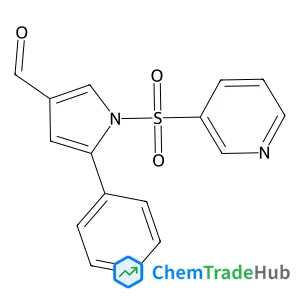
5-Phenyl-1-(pyridin-3-ylsulfonyl)-1H-pyrrole-3-carbaldehyde
CAS Number:
881676-90-0
Molecular Formula:
C16H12N2O3S
Shadi Houshyar, Daniel J. Keddie, Graeme Moad, Roger J. Mulder, Simon Saubern, John Tsanaktsidis
The scope for synthesis of new macro-RAFT agents (Z–C(S)S–(M)–R) by sequential insertion of monomers (M) ‘one at a time’ into an initial RAFT agent (Z–C(S)S–R) has been explored. The process is illustrated with the preparation of a styrene-N-isopropylacrylamide (NIPAM) co-dimer macro-RAFT agent [(CH3)3C(CN)–CH2CH(Ph)–CH2CH(CONHiPr)–SC(S)–S-alkyl] by successive single unit monomer insertions into a cyanoisopropyl trithiocarbonate. Critical factors for success are a high transfer constant for the RAFT agent and a high rate of addition of the radical (R·) to monomer relative to further propagation. With these conditions satisfied, the rate of reaction is largely determined by the rate of R· adding to monomer. Initiator-derived by-products (Z–C(S)S–(M)–I) become an issue when R· is different from the initiator-derived radical (I·).
Guo Wei, Yuliang Jiang, Fei Li, Yiwu Quan, Yixiang Cheng, Chengjian Zhu
DOI: 10.1039/C4PY00755G
Qiuyan Yang, Katja Loos
DOI: 10.1039/C6PY01795A
Ran Yu, Klaus Tauer
DOI: 10.1039/C4PY00458B
Huafeng Chen, Weijing Pan, Kuo-Wei Huang, Xuequan Zhang, Dirong Gong
DOI: 10.1039/C7PY00252A
Chun Feng, Guolin Lu, Gang Sun, Xunwei Liu, Xiaoyu Huang
DOI: 10.1039/C4PY00772G
Qun Luo, Junkai Wang, Yi Lin, Changquan Tang, Junyan Dou, Hongwei Tan, Qingdong Zheng, Chang-Qi Ma, Zheng Cui
DOI: 10.1039/C6PY02161A
Feiyan Zhu, Yongri Liang, Fuxin Liang, Qian Wang, Jiaoli Li, Zhibo Li, Zhenzhong Yang
DOI: 10.1039/C4PY00686K
Niklas Lucht, Steffen Eggers
DOI: 10.1039/C6PY01751G
Anna Isakova, Christian Burton, Daniel J. Nowakowski, Paul D. Topham
DOI: 10.1039/C7PY00394C
When considering alternatives to 1-(4-Chlorophenyl)-N-hydroxymethanimine (CAS: 3...
This compound should be stored in a cool, dry place away from direct sunlight. I...
3-(4-Bromophenyl)-5-(2-fluorophenyl)-1,2,4-oxadiazole is synthesized through a m...
5-Chloro-2-(4-chlorophenyl)-4-methyl-6-[3-(1-piperidinyl)propoxy]pyrimidine (CAS...
2-Chloro-4-(difluoromethoxy)pyridine is used in the pharmaceutical industry for ...
3-Chloro-6-methylpyridazine (CAS: 1121-79-5) is classified under the Globally Ha...
Several alternatives can be used in the synthesis of Methyl 4,5-dimethyl-2-nitro...
Alternatives to (2E,2'E)-3,3'-(1,4-Phenylene)bisacrylaldehyde include other acry...
3-Amino-5-chloropyridin-2-ol hydrochloride is an organic compound with the CAS n...
When handling 6,7-Difluoro-2,3-dihydro-4H-chromen-4-one, it is essential to wear...

Polymer Chemistry welcomes submissions in all areas of polymer science that have a strong focus on macromolecular chemistry. Manuscripts may cover a broad range of fields, yet no direct application focus is required.