












Branching out with aminals: microporous organic polymers from difunctional monomers
Literature Information
Publication Date
2011-12-22
DOI
10.1039/C2PY00506A
Impact Factor
5.582
Authors
Andrea Laybourn, Robert Dawson, Rob Clowes, Jonathan A. Iggo, Andrew I. Cooper, Yaroslav Z. Khimyak, Dave J. Adams
View Original
Abstract
Microporous organic polymers (MOPs) have been prepared via one-pot polycondensation reactions between aldehydes and amines. Primary amines were reacted with imines to produce porous polymers from A2 + B2 monomer combinations. The resulting networks exhibit BET surface areas in the range 500–600 m2 g−1. This approach opens up the possibility of synthesising MOPs using readily-available and inexpensive precursors.
Related Literature
Reactive symbol sequences for a model of hydrogen combustion
Mohammad Alaghemandi
2015-11-26
Paper
DOI: 10.1039/C5CP05125H
Correction: Quantifying transient interactions between amide groups and the guanidinium cation
V. Balos, M. Bonn, J. Hunger
2015-12-14
Correction
DOI: 10.1039/C5CP90226F
Hierarchical NiMoO4 nanowire arrays supported on macroporous graphene foam as binder-free 3D anodes for high-performance lithium storage
Bo Wang, Songmei Li, Xiaoyu Wu, Jianhua Liu, Wenming Tian
2015-11-17
Paper
DOI: 10.1039/C5CP04820F
Electrochemistry and speciation of Au+ in a deep eutectic solvent: growth and morphology of galvanic immersion coatings
Andrew D. Ballantyne, Gregory C. H. Forrest, Gero Frisch, Jennifer M. Hartley, Karl S. Ryder
2015-10-27
Paper
DOI: 10.1039/C5CP05748E
Thermal phase behavior and ion hopping in a 1,2,4-triazolium perfluorobutanesulfonate protic organic ionic plastic crystal
Anirban Mondal, Anurag Prakash Sunda, Sundaram Balasubramanian
2015-12-09
Paper
DOI: 10.1039/C5CP05701A
A fast but accurate excitonic simulation of the electronic circular dichroism of nucleic acids: how can it be achieved?
Daniele Loco, Sandro Jurinovich, Lorenzo Di Bari, Benedetta Mennucci
2015-11-23
Paper
DOI: 10.1039/C5CP06341H
Solvent-shared pairs of densely charged ions induce intense but short-range supra-additive slowdown of water rotation
Ana Vila Verde, Mark Santer, Reinhard Lipowsky
2015-11-25
Paper
DOI: 10.1039/C5CP05726D
Coupled phase field, heat conduction, and elastodynamic simulations of kinetic superheating and nanoscale melting of aluminum nanolayer irradiated by picosecond laser
Yong Seok Hwang, Valery I. Levitas
2015-11-02
Paper
DOI: 10.1039/C5CP04443J
In silico rational design of ionic liquids for the exfoliation and dispersion of boron nitride nanosheets
Gregorio García, Mert Atilhan, Santiago Aparicio
2015-11-19
Paper
DOI: 10.1039/C5CP05376E
Spatial frequency heterodyne imaging of aqueous phase transitions inside multi-walled carbon nanotubes
F. M. Schunk, D. Rand, C. Rose-Petruck
2015-10-26
Paper
DOI: 10.1039/C5CP04508H
You might also like
Compound Q&A
What is 3-Fluoro-2-methylbenzylamine (CAS: 771573-36-5)?
3-Fluoro-2-methylbenzylamine is an organic compound with the CAS number 771573-3...
771573-36-53-Fluoro-2-methylben...
Compound Q&A
Is Tert-butyl 2-(oxetan-3-ylidene)acetate (CAS: 1207175-03-8) safe?
Tert-butyl 2-(oxetan-3-ylidene)acetate is considered safe for its intended uses ...
1207175-03-8Tert-butyl 2-(oxetan...
Compound Q&A
What precautions should be taken when handling 4-Acetyl-2-fluorobenzonitrile (CAS: 214760-18-6)?
Proper personal protective equipment (PPE) such as gloves, goggles, and a lab co...
214760-18-64-Acetyl-2-fluoroben...
Compound Q&A
How is 2-Ethyl-4-methyl-1,3-thiazole (CAS: 15679-12-6) typically synthesized?
2-Ethyl-4-methyl-1,3-thiazole is commonly synthesized via the reaction of thiour...
15679-12-62-Ethyl-4-methyl-1,3...
Compound Q&A
How should 5',5''-([2,2'-Bithiophene]-5,5'-diyl)bis(([1,1':3',1''-terphenyl]-4,4''-dicarboxylic acid)) (CAS: 1227780-71-3) be stored?
This compound should be stored in a cool, dry place away from direct sunlight an...
1227780-71-35',5''''-([2,2'-Bith...
Compound Q&A
What regulatory guidelines apply to L-Lysine Acetate Salt (CAS: 52315-92-1)?
L-Lysine Acetate Salt (CAS: 52315-92-1) is subject to various regulatory guideli...
52315-92-1L-LYSINE ACETATE SAL...
Compound Q&A
Is 6-Fluoro-3-hydroxy-2-pyrazinecarboxamide (CAS: 259793-96-9) safe?
6-Fluoro-3-hydroxy-2-pyrazinecarboxamide (CAS: 259793-96-9) is generally conside...
259793-96-96-Fluoro-3-hydroxy-2...
Compound Q&A
What are the physical and chemical properties of 1,1'-Sulfonylbis(1H-imidazole) (CAS: 7189-69-7)?
1,1'-Sulfonylbis(1H-imidazole) is a crystalline solid with a molecular weight of...
7189-69-71,1'-Sulfonylbis(1H-...
Compound Q&A
What industries use 4-methyl-7-nitro-1H-indole-3-carbonitrile (CAS: 289483-82-5)?
4-Methyl-7-nitro-1H-indole-3-carbonitrile (CAS: 289483-82-5) is primarily used i...
289483-82-54-methyl-7-nitro-1H-...
Compound Q&A
How should waste containing 5-Bromo-3-indolyl-beta-galactoside (CAS: 97753-82-7) be handled?
Waste containing 5-Bromo-3-indolyl-beta-galactoside (CAS: 97753-82-7) should be ...
97753-82-75-Bromo-3-indolyl-be...
Source Journal
Polymer Chemistry

CiteScore:
8.6
Self-citation Rate:
7.3%
Articles per Year:
457
Polymer Chemistry welcomes submissions in all areas of polymer science that have a strong focus on macromolecular chemistry. Manuscripts may cover a broad range of fields, yet no direct application focus is required.
Recommended Compounds
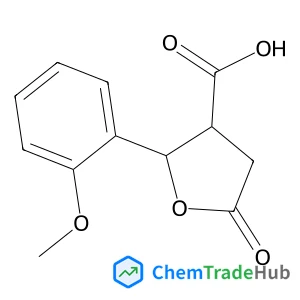
trans-2-(2-Methoxyphenyl)-5-oxotetrahydrofuran-3-carboxylic acid
CAS Number:
99226-02-5
Molecular Formula:
C12H12O5
Recommended Suppliers




Disclaimer
This page provides academic journal information for reference and research purposes only. We are not affiliated with any journal publishers and do not handle publication submissions. For publication-related inquiries, please contact the respective journal publishers directly.
If you notice any inaccuracies in the information displayed, please contact us at support@chemtradehub.com. We will promptly review and address your concerns.