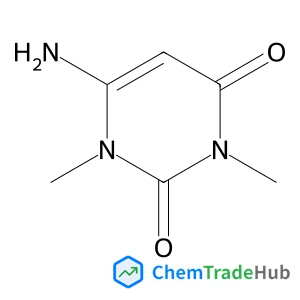
6-amino-1,3-dimethyl-1,2,3,4-tetrahydropyrimidine-2,4-dione
CAS Number:
6642-31-5
Molecular Formula:
C6H9N3O2
The first page of this article is displayed as the abstract.
Dayakar Thatikayala, Deepak Pant, Booki Min
DOI: 10.1039/D1RE00166C
Binyuan Liu, Huili Wang, Li Zhang, Guofu Yang, Xiaoxia Liu, Il Kim
DOI: 10.1039/C3PY00184A
Rohil Daya, Christopher J. Keturakis, Dylan Trandal, Ashok Kumar, Saurabh Y. Joshi, Aleksey Yezerets
DOI: 10.1039/D1RE00041A
Torsten Rossow, Sebastian Hackelbusch, Peter van Assenbergh
DOI: 10.1039/C3PY00104K
Kuo Han, Kui Xu, Matthew R. Gadinski, Qing Wang
DOI: 10.1039/C3PY00174A
Jen-Chieh Hsueh, Kuan Lin Yeh, Hung Lin Lee, Tu Lee
DOI: 10.1039/D1RE00335F
Michael D. Schulz, Rachel R. Ford, Kenneth B. Wagener
DOI: 10.1039/C3PY00531C
An Lv, Xin-Xing Deng, Lei Li, Zi-Long Li, Yao-Zong Wang, Fu-Sheng Du, Zi-Chen Li
DOI: 10.1039/C3PY00382E
4-Nitrophenyl phosphate disodium salt hexahydrate is primarily used as a substra...
2-(Trifluoromethyl)-1,3-oxazole-4-carboxylic Acid (CAS: 1060816-01-4) is widely ...
2-Fluoro-4-biphenylcarboxylic acid should be stored in a cool, dry place at room...
Prednisolone-21-Carboxylic Acid is primarily used in the pharmaceutical industry...
4-(Hydrazinomethyl)-1,2,3-benzenetriol (CAS: 3614-72-0) should be stored in a co...
4-Amino-1-methyl-1H-pyrazole-5-carboxylic acid hydrochloride (CAS: 92534-70-8) i...
Dehydropachymic acid (CAS: 77012-31-8) is regulated by various agencies. It fall...
The market and research trends for 6-[(2,2-Dimethylpropanoyl)amino]nicotinic aci...
1,10-Phenanthroline-2,9-dicarbaldehyde should be stored in a cool, dry place awa...
5-Carbamoyl-11-oxo-10,11-dihydro-5H-dibenzo[b,f]azepin-10-yl acetate can be synt...

Physical Chemistry Chemical Physics (PCCP) is an international journal co-owned by 19 physical chemistry and physics societies from around the world. This journal publishes original, cutting-edge research in physical chemistry, chemical physics and biophysical chemistry. To be suitable for publication in PCCP, articles must include significant innovation and/or insight into physical chemistry; this is the most important criterion that reviewers and Editors will judge against when evaluating submissions. The journal has a broad scope and welcomes contributions spanning experiment, theory, computation and data science. Topical coverage includes spectroscopy, dynamics, kinetics, statistical mechanics, thermodynamics, electrochemistry, catalysis, surface science, quantum mechanics, quantum computing and machine learning. Interdisciplinary research areas such as polymers and soft matter, materials, nanoscience, energy, surfaces/interfaces, and biophysical chemistry are welcomed if they demonstrate significant innovation and/or insight into physical chemistry. Joined experimental/theoretical studies are particularly appreciated when complementary and based on up-to-date approaches.