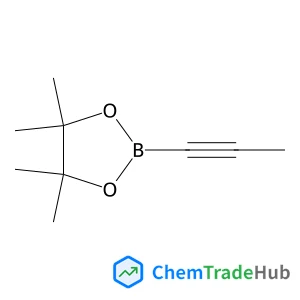
4,4,5,5-Tetramethyl-2-(1-propyn-1-YL)-1,3,2-dioxaborolane
CAS Number:
347389-75-7
Molecular Formula:
C9H15BO2
A graphical abstract is available for this content
DOI: 10.1039/D3NJ03674J
Anna Adler, Marlene Fritsch, Karin Fromell, Bo Nilsson
DOI: 10.1039/D3TB01721D
Md Mohiuddin Soliman, Mohammad Tariqul Islam, Muhammad E. H. Chowdhury, Farayi Musharavati, Touhidul Alam, Norbahiah Misran, Sakib Mahmud, Amith Khandakar
DOI: 10.1039/D3TB01469J
Jiangtao Yu, Linhua Zhu, Xiaoxiao Yu, Jixing Liu, Jingzhou Yin, Peiwen Wu, Jian Liu
DOI: 10.1039/D3NJ04023B
Mohamed Saadi, Imen Dakhlaoui, Fadhel Hajlaoui, Nidhal Drissi, Mustapha Zighrioui, Fethi Jomni, Nathalie Audebrand, Marie Cordier
DOI: 10.1039/D3NJ04819E
Pengfei Tan, Lu Yang, Hele Liu, Binhua Zhou, Jun Pan
DOI: 10.1039/D3NJ03611A
Chaoyang Zhou, Linqi Shi
DOI: 10.1039/D3TB02220J
Jing-Xuan Guo, Tian-Yue Gu, Hao-Ze Li
DOI: 10.1039/D3TB02017G
Fatemeh Asilpour, Dariush Saberi, Alireza Hasaninejad
DOI: 10.1039/D3NJ03273F
6-(3-Fluorophenyl)picolinic acid is generally considered safe for laboratory use...
(3R)-3-Pyrrolidinol is used in the pharmaceutical industry as a precursor for dr...
When handling (4R,5R)-4,5-Diethoxycarbonyl-2,2-dimethyldioxolane (CAS: 59779-75-...
1-(6-Chloroimidazo[1,2-b]pyridazin-3-yl)ethanone is often synthesized via a mult...
The market for N-Ethyl-3,4-dimethylbenzylamine (CAS: 39180-83-1) remains steady,...
Tert-butyl 3-(pyrrolidin-1-yl)azetidine-1-carboxylate is a chemical compound wit...
1-Bromo-3-chloro-2,4-dimethoxybenzene (CAS: 1228956-93-1) falls under the classi...
The safety of 8-Bromo-2-methyl-3,4-dihydroisoquinolin-1(2H)-one (CAS: 1368622-07...
Benzyl [(3S)-2,6-dioxo-3-piperidinyl]carbamate is generally safe when handled wi...
1-{[4-(4,4,5,5-Tetramethyl-1,3,2-dioxaborolan-2-yl)phenyl]sulfonyl}pyrrolidine s...

Physical Chemistry Chemical Physics (PCCP) is an international journal co-owned by 19 physical chemistry and physics societies from around the world. This journal publishes original, cutting-edge research in physical chemistry, chemical physics and biophysical chemistry. To be suitable for publication in PCCP, articles must include significant innovation and/or insight into physical chemistry; this is the most important criterion that reviewers and Editors will judge against when evaluating submissions. The journal has a broad scope and welcomes contributions spanning experiment, theory, computation and data science. Topical coverage includes spectroscopy, dynamics, kinetics, statistical mechanics, thermodynamics, electrochemistry, catalysis, surface science, quantum mechanics, quantum computing and machine learning. Interdisciplinary research areas such as polymers and soft matter, materials, nanoscience, energy, surfaces/interfaces, and biophysical chemistry are welcomed if they demonstrate significant innovation and/or insight into physical chemistry. Joined experimental/theoretical studies are particularly appreciated when complementary and based on up-to-date approaches.
![trans-2-{[(Tert-butoxy)carbonyl]amino}cyclobutane-1-carboxylic acid structure](https://static.chemtradehub.com/structs/951/951173-25-4-27cd.webp "trans-2-{[(Tert-butoxy)carbonyl]amino}cyclobutane-1-carboxylic acid structure")