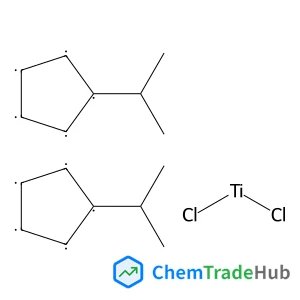
BIS(I-PROPYLCYCLOPENTADIENYL)TITANIUM DICHLORIDE
CAS Number:
12130-65-3
Molecular Formula:
C16H22Cl2Ti
Anna Adler, Marlene Fritsch, Karin Fromell, Bo Nilsson
Surface modification with heparin is a powerful biomaterial coating strategy that protects against innate immunity activation since heparin is a part of the proteoglycan heparan sulfate on cell surfaces in the body. We studied the heparinization of cellular and material surfaces via lipid conjugation to a heparin-binding peptide. In the present study, we synthesized fragmented heparin (fHep)-conjugated phospholipids and studied their regulation of the innate immune system on a lipid bilayered surface using liposomes. Liposomes have versatile applications, such as drug-delivery systems, due to their ability to carry a wide range of molecules. Owing to their morphological similarity to cell membranes, they can also be used to mimic a simple cell-membrane to study protein–lipid interactions. We investigated the interaction of complement-regulators, factor H and C4b-binding protein (C4BP), as well as the coagulation inhibitor antithrombin (AT), with fHep-lipids on the liposomal surface. Herein, we studied the ability of fHep-lipids to recruit factor H, C4BP, and AT using a quartz crystal microbalance with dissipation monitoring. With dynamic light scattering, we demonstrated that liposomes could be modified with fHep-lipids and were stable up to 60 days at 4 °C. Using a capillary western blot-based method (Wes), we showed that fHep-liposomes could recruit factor H in a model system using purified proteins and assist in the degradation of the active complement protein C3b to iC3b. Furthermore, we found that fHep-liposomes could recruit factor H and AT from human plasma. Therefore, the use of fHep-lipids could be a potential coating for liposomes and cell surfaces to regulate the immune system on the lipid surface.

Main Group Chemistry

Topics in Catalysis

Bioorganic & Medicinal Chemistry Letters

Atomization and Sprays

Medicinal Chemistry Research

Acta Metallurgica Sinica-English Letters

Herald of the Russian Academy of Sciences

Critical Reviews in Solid State and Materials Sciences

Electroanalysis

Bioorganic & Medicinal Chemistry
Nabin Kumar Pal, Carola Kryschi
DOI: 10.1039/C5CP01773D
Ruiqing Li, Linlin Li, Yimai Liang, Nannan Zhang, Yali Liu, Shucai Gan
DOI: 10.1039/C5CP03421C
Hui Wang, Chen Li, Weizhou Wang, Wei Jun Jin
DOI: 10.1039/C5CP03076E
Daniel C. Rodrigues, Michele L. de Souza, Klester S. Souza, Diego P. dos Santos, Gustavo F. S. Andrade, Marcia L. A. Temperini
DOI: 10.1039/C4CP05080K
Sebastián Miranda-Rojas
DOI: 10.1039/C5CP04503G
Ketzasmin A. Terrón-Mejía, Roberto López-Rendón, Armando Gama Goicochea
DOI: 10.1039/C5CP03823E
DOI: 10.1039/C5CP03570H
S. I. Sadovnikov, A. I. Gusev
DOI: 10.1039/C5CP02499D
6-(3-Fluorophenyl)picolinic acid is generally considered safe for laboratory use...
(3R)-3-Pyrrolidinol is used in the pharmaceutical industry as a precursor for dr...
When handling (4R,5R)-4,5-Diethoxycarbonyl-2,2-dimethyldioxolane (CAS: 59779-75-...
1-(6-Chloroimidazo[1,2-b]pyridazin-3-yl)ethanone is often synthesized via a mult...
The market for N-Ethyl-3,4-dimethylbenzylamine (CAS: 39180-83-1) remains steady,...
Tert-butyl 3-(pyrrolidin-1-yl)azetidine-1-carboxylate is a chemical compound wit...
1-Bromo-3-chloro-2,4-dimethoxybenzene (CAS: 1228956-93-1) falls under the classi...
The safety of 8-Bromo-2-methyl-3,4-dihydroisoquinolin-1(2H)-one (CAS: 1368622-07...
Benzyl [(3S)-2,6-dioxo-3-piperidinyl]carbamate is generally safe when handled wi...
1-{[4-(4,4,5,5-Tetramethyl-1,3,2-dioxaborolan-2-yl)phenyl]sulfonyl}pyrrolidine s...
Journal of Materials Chemistry A, B & C cover high quality studies across all fields of materials chemistry. The journals focus on those theoretical or experimental studies that report new understanding, applications, properties and synthesis of materials. The journals have a strong history of publishing quality reports of interest to interdisciplinary communities and providing an efficient and rigorous service through peer review and publication. The journals are led by an international team of Editors-in-Chief and Associate Editors who are all active researchers in their fields. Journal of Materials Chemistry A, B & C are separated by the intended application of the material studied. Broadly, applications in energy and sustainability are of interest to Journal of Materials Chemistry A, applications in biology and medicine are of interest to Journal of Materials Chemistry B, and applications in optical, magnetic and electronic devices are of interest to Journal of Materials Chemistry C. More than one Journal of Materials Chemistry journal may be suitable for certain fields and researchers are encouraged to submit their paper to the journal that they feel best fits for their particular article. Example topic areas within the scope of Journal of Materials Chemistry B are listed below. This list is neither exhaustive nor exclusive. Antifouling coatings Biocompatible materials Bioelectronics Bioimaging Biomimetics Biomineralisation Bionics Biosensors Diagnostics Drug delivery Gene delivery Immunobiology Nanomedicine Regenerative medicine & Tissue engineering Scaffolds Soft robotics Stem cells Therapeutic devices image block All articles published in Journal of Materials Chemistry B from 2019 onwards will be indexed in MEDLINE®. Articles that primarily focus on providing insight into the underlying science and performance of biomaterials within a biological environment are more suited to our companion journal, Biomaterials Science.
![trans-2-{[(Tert-butoxy)carbonyl]amino}cyclobutane-1-carboxylic acid structure](https://static.chemtradehub.com/structs/951/951173-25-4-27cd.webp "trans-2-{[(Tert-butoxy)carbonyl]amino}cyclobutane-1-carboxylic acid structure")