












Conformational equilibria in carboxylic acid bimolecules: a rotational study of acrylic acid–formic acid
Literature Information
Publication Date
2012-12-21
DOI
10.1039/C2CP44131D
Impact Factor
3.676
Authors
Gang Feng, Qian Gou, Luca Evangelisti, Zhining Xia, Walther Caminati
View Original
Abstract
The bimolecule acrylic acid–formic acid has been investigated by pulsed jet Fourier transform microwave spectroscopy. The complex adopts two different conformational shapes, according to the cis or trans forms of the acrylic acid moiety. The measurements have been extended to four deuterated and to four 13C (natural abundance) species, and their combinations, for each conformer. These data allowed us to determine the carbon skeleton structures and to size quantitatively the structural effect caused by the OH → OD isotopic substitutions (the Ubbelohde effect).
Recommended Journals
Related Literature
Proton relaxation and intermolecular structure of liquid formic acid: a nuclear magnetic resonance study
2002-03-14
Paper
DOI: 10.1039/B110358J
Controlled pattern formation in the CDIMA reaction with a moving boundary of illumination
Mads Kærn, Razvan Satnoianu, Alberto P. Muñuzuri, Michael Menzinger
2002-03-13
Paper
DOI: 10.1039/B109387H
Phase equilibria of hydrogel systems
Andreas Hüther, Bernd Schäfer, Xiaoping Xu, Gerd Maurer
2002-02-14
Paper
DOI: 10.1039/B108496H
A full dimensional ab initio direct trajectory study on the ionization dynamics of SiH4
Hiroto Tachikawa
2002-02-22
Paper
DOI: 10.1039/B109641A
Characteristic cyclic voltammograms of alkyl viologens at single crystal gold electrodes
Kazuki Arihara, Takeo Ohsaka, Fusao Kitamura
2002-02-13
Communication
DOI: 10.1039/B109879A
The effect of pressure on the liquid–liquid phase equilibrium of two polydisperse polyalkylsiloxane blends
Thomas Kraska, Leonid V. Yelash
2002-02-18
Paper
DOI: 10.1039/B109176J
On the chemical properties of sedimentary sulfur in estuarine environments
G. Billon, B. Ouddane, L. Gengembre, A. Boughriet
2002-01-23
Paper
DOI: 10.1039/B108638N
Chemically induced oscillations in a pH-responsive hydrogel
Colin J. Crook, Andrew Smith, Richard A. L. Jones, Anthony J. Ryan
2002-03-18
Paper
DOI: 10.1039/B109977A
Co-existence of hydrated electron and metal di-cation in [Mg(H2O)n]+
2002-03-07
Paper
DOI: 10.1039/B109774C
Use of ab initio interaction energies for the prediction of phase equilibria in the system nitrogen–ethane
Gabriele Raabe, Juergen Koehler
2002-01-14
Paper
DOI: 10.1039/B108641N
You might also like
Compound Q&A
What regulatory guidelines apply to 6-Bromo-2-methylimidazo[1,2-a]pyrimidine (CAS: 1111638-05-1)?
6-Bromo-2-methylimidazo[1,2-a]pyrimidine (CAS: 1111638-05-1) falls under various...
1111638-05-16-Bromo-2-methylimid...
Compound Q&A
Are there alternatives to 1-Pyrrolidineethanol, β-methyl-α-phenyl-, (αS,βR) (CAS: 123620-80-4) in synthesis?
While there are no direct alternatives, similar compounds like 1-Pyrrolidineetha...
123620-80-41-Pyrrolidineethanol...
Compound Q&A
Is 4-Methyl-2,6-bis(2-methyl-2-propanyl)phenyl methylcarbamate (CAS: 1918-11-2) safe?
4-Methyl-2,6-bis(2-methyl-2-propanyl)phenyl methylcarbamate (CAS: 1918-11-2) is ...
1918-11-24-Methyl-2,6-bis(2-m...
Compound Q&A
How should 2-(3-Bromo-4-fluorophenyl)-1,3-dioxolane (CAS: 77771-04-1) be stored?
2-(3-Bromo-4-fluorophenyl)-1,3-dioxolane (CAS: 77771-04-1) should be stored in a...
77771-04-12-(3-Bromo-4-fluorop...
Compound Q&A
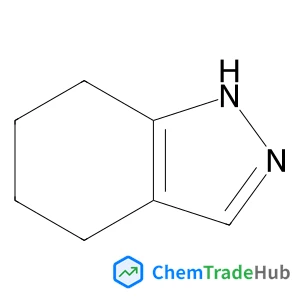
What are the physical and chemical properties of 4,5,6,7-Tetrahydro-1H-indazole hydrochloride (CAS: 18161-11-0)?
4,5,6,7-Tetrahydro-1H-indazole hydrochloride is a white crystalline solid with a...
18161-11-04,5,6,7-Tetrahydro-1...
Compound Q&A
What is (2R)-1-Methoxy-3-phenyl-2-propanamine (CAS: 59919-07-2)?
(2R)-1-Methoxy-3-phenyl-2-propanamine is a chiral organic compound with the CAS ...
59919-07-2(2R)-1-Methoxy-3-phe...
Compound Q&A
What industries use Ethyl 1-(1-phenylethyl)-1H-imidazole-5-carboxylate (CAS: 56649-47-9)?
Ethyl 1-(1-phenylethyl)-1H-imidazole-5-carboxylate is used in various industries...
56649-47-9Ethyl 1-(1-phenyleth...
Compound Q&A
What regulatory guidelines apply to 4-[(1E,3S)-1-(4-Hydroxyphenyl)-1,4-pentadien-3-yl]phenol (CAS: 17676-24-3)?
4-[(1E,3S)-1-(4-Hydroxyphenyl)-1,4-pentadien-3-yl]phenol (CAS: 17676-24-3) falls...
17676-24-34-[(1E,3S)-1-(4-Hydr...
Compound Q&A
What industries use (S)-3-Amino-5-phenylpentanoic acid hydrochloride (CAS: 331846-97-0)?
(S)-3-Amino-5-phenylpentanoic acid hydrochloride is primarily used in the pharma...
331846-97-0(S)-3-Amino-5-phenyl...
Compound Q&A
How is 7-methoxy-1-benzothiophene-2-carboxylic acid (CAS: 88791-07-5) typically synthesized?
7-Methoxy-1-benzothiophene-2-carboxylic acid is typically synthesized by reactin...
88791-07-57-methoxy-1-benzothi...
Source Journal
Physical Chemistry Chemical Physics

CiteScore:
5.5
Self-citation Rate:
10.3%
Articles per Year:
3036
Physical Chemistry Chemical Physics (PCCP) is an international journal co-owned by 19 physical chemistry and physics societies from around the world. This journal publishes original, cutting-edge research in physical chemistry, chemical physics and biophysical chemistry. To be suitable for publication in PCCP, articles must include significant innovation and/or insight into physical chemistry; this is the most important criterion that reviewers and Editors will judge against when evaluating submissions. The journal has a broad scope and welcomes contributions spanning experiment, theory, computation and data science. Topical coverage includes spectroscopy, dynamics, kinetics, statistical mechanics, thermodynamics, electrochemistry, catalysis, surface science, quantum mechanics, quantum computing and machine learning. Interdisciplinary research areas such as polymers and soft matter, materials, nanoscience, energy, surfaces/interfaces, and biophysical chemistry are welcomed if they demonstrate significant innovation and/or insight into physical chemistry. Joined experimental/theoretical studies are particularly appreciated when complementary and based on up-to-date approaches.
Recommended Compounds
![4-Penten-1-yl 2-[(2-furylmethyl)(1H-imidazol-1-ylcarbonyl)amino]butanoate structure](https://static.chemtradehub.com/structs/101/101903-30-4-ac34.webp "4-Penten-1-yl 2-[(2-furylmethyl)(1H-imidazol-1-ylcarbonyl)amino]butanoate structure")
4-Penten-1-yl 2-[(2-furylmethyl)(1H-imidazol-1-ylcarbonyl)amino]butanoate
CAS Number:
101903-30-4
Molecular Formula:
C18H23N3O4
Recommended Suppliers








Disclaimer
This page provides academic journal information for reference and research purposes only. We are not affiliated with any journal publishers and do not handle publication submissions. For publication-related inquiries, please contact the respective journal publishers directly.
If you notice any inaccuracies in the information displayed, please contact us at support@chemtradehub.com. We will promptly review and address your concerns.