












Chemically induced oscillations in a pH-responsive hydrogel
Literature Information
Publication Date
2002-03-18
DOI
10.1039/B109977A
Impact Factor
3.676
Authors
Colin J. Crook, Andrew Smith, Richard A. L. Jones, Anthony J. Ryan
View Original
Abstract
A Landolt pH-oscillator based on a bromate/sulfite/ferrocyanide reaction has been developed with a room temperature period of 20 min and a range of 3.1 ≤ pH ≤ 7.0. This system has been used to drive periodic oscillations in volume in a pH responsive hydrogel. The gel is coupled to the reaction and changes volume by a factor of at least 6. A continuously stirred, constant volume, tank reactor was set-up on an optical microscope and the reaction pH and gel size monitored.
Recommended Journals
Related Literature
Visible light photoredox catalyzed deprotection of 1,3-oxathiolanes
Mingyang Yang, Zhimin Xing, Bowen Fang, Xingang Xie, Xuegong She
2019-12-06
Paper
DOI: 10.1039/C9OB02517K
Copper-catalyzed diastereoselective hydrothioetherification of oxa(aza)benzonorbornadienes
Yongqi Yao, Wen Yang, Yun Tan, Shuqi Chen, Donghan Chen, Dingqiao Yang
2020-04-20
Paper
DOI: 10.1039/D0OB00659A
A Rh-catalyzed three-component reaction for the diastereoselective synthesis of pyrazolone derivatives with contiguous quaternary stereocenters
Chaoqun Ao, Jingjing Huang, Xinfang Xu, Shikun Jia, Zhenghui Kang, Wenhao Hu
2020-04-13
Communication
DOI: 10.1039/D0OB00482K
Photocatalytic xanthate-based radical addition/cyclization reaction sequence toward 2-biphenyl isocyanides: synthesis of 6-alkylated phenanthridines
Pedro López-Mendoza, Luis D. Miranda
2020-04-22
Communication
DOI: 10.1039/D0OB00136H
Examination of pinanediol–boronic acid ester formation in aqueous media: relevance to the relative stability of trigonal and tetrahedral boronate esters
Mayte A. Martínez-Aguirre, Marcos Flores-Alamo, Felipe Medrano, Anatoly K. Yatsimirsky
2020-03-18
Paper
DOI: 10.1039/D0OB00201A
Modular continuous flow synthesis of orthogonally protected 6-deoxy glucose glycals
Subbarao Yalamanchili, Tu-Anh V. Nguyen, Nicola L. B. Pohl, Clay S. Bennett
2020-04-07
Communication
DOI: 10.1039/D0OB00522C
Multiphosphorylated peptides: importance, synthetic strategies, and applications for studying biological mechanisms
Mamidi Samarasimhareddy, Guy Mayer, Mattan Hurevich, Assaf Friedler
2020-04-01
Review Article
DOI: 10.1039/D0OB00499E
You might also like
Compound Q&A
What regulatory guidelines apply to 6-Bromo-2-methylimidazo[1,2-a]pyrimidine (CAS: 1111638-05-1)?
6-Bromo-2-methylimidazo[1,2-a]pyrimidine (CAS: 1111638-05-1) falls under various...
1111638-05-16-Bromo-2-methylimid...
Compound Q&A
Are there alternatives to 1-Pyrrolidineethanol, β-methyl-α-phenyl-, (αS,βR) (CAS: 123620-80-4) in synthesis?
While there are no direct alternatives, similar compounds like 1-Pyrrolidineetha...
123620-80-41-Pyrrolidineethanol...
Compound Q&A
Is 4-Methyl-2,6-bis(2-methyl-2-propanyl)phenyl methylcarbamate (CAS: 1918-11-2) safe?
4-Methyl-2,6-bis(2-methyl-2-propanyl)phenyl methylcarbamate (CAS: 1918-11-2) is ...
1918-11-24-Methyl-2,6-bis(2-m...
Compound Q&A
How should 2-(3-Bromo-4-fluorophenyl)-1,3-dioxolane (CAS: 77771-04-1) be stored?
2-(3-Bromo-4-fluorophenyl)-1,3-dioxolane (CAS: 77771-04-1) should be stored in a...
77771-04-12-(3-Bromo-4-fluorop...
Compound Q&A
What are the physical and chemical properties of 4,5,6,7-Tetrahydro-1H-indazole hydrochloride (CAS: 18161-11-0)?
4,5,6,7-Tetrahydro-1H-indazole hydrochloride is a white crystalline solid with a...
18161-11-04,5,6,7-Tetrahydro-1...
Compound Q&A
What is (2R)-1-Methoxy-3-phenyl-2-propanamine (CAS: 59919-07-2)?
(2R)-1-Methoxy-3-phenyl-2-propanamine is a chiral organic compound with the CAS ...
59919-07-2(2R)-1-Methoxy-3-phe...
Compound Q&A
What industries use Ethyl 1-(1-phenylethyl)-1H-imidazole-5-carboxylate (CAS: 56649-47-9)?
Ethyl 1-(1-phenylethyl)-1H-imidazole-5-carboxylate is used in various industries...
56649-47-9Ethyl 1-(1-phenyleth...
Compound Q&A
What regulatory guidelines apply to 4-[(1E,3S)-1-(4-Hydroxyphenyl)-1,4-pentadien-3-yl]phenol (CAS: 17676-24-3)?
4-[(1E,3S)-1-(4-Hydroxyphenyl)-1,4-pentadien-3-yl]phenol (CAS: 17676-24-3) falls...
17676-24-34-[(1E,3S)-1-(4-Hydr...
Compound Q&A
What industries use (S)-3-Amino-5-phenylpentanoic acid hydrochloride (CAS: 331846-97-0)?
(S)-3-Amino-5-phenylpentanoic acid hydrochloride is primarily used in the pharma...
331846-97-0(S)-3-Amino-5-phenyl...
Compound Q&A
How is 7-methoxy-1-benzothiophene-2-carboxylic acid (CAS: 88791-07-5) typically synthesized?
7-Methoxy-1-benzothiophene-2-carboxylic acid is typically synthesized by reactin...
88791-07-57-methoxy-1-benzothi...
Source Journal
Physical Chemistry Chemical Physics

CiteScore:
5.5
Self-citation Rate:
10.3%
Articles per Year:
3036
Physical Chemistry Chemical Physics (PCCP) is an international journal co-owned by 19 physical chemistry and physics societies from around the world. This journal publishes original, cutting-edge research in physical chemistry, chemical physics and biophysical chemistry. To be suitable for publication in PCCP, articles must include significant innovation and/or insight into physical chemistry; this is the most important criterion that reviewers and Editors will judge against when evaluating submissions. The journal has a broad scope and welcomes contributions spanning experiment, theory, computation and data science. Topical coverage includes spectroscopy, dynamics, kinetics, statistical mechanics, thermodynamics, electrochemistry, catalysis, surface science, quantum mechanics, quantum computing and machine learning. Interdisciplinary research areas such as polymers and soft matter, materials, nanoscience, energy, surfaces/interfaces, and biophysical chemistry are welcomed if they demonstrate significant innovation and/or insight into physical chemistry. Joined experimental/theoretical studies are particularly appreciated when complementary and based on up-to-date approaches.
Recommended Compounds
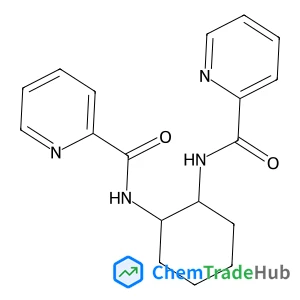
N,N'-(1R,2R)-1,2-Cyclohexanediyldi(2-pyridinecarboxamide)
CAS Number:
218290-24-5
Molecular Formula:
C18H20N4O2
Recommended Suppliers





Disclaimer
This page provides academic journal information for reference and research purposes only. We are not affiliated with any journal publishers and do not handle publication submissions. For publication-related inquiries, please contact the respective journal publishers directly.
If you notice any inaccuracies in the information displayed, please contact us at support@chemtradehub.com. We will promptly review and address your concerns.