


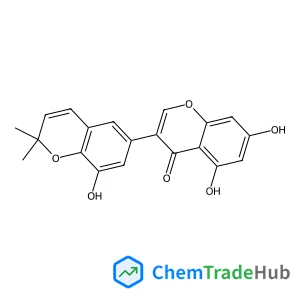
5,7,8'-Trihydroxy-2',2'-dimethyl-2'H,4H-3,6'-bichromen-4-one
CAS Number:
129280-33-7
Molecular Formula:
C20H16O6
Gabriele Raabe, Juergen Koehler
Ab initio molecular orbital methods have been used for calculations of interaction parameters of the UNIQUAC and NRTL activity coefficient model to predict phase equilibria in the system nitrogen–ethane. The UNIQUAC and NRTL model with ab initio parameters, calculated on the MP4 and QCISD(T) theory level, have been used in different gE-mixing rules to predict high-pressure vapor–liquid- (VLE) and vapor–liquid–liquid-equilibria (VLLE) by the Peng–Robinson and the Soave–Redlich–Kwong equation of state. The results have been compared to predictions based on UNIFAC with the PSRK-mixing rule. The results using ab initio-UNIQUAC are poor. However, ab initio-NRTL gives good VLE-predictions with all gE-mixing rules and with both equations of state. Only in the temperature range below 133 K, where the VLLE occur, is ab initio-NRTL inferior to the predictions by UNIFAC.

Organic Process Research & Development

Nature Medicine

Current Opinion in Colloid & Interface Science

Acta Materialia

Russian Journal of Organic Chemistry

Journal of Natural Medicines

New Journal of Chemistry

Russian Journal of Applied Chemistry

Crystallography Reports

Chemistry Education Research and Practice
Weicheng Wu, Andrew. C. Grimsdale, Klaus Müllen
DOI: 10.1039/B301512M
Akihiko Tsuda, Yasuyuki Nakamura, Atsuhiro Osuka
DOI: 10.1039/B302032K
S. P. Cork, G. Cressey, R. H. Jones, S. J. Teat, V. L. Zholobenko
DOI: 10.1039/B410366C
Gabriela A. Grasa, Rohit Singh, Natalie M. Scott, Edwin D. Stevens, Steven P. Nolan
DOI: 10.1039/B410986D
Sarah E. Lister, Ivana Radosavljevic Evans, Judith A. K. Howard, Alan Coelho, John S. O. Evans
DOI: 10.1039/B408413F
Richard T. Baker, Leila Naji, Karen Lochhead, John A. Chudek
DOI: 10.1039/B301039B
Hiroshi Shiigi, Yojiro Yamamoto, Hidetaka Yakabe, Shiho Tokonami, Tsutomu Nagaoka
DOI: 10.1039/B212226J
Hiroyuki Kodama, Sachiko Matsumura, Taro Yamashita, Hisakazu Mihara
DOI: 10.1039/B409641J
Steven A. Raw, Richard J. K. Taylor
DOI: 10.1039/B316107B
(1R,3S)-1,3-Cyclopentanediol finds applications in various industries. In the ph...
When handling N'-[4-(Dimethylamino)phenyl]-N,N-dimethyl-1,4-benzenediamine, it i...
There are several alternatives to 5-(2,4-Difluorophenyl)-2-methoxypyrimidine in ...
1-(3-Methoxyphenoxy)propan-2-ol (CAS: 382141-68-6) must comply with the Globally...
Tetrodotoxin Citrate is extremely dangerous and should be handled with extreme c...
2-Methyl-2-propanyl [(1R,3S)-3-hydroxycyclopentyl]carbamate (CAS: 225641-84-9) i...
Waste containing 4-(2-Hydroxyhexafluoroisopropyl)Benzoic Acid (CAS: 16261-80-6) ...
2-Methyl-2-proanyl {(2S)-1-[(benzyloxy)amino]-3-hydroxy-3-methyl-1-oxo-2-butanyl...
Benzeneethanamine, α-ethyl-, hydrochloride (1:1) is an organic compound with the...
In the synthesis of compounds similar to 3-{(E)-[4-(Dimethylamino)phenyl]diazeny...

Physical Chemistry Chemical Physics (PCCP) is an international journal co-owned by 19 physical chemistry and physics societies from around the world. This journal publishes original, cutting-edge research in physical chemistry, chemical physics and biophysical chemistry. To be suitable for publication in PCCP, articles must include significant innovation and/or insight into physical chemistry; this is the most important criterion that reviewers and Editors will judge against when evaluating submissions. The journal has a broad scope and welcomes contributions spanning experiment, theory, computation and data science. Topical coverage includes spectroscopy, dynamics, kinetics, statistical mechanics, thermodynamics, electrochemistry, catalysis, surface science, quantum mechanics, quantum computing and machine learning. Interdisciplinary research areas such as polymers and soft matter, materials, nanoscience, energy, surfaces/interfaces, and biophysical chemistry are welcomed if they demonstrate significant innovation and/or insight into physical chemistry. Joined experimental/theoretical studies are particularly appreciated when complementary and based on up-to-date approaches.
![N,N'-1,2-Ethanediylbis[2-(vinylsulfonyl)acetamide] structure](https://static.chemtradehub.com/structs/667/66710-66-5-b556.webp "N,N'-1,2-Ethanediylbis[2-(vinylsulfonyl)acetamide] structure")




