













Bandgap broadly tunable GaZnSeAs alloy nanowires
Literature Information
Publication Date
2013-01-22
DOI
10.1039/C2CP43718J
Impact Factor
3.676
Authors
Yicheng Wang, Jinyou Xu, Pinyun Ren, Qinglin Zhang, Xiujuan Zhuang, Xiaoli Zhu, Qiang Wan, Hong Zhou, Wei Hu, Anlian Pan
View Original
Abstract
Composition-tunable semiconductor alloy nanowires are emerging as an important class of materials for the realization of high-performance laterally-arranged multiple bandgap (LAMB) solar cells. Here we report the first growth of GaZnSeAs quaternary alloy nanowires with composed elements between two different groups using a temperature/space-selective CVD route. Under laser excitation, these special quaternary alloy nanowires exhibit composition-related characteristic emissions, with peak wavelengths gradually tunable from 470 nm (2.64 eV) to 832 nm (1.49 eV), covering almost the entire visible spectrum. Surface photovoltage measurements further reveal that these alloy nanowires have tunable bandgaps along the length of the substrate, making them promising candidates for developing high-efficiency LAMB solar cells. These quaternary alloy nanowires represent a new advancement in material synthesis and would have potential applications in a variety of function-tunable and broadband-response optoelectronic devices.
Related Literature
Degradation of naphthalenesulfonic acids by oxidation with ozone in aqueous phase
J. Rivera-Utrilla, M. Sánchez-Polo, C. A. Zaror
2002-02-21
Paper
DOI: 10.1039/B108194B
Phase behaviour of a two-dimensional Lennard-Jones binary mixture Part II. Type III to Type I transition
Osvaldo H. Scalise, Moises Silbert
2002-02-12
Paper
DOI: 10.1039/B107990P
Energetics of a model NH–π interaction: the gas phase benzene–NH3 complex
Michel Mons, Iliana Dimicoli, Benjamin Tardivel, François Piuzzi, Valérie Brenner, Philippe Millié
2002-01-15
Paper
DOI: 10.1039/B108146M
Effects of surface tension and rotation on the Rayleigh–Taylor instability
A. H. A. Ayyad
2002-03-13
Paper
DOI: 10.1039/B106242P
Heat capacity behaviour of pore confined benzene and hexafluorobenzene in NaY zeolite
Guohua Zhao, Barara Groß, Herbert Dilger, Emil Roduner
2002-02-11
Paper
DOI: 10.1039/B110158G
Molecular structure and infrared spectra of dimethyl oxalate
Susy Branco Lopes, Leszek Lapinski, Rui Fausto
2002-02-04
Paper
DOI: 10.1039/B107232N
Infrared and Raman spectra, conformational stability, vibrational assignment, ab initio calculations and r0 structural parameters for N-methylpropargyl amine
Gamil A. Guirgis, Stephen Bell, Chao Zheng, James R. Durig
2002-03-19
Paper
DOI: 10.1039/B109222G
Inelastic neutron scattering spectra of the transverse acoustic modes of the normal alkanes
John Tomkinson, Stewart F. Parker, Dale A. Braden, Bruce S. Hudson
2002-01-30
Paper
DOI: 10.1039/B110091B
Geometric foundation of thermo-statistics, phase transitions, second law of thermodynamics, but without thermodynamic limit
2002-02-19
Paper
DOI: 10.1039/B108775D
You might also like
Compound Q&A
What regulatory guidelines apply to 6-Bromo-2-methylimidazo[1,2-a]pyrimidine (CAS: 1111638-05-1)?
6-Bromo-2-methylimidazo[1,2-a]pyrimidine (CAS: 1111638-05-1) falls under various...
1111638-05-16-Bromo-2-methylimid...
Compound Q&A
Are there alternatives to 1-Pyrrolidineethanol, β-methyl-α-phenyl-, (αS,βR) (CAS: 123620-80-4) in synthesis?
While there are no direct alternatives, similar compounds like 1-Pyrrolidineetha...
123620-80-41-Pyrrolidineethanol...
Compound Q&A
Is 4-Methyl-2,6-bis(2-methyl-2-propanyl)phenyl methylcarbamate (CAS: 1918-11-2) safe?
4-Methyl-2,6-bis(2-methyl-2-propanyl)phenyl methylcarbamate (CAS: 1918-11-2) is ...
1918-11-24-Methyl-2,6-bis(2-m...
Compound Q&A
How should 2-(3-Bromo-4-fluorophenyl)-1,3-dioxolane (CAS: 77771-04-1) be stored?
2-(3-Bromo-4-fluorophenyl)-1,3-dioxolane (CAS: 77771-04-1) should be stored in a...
77771-04-12-(3-Bromo-4-fluorop...
Compound Q&A
What are the physical and chemical properties of 4,5,6,7-Tetrahydro-1H-indazole hydrochloride (CAS: 18161-11-0)?
4,5,6,7-Tetrahydro-1H-indazole hydrochloride is a white crystalline solid with a...
18161-11-04,5,6,7-Tetrahydro-1...
Compound Q&A
What is (2R)-1-Methoxy-3-phenyl-2-propanamine (CAS: 59919-07-2)?
(2R)-1-Methoxy-3-phenyl-2-propanamine is a chiral organic compound with the CAS ...
59919-07-2(2R)-1-Methoxy-3-phe...
Compound Q&A
What industries use Ethyl 1-(1-phenylethyl)-1H-imidazole-5-carboxylate (CAS: 56649-47-9)?
Ethyl 1-(1-phenylethyl)-1H-imidazole-5-carboxylate is used in various industries...
56649-47-9Ethyl 1-(1-phenyleth...
Compound Q&A
What regulatory guidelines apply to 4-[(1E,3S)-1-(4-Hydroxyphenyl)-1,4-pentadien-3-yl]phenol (CAS: 17676-24-3)?
4-[(1E,3S)-1-(4-Hydroxyphenyl)-1,4-pentadien-3-yl]phenol (CAS: 17676-24-3) falls...
17676-24-34-[(1E,3S)-1-(4-Hydr...
Compound Q&A
What industries use (S)-3-Amino-5-phenylpentanoic acid hydrochloride (CAS: 331846-97-0)?
(S)-3-Amino-5-phenylpentanoic acid hydrochloride is primarily used in the pharma...
331846-97-0(S)-3-Amino-5-phenyl...
Compound Q&A
How is 7-methoxy-1-benzothiophene-2-carboxylic acid (CAS: 88791-07-5) typically synthesized?
7-Methoxy-1-benzothiophene-2-carboxylic acid is typically synthesized by reactin...
88791-07-57-methoxy-1-benzothi...
Source Journal
Physical Chemistry Chemical Physics

CiteScore:
5.5
Self-citation Rate:
10.3%
Articles per Year:
3036
Physical Chemistry Chemical Physics (PCCP) is an international journal co-owned by 19 physical chemistry and physics societies from around the world. This journal publishes original, cutting-edge research in physical chemistry, chemical physics and biophysical chemistry. To be suitable for publication in PCCP, articles must include significant innovation and/or insight into physical chemistry; this is the most important criterion that reviewers and Editors will judge against when evaluating submissions. The journal has a broad scope and welcomes contributions spanning experiment, theory, computation and data science. Topical coverage includes spectroscopy, dynamics, kinetics, statistical mechanics, thermodynamics, electrochemistry, catalysis, surface science, quantum mechanics, quantum computing and machine learning. Interdisciplinary research areas such as polymers and soft matter, materials, nanoscience, energy, surfaces/interfaces, and biophysical chemistry are welcomed if they demonstrate significant innovation and/or insight into physical chemistry. Joined experimental/theoretical studies are particularly appreciated when complementary and based on up-to-date approaches.
Recommended Compounds
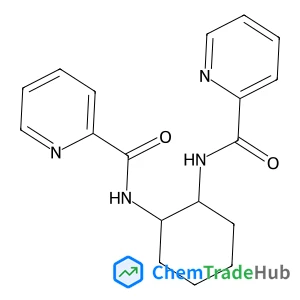
N,N'-(1R,2R)-1,2-Cyclohexanediyldi(2-pyridinecarboxamide)
CAS Number:
218290-24-5
Molecular Formula:
C18H20N4O2


Recommended Suppliers





Disclaimer
This page provides academic journal information for reference and research purposes only. We are not affiliated with any journal publishers and do not handle publication submissions. For publication-related inquiries, please contact the respective journal publishers directly.
If you notice any inaccuracies in the information displayed, please contact us at support@chemtradehub.com. We will promptly review and address your concerns.