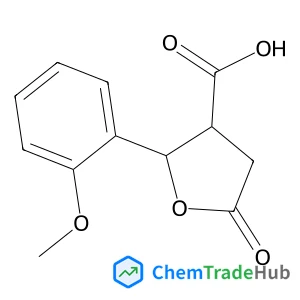
trans-2-(2-Methoxyphenyl)-5-oxotetrahydrofuran-3-carboxylic acid
CAS Number:
99226-02-5
Molecular Formula:
C12H12O5
Luwei Sun, Haiping He, Liang Hu, Zhizhen Ye
This work presents positive experimental evidence for the formation of a carbon–nitrogen complex in ZnO, which was theoretically predicted previously. A very high nitrogen content up to ∼8 at% can be doped into ZnO nanostructures via the formation of a carbon–nitrogen complex, which in turn suppresses the formation of a nitrogen acceptor.
Peter Burtscher, Norbert Moszner
DOI: 10.1039/C3PY00356F
Sujuan Zhai, Xuemei Song, Chun Feng, Xiuyu Jiang, Yongjun Li, Guolin Lu, Xiaoyu Huang
DOI: 10.1039/C3PY00474K
Lijun Huo, Zhaojun Li, Xia Guo, Yue Wu, Maojie Zhang, Long Ye, Shaoqing Zhang, Jianhui Hou
DOI: 10.1039/C3PY00074E
Jiang Yuan, Xiaobo Huang, Pengfei Li, Li Li
DOI: 10.1039/C3PY00565H
Jinping Zhang, Jun Li, Liyan Huang, Zhengping Liu
DOI: 10.1039/C3PY00484H
Yulia Rogan, Ludmila Starannikova, Victoria Ryzhikh, Yuri Yampolskii, Paola Bernardo, Fabio Bazzarelli, Johannes Carolus Jansen, Neil B. McKeown
DOI: 10.1039/C3PY00451A
Mohamad-Ali Tehfe, Frédéric Dumur, Bernadette Graff, Fabrice Morlet-Savary, Didier Gigmes, Jean-Pierre Fouassier, Jacques Lalevée
DOI: 10.1039/C3PY00372H
DOI: 10.1039/C3PY00216K
6-(3-Fluorophenyl)picolinic acid is generally considered safe for laboratory use...
(3R)-3-Pyrrolidinol is used in the pharmaceutical industry as a precursor for dr...
When handling (4R,5R)-4,5-Diethoxycarbonyl-2,2-dimethyldioxolane (CAS: 59779-75-...
1-(6-Chloroimidazo[1,2-b]pyridazin-3-yl)ethanone is often synthesized via a mult...
The market for N-Ethyl-3,4-dimethylbenzylamine (CAS: 39180-83-1) remains steady,...
Tert-butyl 3-(pyrrolidin-1-yl)azetidine-1-carboxylate is a chemical compound wit...
1-Bromo-3-chloro-2,4-dimethoxybenzene (CAS: 1228956-93-1) falls under the classi...
The safety of 8-Bromo-2-methyl-3,4-dihydroisoquinolin-1(2H)-one (CAS: 1368622-07...
Benzyl [(3S)-2,6-dioxo-3-piperidinyl]carbamate is generally safe when handled wi...
1-{[4-(4,4,5,5-Tetramethyl-1,3,2-dioxaborolan-2-yl)phenyl]sulfonyl}pyrrolidine s...

Physical Chemistry Chemical Physics (PCCP) is an international journal co-owned by 19 physical chemistry and physics societies from around the world. This journal publishes original, cutting-edge research in physical chemistry, chemical physics and biophysical chemistry. To be suitable for publication in PCCP, articles must include significant innovation and/or insight into physical chemistry; this is the most important criterion that reviewers and Editors will judge against when evaluating submissions. The journal has a broad scope and welcomes contributions spanning experiment, theory, computation and data science. Topical coverage includes spectroscopy, dynamics, kinetics, statistical mechanics, thermodynamics, electrochemistry, catalysis, surface science, quantum mechanics, quantum computing and machine learning. Interdisciplinary research areas such as polymers and soft matter, materials, nanoscience, energy, surfaces/interfaces, and biophysical chemistry are welcomed if they demonstrate significant innovation and/or insight into physical chemistry. Joined experimental/theoretical studies are particularly appreciated when complementary and based on up-to-date approaches.