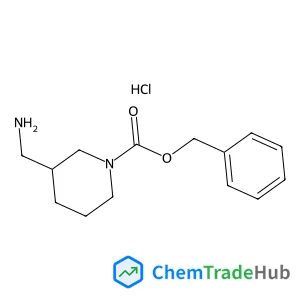
Benzyl 3-(aminomethyl)piperidine-1-carboxylate hydrochloride
CAS Number:
1186663-23-9
Molecular Formula:
C14H21ClN2O2
Wenjun Luo, Jiajia Wang, Xin Zhao, Zongyan Zhao, Zhigang Zou
Photoelectrochemical water splitting is an attractive method to produce H2 fuel from solar energy and water. Ion doping with higher valence states was used widely to enhance the photocurrent of an n-type oxide semiconductor. In this study, the different doping sites and the photoelectrochemical properties of Mo6+, W6+ and Sn4+-doped BiVO4 were studied systematically. The results suggested that Mo6+ or W6+-doped BiVO4 had a much higher photocurrent while the photocurrent of Sn4+-doped BiVO4 did not change obviously. Raman and XPS were used to identify the doping sites in the BiVO4 crystal lattice. It was found that Mo or W substituted V sites but Sn did not substitute Bi sites. Results of theoretical calculation indicated that a higher formation energy and lower solubility of impurity ions led to serious SnO2 segregation on the surface of the Sn4+-doped BiVO4 thin film, which was the main reason for the poor performance of Sn-doped BiVO4. The higher formation energy of Sn4+ came from the large mismatch of ion radius and different outer shell electron distribution. These results can offer guidance in choosing suitable doping ions for other semiconductor photoelectrodes.

Biopolymers

Chemistry of Heterocyclic Compounds

Chemical & Pharmaceutical Bulletin

Advances in Colloid and Interface Science

Cement and Concrete Research

Accounts of Chemical Research

Anti-Corrosion Methods and Materials

Chemistry of Natural Compounds

Journal of the American Chemical Society

Doklady Chemistry
Dong-Gyun Kim, Hyo Kang, Yong-Seok Choi, Sungsoo Han, Jong-Chan Lee
DOI: 10.1039/C3PY00756A
Haibo Wang, Fangming Xu, Yin Wang, Xiangsheng Liu, Qiao Jin, Jian Ji
DOI: 10.1039/C3PY00139C
Xiaoyong Zhang, Junfeng Hui, Bin Yang, Yong Yang, Daidi Fan, Meiying Liu, Lei Tao, Yen Wei
DOI: 10.1039/C3PY00489A
Florian Herbst, Wolfgang H. Binder
DOI: 10.1039/C3PY00362K
Yu Zhu, Xiaogong Wang
DOI: 10.1039/C3PY00757J
Prasad V. Pawar, Shalini V. Gohil, Jay Prakash Jain, Neeraj Kumar
DOI: 10.1039/C3PY00023K
Alexander A. Steinschulte, Bjoern Schulte, Natascha Drude, Michael Erberich, Christian Herbert, Jun Okuda, Martin Möller, Felix A. Plamper
DOI: 10.1039/C3PY00444A
Apiradee Honglawan, Houping Ni, Drew Weissman
DOI: 10.1039/C3PY00390F
Mingming Zhang, Qingqing Xiong, Jinqian Chen, Yinsong Wang
DOI: 10.1039/C3PY00656E
Chun Zhang, Lian-Hui Peng, Buyi Li, Ying Liu, Peng-Cheng Zhu, Zhen Wang, Deng-Huang Zhan, Bien Tan, Xiang-Liang Yang, Hui-Bi Xu
DOI: 10.1039/C3PY00499F
6-(3-Fluorophenyl)picolinic acid is generally considered safe for laboratory use...
(3R)-3-Pyrrolidinol is used in the pharmaceutical industry as a precursor for dr...
When handling (4R,5R)-4,5-Diethoxycarbonyl-2,2-dimethyldioxolane (CAS: 59779-75-...
1-(6-Chloroimidazo[1,2-b]pyridazin-3-yl)ethanone is often synthesized via a mult...
The market for N-Ethyl-3,4-dimethylbenzylamine (CAS: 39180-83-1) remains steady,...
Tert-butyl 3-(pyrrolidin-1-yl)azetidine-1-carboxylate is a chemical compound wit...
1-Bromo-3-chloro-2,4-dimethoxybenzene (CAS: 1228956-93-1) falls under the classi...
The safety of 8-Bromo-2-methyl-3,4-dihydroisoquinolin-1(2H)-one (CAS: 1368622-07...
Benzyl [(3S)-2,6-dioxo-3-piperidinyl]carbamate is generally safe when handled wi...
1-{[4-(4,4,5,5-Tetramethyl-1,3,2-dioxaborolan-2-yl)phenyl]sulfonyl}pyrrolidine s...

Physical Chemistry Chemical Physics (PCCP) is an international journal co-owned by 19 physical chemistry and physics societies from around the world. This journal publishes original, cutting-edge research in physical chemistry, chemical physics and biophysical chemistry. To be suitable for publication in PCCP, articles must include significant innovation and/or insight into physical chemistry; this is the most important criterion that reviewers and Editors will judge against when evaluating submissions. The journal has a broad scope and welcomes contributions spanning experiment, theory, computation and data science. Topical coverage includes spectroscopy, dynamics, kinetics, statistical mechanics, thermodynamics, electrochemistry, catalysis, surface science, quantum mechanics, quantum computing and machine learning. Interdisciplinary research areas such as polymers and soft matter, materials, nanoscience, energy, surfaces/interfaces, and biophysical chemistry are welcomed if they demonstrate significant innovation and/or insight into physical chemistry. Joined experimental/theoretical studies are particularly appreciated when complementary and based on up-to-date approaches.