












Quantification of silanol sites for the most common mesoporous ordered silicas and organosilicas: total versus accessible silanols
Literature Information
Publication Date
2012-11-07
DOI
10.1039/C2CP42811C
Impact Factor
3.676
Authors
Matthias Ide, Mohamad El-Roz, Els De Canck, Aurélie Vicente, Tom Planckaert, Isabel Van Driessche, Frédéric Lynen, Veronique Van Speybroeck, Frédéric Thybault-Starzyk, Pascal Van Der Voort
View Original
Abstract
IR and NMR spectroscopy were used to determine the silanol content in the most common mesoporous ordered silicas: MCM-41, MCM-48, SBA-15 and SBA-16. In addition, a spray dried MCM-41 and an ethene bridged PMO are investigated. The results are compared with a commercial chromatographic silica (Nucleosil). The complete distribution of surface and bulk silanols, and of isolated, geminal and vicinal silanols for all these materials is presented. A distinction is made between the total silanol number and the reachable or surface silanol content. The latter is determined by controlled reactions with simple silanes. All mesoporous ordered silicas, and especially the thick walled SBA-type materials and the PMO contain a surprisingly high amount of total silanol sites, albeit that up to 90% of these silanols are buried inside the walls and are not reachable for small silanes.
Related Literature
Fabrication of polymerizable ZnS nanoparticles in N,N′-dimethylacrylamide and the resulting high refractive index optical materials
Guoyan Zhang, Jibin Zhang, Bai Yang
2013-04-26
Paper
DOI: 10.1039/C3PY00458A
Nitrogen-rich diaminotriazine-based porous organic polymers for small gas storage and selective uptake
Wei-Chao Song, Xiao-Kang Xu, Qiang Chen, Zhan-Zhong Zhuang, Xian-He Bu
2013-06-13
Paper
DOI: 10.1039/C3PY00590A
Photochemical thiol–yne functionalization of polypeptide scaffolds
Kai-Steffen Krannig, Jin Huang, Andreas Heise, Helmut Schlaad
2013-05-01
Paper
DOI: 10.1039/C3PY00428G
Photoinduced polyaddition of multifunctional azides and alkynes
Peter Burtscher, Norbert Moszner
2013-04-24
Paper
DOI: 10.1039/C3PY00356F
Post-polymerization modification of reactive polymers derived from vinylcyclopropane: 1. synthesis and thermo-responsive behaviour
Denis H. Seuyep N., Gerrit A. Luinstra, Patrick Theato
2013-02-18
Paper
DOI: 10.1039/C3PY00109A
Thiourea-functionalized poly(phenyleneethynylene): fluorescent chemosensors for anions and cations
Xue Yong, Wen Wan, Mingjian Su, Wenwei You, Xinwei Lu, Yichen Yan, Jinqing Qu, Ruiyuan Liu, Toshio Masuda
2013-05-09
Paper
DOI: 10.1039/C3PY00359K
Synthesis and photoresponsive properties of two liquid crystalline polymers bearing branched azobenzene-containing side chains
Yu Zhu, Xiaogong Wang
2013-07-09
Paper
DOI: 10.1039/C3PY00757J
An efficient method to synthesize vinyl ethers (VEs) that bear various halogenated or functional groups and their radical copolymerization with chlorotrifluoroethylene (CTFE) to yield functional poly(VE-alt-CTFE) alternated copolymers
Ali Alaaeddine, Guillaume Couture, Bruno Ameduri
2013-05-09
Paper
DOI: 10.1039/C3PY00443K
You might also like
Compound Q&A
Is 6-(3-Fluorophenyl)picolinic acid (CAS: 887982-40-3) safe?
6-(3-Fluorophenyl)picolinic acid is generally considered safe for laboratory use...
887982-40-36-(3-Fluorophenyl)pi...
Compound Q&A
What industries use (3R)-3-Pyrrolidinol (CAS: 2799-21-5)?
(3R)-3-Pyrrolidinol is used in the pharmaceutical industry as a precursor for dr...
2799-21-5(3R)-3-Pyrrolidinol
Compound Q&A
What precautions should be taken when handling (4R,5R)-4,5-Diethoxycarbonyl-2,2-dimethyldioxolane (CAS: 59779-75-8)?
When handling (4R,5R)-4,5-Diethoxycarbonyl-2,2-dimethyldioxolane (CAS: 59779-75-...
59779-75-8(4R,5R)-4,5-Diethoxy...
Compound Q&A
How is 1-(6-Chloroimidazo[1,2-b]pyridazin-3-yl)ethanone (CAS: 90734-71-7) typically synthesized?
1-(6-Chloroimidazo[1,2-b]pyridazin-3-yl)ethanone is often synthesized via a mult...
90734-71-71-(6-Chloroimidazo[1...
Compound Q&A
What is the market or research trend for N-Ethyl-3,4-dimethylbenzylamine (CAS: 39180-83-1)?
The market for N-Ethyl-3,4-dimethylbenzylamine (CAS: 39180-83-1) remains steady,...
39180-83-1N-Ethyl-3,4-dimethyl...
Compound Q&A
What is Tert-butyl 3-(pyrrolidin-1-yl)azetidine-1-carboxylate (CAS: 1019008-21-9)?
Tert-butyl 3-(pyrrolidin-1-yl)azetidine-1-carboxylate is a chemical compound wit...
1019008-21-9Tert-butyl 3-(pyrrol...
Compound Q&A
What regulatory guidelines apply to 1-Bromo-3-chloro-2,4-dimethoxybenzene (CAS: 1228956-93-1)?
1-Bromo-3-chloro-2,4-dimethoxybenzene (CAS: 1228956-93-1) falls under the classi...
1228956-93-11-Bromo-3-chloro-2,4...
Compound Q&A
Is 8-Bromo-2-methyl-3,4-dihydroisoquinolin-1(2H)-one (CAS: 1368622-07-4) safe?
The safety of 8-Bromo-2-methyl-3,4-dihydroisoquinolin-1(2H)-one (CAS: 1368622-07...
1368622-07-48-Bromo-2-methyl-3,4...
Compound Q&A
Is Benzyl [(3S)-2,6-dioxo-3-piperidinyl]carbamate (CAS: 22785-43-9) safe?
Benzyl [(3S)-2,6-dioxo-3-piperidinyl]carbamate is generally safe when handled wi...
22785-43-9Benzyl [(3S)-2,6-dio...
Compound Q&A
How should 1-{[4-(4,4,5,5-Tetramethyl-1,3,2-dioxaborolan-2-yl)phenyl]sulfonyl}pyrrolidine (CAS: 928657-21-0) be stored?
1-{[4-(4,4,5,5-Tetramethyl-1,3,2-dioxaborolan-2-yl)phenyl]sulfonyl}pyrrolidine s...
928657-21-01-{[4-(4,4,5,5-Tetra...
Source Journal
Physical Chemistry Chemical Physics

CiteScore:
5.5
Self-citation Rate:
10.3%
Articles per Year:
3036
Physical Chemistry Chemical Physics (PCCP) is an international journal co-owned by 19 physical chemistry and physics societies from around the world. This journal publishes original, cutting-edge research in physical chemistry, chemical physics and biophysical chemistry. To be suitable for publication in PCCP, articles must include significant innovation and/or insight into physical chemistry; this is the most important criterion that reviewers and Editors will judge against when evaluating submissions. The journal has a broad scope and welcomes contributions spanning experiment, theory, computation and data science. Topical coverage includes spectroscopy, dynamics, kinetics, statistical mechanics, thermodynamics, electrochemistry, catalysis, surface science, quantum mechanics, quantum computing and machine learning. Interdisciplinary research areas such as polymers and soft matter, materials, nanoscience, energy, surfaces/interfaces, and biophysical chemistry are welcomed if they demonstrate significant innovation and/or insight into physical chemistry. Joined experimental/theoretical studies are particularly appreciated when complementary and based on up-to-date approaches.
Recommended Compounds
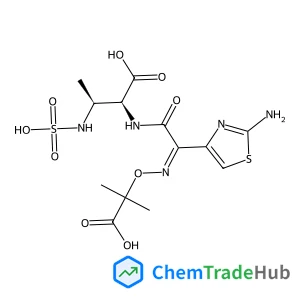
Aztreonam USP Related Compound A (Open-ring Aztreonam)
CAS Number:
87500-74-1
Molecular Formula:
C13H19N5O9S2
Recommended Suppliers




Disclaimer
This page provides academic journal information for reference and research purposes only. We are not affiliated with any journal publishers and do not handle publication submissions. For publication-related inquiries, please contact the respective journal publishers directly.
If you notice any inaccuracies in the information displayed, please contact us at support@chemtradehub.com. We will promptly review and address your concerns.