












An efficient method to synthesize vinyl ethers (VEs) that bear various halogenated or functional groups and their radical copolymerization with chlorotrifluoroethylene (CTFE) to yield functional poly(VE-alt-CTFE) alternated copolymers
Literature Information
Publication Date
2013-05-09
DOI
10.1039/C3PY00443K
Impact Factor
5.582
Authors
Ali Alaaeddine, Guillaume Couture, Bruno Ameduri
View Original
Abstract
An air-stable palladium catalyst formed in situ from commercially available components efficiently catalyzed the transetherification between ethyl vinyl ether and various alcohols to lead to the corresponding original vinyl ethers in 40–84% yield in a single step. First, a series of vinyl ether monomers that bear various functional groups, such as halogenomethyl groups, amino groups, carbonate side-groups, oligo(ethylene oxide), and oligo(fluoroether) chains, were prepared and characterized by 1H and 13C NMR spectroscopy. Then, radical copolymerization of such novel vinyl ethers with chlorotrifluoroethylene (CTFE) led to alternating poly(CTFE-alt-VE) copolymers that contained various functional dangling groups. A series of copolymers with different amounts of functional groups were obtained in fair to good yield (32–81%). Their alternating structure was confirmed by elemental analysis as well as by 1H, 19F, and 13C NMR spectroscopy. Their thermogravimetric analyses under air showed decomposition temperatures at 10% weight loss (Td,10%) ranging from 214 to 324 °C. The oligo(fluoroether) chain-based copolymers appeared more thermostable than those based on other various functional groups.
Related Literature
Constructing accurate interaction potentials to describe the microsolvation of protonated methane by helium atoms
Felix Uhl, Harald Forbert, Dominik Marx
2017-03-03
Paper
DOI: 10.1039/C7CP00652G
CO2 electroreduction performance of a single transition metal atom supported on porphyrin-like graphene: a computational study
Zhongxu Wang
2017-08-08
Paper
DOI: 10.1039/C7CP04299J
Insights into the unprecedented epoxidation mechanism of fumitremorgin B endoperoxidase (FtmOx1) from Aspergillus fumigatus by QM/MM calculations
Xiya Wang, Hao Su, Yongjun Liu
2017-02-17
Paper
DOI: 10.1039/C7CP00313G
Stabilization of ultra-small [Ag2]2+ and [Agm]n+ nano-clusters through negatively charged tetrahedrons in oxyfluoride glass networks: To largely enhance the luminescence quantum yields
Ronghua Ma, Xiaotong Chen, Xvsheng Qiao, Xianping Fan, Jincheng Du, Xianghua Zhang
2017-05-30
Paper
DOI: 10.1039/C7CP02531A
Pd-P nanoparticles supported on PxOy-incorporated carbon nanotubes for enhanced methanol oxidation in an alkaline medium
Yanan Xie, Weizhen Yu, Juan Wang, Yifei Wu, Shuo Niu, Wenyao Guo, Tsungwu Lin, Lidong Shao
2017-08-18
Paper
DOI: 10.1039/C7CP04540A
On the mobility of carriers at semi-coherent oxide heterointerfaces
Pratik P. Dholabhai, Enrique Martínez, Nicholas T. Brown, Blas Pedro Uberuaga
2017-08-17
Paper
DOI: 10.1039/C7CP04884J
The frequency-dependent AC photoresistance behavior of ZnO thin films grown on different sapphire substrates
Jorge L. Cholula-Díaz, José Barzola-Quiquia, Marcelo Videa, Chunhai Yin, Pablo Esquinazi
2017-08-17
Communication
DOI: 10.1039/C7CP04052K
Improving the capacity of lithium–sulfur batteries by tailoring the polysulfide adsorption efficiency of hierarchical oxygen/nitrogen-functionalized carbon host materials
Artur Schneider, Torsten Brezesinski
2017-02-23
Paper
DOI: 10.1039/C6CP08865A
Tunable phenol remediation from wastewater using SWCNT-based, sub-nanometer porous membranes: reactive molecular dynamics simulations and DFT calculations
F. Moradi, M. Darvish Ganji, Y. Sarrafi
2017-02-23
Paper
DOI: 10.1039/C6CP08525C
Influence of co-non-solvency on hydrophobic molecules driven by excluded volume effect
2017-08-15
Communication
DOI: 10.1039/C7CP04152G
You might also like
Compound Q&A
Is 6-(3-Fluorophenyl)picolinic acid (CAS: 887982-40-3) safe?
6-(3-Fluorophenyl)picolinic acid is generally considered safe for laboratory use...
887982-40-36-(3-Fluorophenyl)pi...
Compound Q&A
What industries use (3R)-3-Pyrrolidinol (CAS: 2799-21-5)?
(3R)-3-Pyrrolidinol is used in the pharmaceutical industry as a precursor for dr...
2799-21-5(3R)-3-Pyrrolidinol
Compound Q&A
What precautions should be taken when handling (4R,5R)-4,5-Diethoxycarbonyl-2,2-dimethyldioxolane (CAS: 59779-75-8)?
When handling (4R,5R)-4,5-Diethoxycarbonyl-2,2-dimethyldioxolane (CAS: 59779-75-...
59779-75-8(4R,5R)-4,5-Diethoxy...
Compound Q&A
How is 1-(6-Chloroimidazo[1,2-b]pyridazin-3-yl)ethanone (CAS: 90734-71-7) typically synthesized?
1-(6-Chloroimidazo[1,2-b]pyridazin-3-yl)ethanone is often synthesized via a mult...
90734-71-71-(6-Chloroimidazo[1...
Compound Q&A
What is the market or research trend for N-Ethyl-3,4-dimethylbenzylamine (CAS: 39180-83-1)?
The market for N-Ethyl-3,4-dimethylbenzylamine (CAS: 39180-83-1) remains steady,...
39180-83-1N-Ethyl-3,4-dimethyl...
Compound Q&A
What is Tert-butyl 3-(pyrrolidin-1-yl)azetidine-1-carboxylate (CAS: 1019008-21-9)?
Tert-butyl 3-(pyrrolidin-1-yl)azetidine-1-carboxylate is a chemical compound wit...
1019008-21-9Tert-butyl 3-(pyrrol...
Compound Q&A
What regulatory guidelines apply to 1-Bromo-3-chloro-2,4-dimethoxybenzene (CAS: 1228956-93-1)?
1-Bromo-3-chloro-2,4-dimethoxybenzene (CAS: 1228956-93-1) falls under the classi...
1228956-93-11-Bromo-3-chloro-2,4...
Compound Q&A
Is 8-Bromo-2-methyl-3,4-dihydroisoquinolin-1(2H)-one (CAS: 1368622-07-4) safe?
The safety of 8-Bromo-2-methyl-3,4-dihydroisoquinolin-1(2H)-one (CAS: 1368622-07...
1368622-07-48-Bromo-2-methyl-3,4...
Compound Q&A
Is Benzyl [(3S)-2,6-dioxo-3-piperidinyl]carbamate (CAS: 22785-43-9) safe?
Benzyl [(3S)-2,6-dioxo-3-piperidinyl]carbamate is generally safe when handled wi...
22785-43-9Benzyl [(3S)-2,6-dio...
Compound Q&A
How should 1-{[4-(4,4,5,5-Tetramethyl-1,3,2-dioxaborolan-2-yl)phenyl]sulfonyl}pyrrolidine (CAS: 928657-21-0) be stored?
1-{[4-(4,4,5,5-Tetramethyl-1,3,2-dioxaborolan-2-yl)phenyl]sulfonyl}pyrrolidine s...
928657-21-01-{[4-(4,4,5,5-Tetra...
Source Journal
Polymer Chemistry

CiteScore:
8.6
Self-citation Rate:
7.3%
Articles per Year:
457
Polymer Chemistry welcomes submissions in all areas of polymer science that have a strong focus on macromolecular chemistry. Manuscripts may cover a broad range of fields, yet no direct application focus is required.
Recommended Compounds
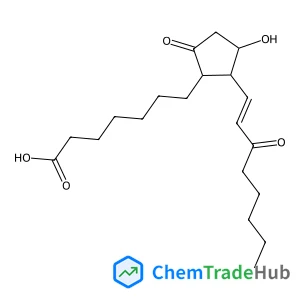
(11alpha,13E)-11-Hydroxy-9,15-dioxoprost-13-en-1-oic acid
CAS Number:
22973-19-9
Molecular Formula:
C20H32O5
Recommended Suppliers






Disclaimer
This page provides academic journal information for reference and research purposes only. We are not affiliated with any journal publishers and do not handle publication submissions. For publication-related inquiries, please contact the respective journal publishers directly.
If you notice any inaccuracies in the information displayed, please contact us at support@chemtradehub.com. We will promptly review and address your concerns.