












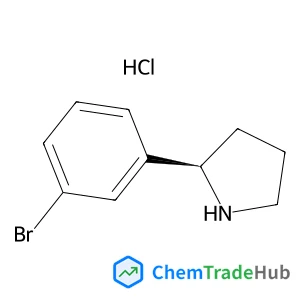
(2R)-2-(3-Bromophenyl)pyrrolidine hydrochloride (1:1)
CAS Number:
1391550-13-2
Molecular Formula:
C10H13BrClN
Nina O. C. Winter, Nora K. Graf, Samuel Leutwyler, Christof Hättig
In the present study a benchmark set of medium-sized and large aromatic organic molecules with 10–78 atoms is presented. For this test set 0–0 transition energies measured in supersonic jets are compared to those calculated with DFT and the B3LYP functional, ADC(2), CC2 and the spin-scaled CC2 variants SOS-CC2 and SCS-CC2. Geometries of the ground and excited states have been optimized with these methods in polarized triple zeta basis sets. Zero-point vibrational corrections have been calculated with the same methods and basis sets. In addition the energies have been corrected by single point calculations with a triple zeta basis augmented with diffuse functions, aug-cc-pVTZ. The deviations of the theoretical results from experimental electronic origins, which have all been measured in the gas phase with high-resolution techniques, were evaluated. The accuracy of SOS-CC2 is comparable to that of unscaled CC2, whereas ADC(2) has slightly larger errors. The lowest errors were found for SCS-CC2. All correlated wave function methods provide significantly better results than DFT with the B3LYP functional. The effects of the energy corrections from the augmented basis set and the method-consistent calculation of the zero-point vibrational corrections are small. With this benchmark set reliable reference data for 0–0 transition energies for larger organic chromophores are available that can be used to benchmark the accuracy of other quantum chemical methods such as new DFT functionals or semi-empirical methods for excitation energies and structures and thereby augments available benchmark sets augments present benchmark sets which include mainly smaller molecules.
Uttam Anand, Saptarshi Mukherjee
DOI: 10.1039/C3CP50207D
Oliver L. G. Alderman, Alex C. Hannon, Diane Holland, Steve Feller, Gloria Lehr, Adam J. Vitale, Uwe Hoppe, Martin v. Zimmerman, Anke Watenphul
DOI: 10.1039/C3CP51348C
Xiangchao Ma, Ying Dai, Meng Guo, Yingtao Zhu, Baibiao Huang
DOI: 10.1039/C3CP44519D
Piotr Bernatowicz
DOI: 10.1039/C3CP50963J
George Hasegawa, Mai Sannohe, Yuya Ishihara, Kazuyoshi Kanamori, Kazuki Nakanishi, Takeshi Abe
DOI: 10.1039/C3CP50352F
Johannes Auerswald, Bernd Engels, Ingo Fischer, Thiemo Gerbich, Jörg Herterich, Anke Krueger, Melanie Lang, Hans-Christian Schmitt, Christof Schon, Christof Walter
DOI: 10.1039/C3CP44271C
Reshma Sultana, Naser Reza, Helena Woodvine, Jonathan G. Terry, Anthony J. Walton, Charlotte L. Brady, Ilka Schmueser, Andrew R. Mount
DOI: 10.1039/C3CP50759A
Narendra Kurra, Dipanwita Dutta, Giridhar U. Kulkarni
DOI: 10.1039/C3CP50675D
U. Hoppe, L. Delevoye, L. Montagne, M. v. Zimmermann, A. C. Hannon
DOI: 10.1039/C2CP42772A
Yuriy I. Prylutskyy, Anatoly S. Buchelnikov, Dmitry P. Voronin, Viktor V. Kostjukov, Uwe Ritter, John A. Parkinson, Maxim P. Evstigneev
DOI: 10.1039/C3CP50187F
N-(4-Methoxybenzyl)-2-pyridinamine (CAS: 52818-63-0) is increasingly being used ...
When handling Ethyl 4-(2-chlorophenyl)-1,3-thiazole-2-carboxylate, appropriate p...
Diethyldiselane (CAS: 628-39-7) is classified under the Globally Harmonized Syst...
The market for oxocopper (CAS: 12053-18-8) is primarily driven by its use in cat...
The market for 5-{[(2-Methyl-2-propanyl)oxy]carbonyl}-5-azaspiro[2.4]heptane-7-c...
2-(1-Pyrrolidinyl)-4-pyridinamine is a chemical compound with the CAS number 359...
2-(3-Pyridinyl)-1-azabicyclo[2.2.2]octane (CAS: 91556-75-1) is a crystalline sol...
(S)-Alpha-allyl-proline hydrochloride is usually synthesized via a Wittig reacti...
3-Methyl-1,2-oxazole-5-carboxylic acid (CAS: 4857-42-5) is an organic compound w...
Lys-SMCC-DM1 is synthesized via a multi-step process involving the coupling of S...

Physical Chemistry Chemical Physics (PCCP) is an international journal co-owned by 19 physical chemistry and physics societies from around the world. This journal publishes original, cutting-edge research in physical chemistry, chemical physics and biophysical chemistry. To be suitable for publication in PCCP, articles must include significant innovation and/or insight into physical chemistry; this is the most important criterion that reviewers and Editors will judge against when evaluating submissions. The journal has a broad scope and welcomes contributions spanning experiment, theory, computation and data science. Topical coverage includes spectroscopy, dynamics, kinetics, statistical mechanics, thermodynamics, electrochemistry, catalysis, surface science, quantum mechanics, quantum computing and machine learning. Interdisciplinary research areas such as polymers and soft matter, materials, nanoscience, energy, surfaces/interfaces, and biophysical chemistry are welcomed if they demonstrate significant innovation and/or insight into physical chemistry. Joined experimental/theoretical studies are particularly appreciated when complementary and based on up-to-date approaches.
![1-(1-Benzyl-1,2,3,6-tetrahydropyridin-4-yl)-1H-benzo[d]imidazol-2(3H)-one structure](https://static.chemtradehub.com/structs/603/60373-71-9-7dfb.webp "1-(1-Benzyl-1,2,3,6-tetrahydropyridin-4-yl)-1H-benzo[d]imidazol-2(3H)-one structure")
![1-oxaspiro[4.4]nonan-6-one structure](https://static.chemtradehub.com/structs/134/134179-01-4-e051.webp "1-oxaspiro[4.4]nonan-6-one structure")




