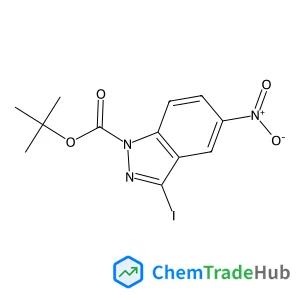
Tert-butyl 3-iodo-5-nitro-1H-indazole-1-carboxylate
CAS Number:
459133-69-8
Molecular Formula:
C12H12IN3O4
Kyoung Ju Kim, Woong-Ryeol Yu, Ji Ho Youk, Jinyong Lee
The formation of carbon nanotubes (CNTs) through precipitated carbons emerging from supersaturated metal catalysts is an established mechanism for their growth during the CVD process. Here, the CNT growth mode is determined by the interaction between the substrate and the catalyst nanoparticle, e.g., the tip-growth mode for the weak adhesion between them and the base-growth mode for the strong adhesion case. With microscopic evidence, this study reports another factor that governs the growth mode of CNTs on carbon-based substrates. Catalyst nanoparticles after only sputtering and annealing processes before the chemical vapor deposition (CVD) process are fully or partially wrapped with some graphitic layers, which are formed by carbons escaping from the carbon substrate. The formation of the wrapping graphitic layers is initiated by catalyst atoms diffusing into the carbon substrate during the catalyst sputtering process. The diffused catalyst atoms later coalesce into the nanoparticles, during which carbon atoms escape from the carbon substrate, forming the graphitic layers which wrap around the catalyst nanoparticles for energy minimization. Then, the carbon atoms generated from the catalytic reactions during the CVD process interact with the carbons in the graphitic layers wrapped around the catalyst nanoparticles, bringing about clear tip-growth of CNTs on carbon-based substrates and a stable interface (carbon–carbon bonding) between CNTs and carbon-based substrates.
Sherdil Khan, Maximiliano J. M. Zapata, Marcelo B. Pereira, Renato V. Gonçalves, Lukas Strizik, Jairton Dupont, Marcos J. L. Santos, Sérgio R. Teixeira
DOI: 10.1039/C5CP03645C
Debabrata Sikdar, Shakeeb B. Hasan, Michael Urbakh, Joshua B. Edel, Alexei A. Kornyshev
DOI: 10.1039/C6CP04551K
Guoguang Wu, Weitao Zheng, Fubin Gao, Hang Yang, Yang Zhao, Jingzhi Yin, Wei Zheng, Wancheng Li, Baolin Zhang, Guotong Du
DOI: 10.1039/C6CP03199D
M. Mihaylov, S. Andonova, K. Chakarova, A. Vimont, E. Ivanova, N. Drenchev, K. Hadjiivanov
DOI: 10.1039/C5CP04139B
Debmalya Bhunia, Rajdeep Chowdhury, Kankan Bhattacharyya
DOI: 10.1039/C5CP04908C
Yassin A. Jeilani, Chelesa Fearce, Minh Tho Nguyen
DOI: 10.1039/C5CP03247D
Yafei Jiang, Hongwei Tan, Jimin Zheng, Xichen Li, Guangju Chen, Zongchao Jia
DOI: 10.1039/C5CP03342J
Demian Marchione, Martin R. S. McCoustra
DOI: 10.1039/C6CP01787H
Patrick K. Tamukong, Wadumesthrige D. N. Peiris, Svetlana Kilina
DOI: 10.1039/C6CP01665K
Jeffrey J. Black, Thomas Murphy, Rob Atkin, Andrew Dolan, Leigh Aldous
DOI: 10.1039/C6CP02255C
When handling 4-Methyl-6-(trifluoromethyl)quinoline (CAS: 40716-16-3), safety go...
4-(3,5-Difluorophenyl)aniline is an aromatic organic compound with the CAS numbe...
5-{[4-(Trifluoromethyl)phenyl]sulfanyl}-1,2,3-thiadiazole-4-carboxylic acid can ...
The market for 4-Benzylaniline hydrochloride (CAS: 6317-57-3) is steadily growin...
[3-(Diethylsulfamoyl)phenyl]boronic acid is generally considered safe when handl...
3-Bromo-2,5-dimethoxyaniline is mainly used in the pharmaceutical and chemical i...
N-Methyl-1-(5-methyl-1H-indol-3-yl)methanamine (CAS: 915922-67-7) is subject to ...
This compound is primarily used in the pharmaceutical industry for the synthesis...
2-Methyl-2-propanyl [(1S,3R)-3-aminocyclohexyl]carbamate (CAS: 1298101-47-9) sho...
Ethyl 2-bromo-4,4,4-trifluorobutanoate (CAS: 367-33-9) is utilized in the pharma...

Physical Chemistry Chemical Physics (PCCP) is an international journal co-owned by 19 physical chemistry and physics societies from around the world. This journal publishes original, cutting-edge research in physical chemistry, chemical physics and biophysical chemistry. To be suitable for publication in PCCP, articles must include significant innovation and/or insight into physical chemistry; this is the most important criterion that reviewers and Editors will judge against when evaluating submissions. The journal has a broad scope and welcomes contributions spanning experiment, theory, computation and data science. Topical coverage includes spectroscopy, dynamics, kinetics, statistical mechanics, thermodynamics, electrochemistry, catalysis, surface science, quantum mechanics, quantum computing and machine learning. Interdisciplinary research areas such as polymers and soft matter, materials, nanoscience, energy, surfaces/interfaces, and biophysical chemistry are welcomed if they demonstrate significant innovation and/or insight into physical chemistry. Joined experimental/theoretical studies are particularly appreciated when complementary and based on up-to-date approaches.
![6-Bromo-3-ethyl-3H-imidazo[4,5-b]pyridine structure](https://static.chemtradehub.com/structs/103/1033202-59-3-2a8f.webp "6-Bromo-3-ethyl-3H-imidazo[4,5-b]pyridine structure")
![2,4-Dichloro-6-isopropyl-5H-pyrrolo[3,4-d]pyrimidin-7(6H)-one structure](https://static.chemtradehub.com/structs/107/1079649-94-7-ad4a.webp "2,4-Dichloro-6-isopropyl-5H-pyrrolo[3,4-d]pyrimidin-7(6H)-one structure")