












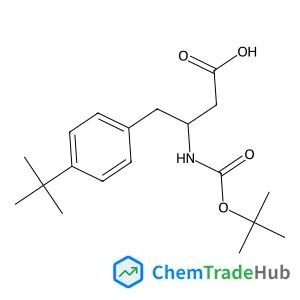
(S)-3-((tert-Butoxycarbonyl)amino)-4-(4-(tert-butyl)phenyl)butanoic acid
CAS Number:
403661-85-8
Molecular Formula:
C19H29NO4
Megumi Shintani, Yushi Matsuo, Shun Sakuraba
The location, orientation, and dynamics of hydrophobic small molecules in lipid membranes are studied through combined use of solution-state 1H-NMR and MD simulation. 1-Naphthol and 1-methylnaphthalene were adopted as the small molecules with or without hydrophilic groups. The nuclear Overhauser effect (NOE) measurement was performed for large unilamellar vesicles (100 nm in diameter) composed of dimyristoylphosphatidylcholine (DMPC) and the naphthalene derivative. The transient NOE-SE (spin–echo) scheme previously reported (J. Phys. Chem. B, 2011, 115, 9106–9115) was employed to quantitatively determine the NOE cross relaxation rate constant between DMPC and the naphthalene derivative. The observed NOE shows that both the naphthalene derivatives distribute over a wide domain across the normal of the essentially planar membrane ranging from the hydrophobic core to the hydrophilic headgroup. The experimental NOE information was further refined in combination with the analysis of time correlation functions in MD simulation. It was found that 1-naphthol exhibits a slight preference for pointing its OH group toward the hydrophilic domain of the membrane and that no definite preference can be concluded for the orientation of 1-methylnaphthalene. When 1-naphthol and 1-methylnaphthalene are compared, the NOE is stronger for 1-naphthol due to the restricted motion of the OH group. The slowdown of the 1-naphthol motion is also evidenced by the 1H spectral line width.
Duccio Fanelli, Stefano Angioletti-Uberti
DOI: 10.1039/C6CP01179A
Miao Miao, Gangling Wang, Shaomei Cao, Xin Feng, Jianhui Fang, Liyi Shi
DOI: 10.1039/C5CP04679C
Pradyumna Mulpur, Sairam Yadavilli, Praharsha Mulpur, Neeharika Kondiparthi, Venkataramaniah Kamisetti
DOI: 10.1039/C5CP04268B
Marat A. Ziganshin, Nadezhda S. Gubina, Alexander V. Gerasimov, Valery V. Gorbatchuk, Sufia A. Ziganshina, Anton P. Chuklanov, Anastas A. Bukharaev
DOI: 10.1039/C5CP03309H
Ross H. McKenzie
DOI: 10.1039/C5CP02239H
Michèle Chevalier, Claudine Crépin
DOI: 10.1039/C6CP02796B
M. H. Ghatee, S. Namvar, A. R. Zolghadr, F. Moosavi
DOI: 10.1039/C5CP02683K
Debabrata Sikdar, Shakeeb B. Hasan, Michael Urbakh, Joshua B. Edel, Alexei A. Kornyshev
DOI: 10.1039/C6CP04551K
Rafał Orłowski, Marzena Banasiewicz, Guillaume Clermont, Frédéric Castet, Rashid Nazir, Mireille Blanchard-Desce, Daniel T. Gryko
DOI: 10.1039/C5CP03523F
Chaitanya V. Mungi, Sachin Kumar Singh, Sudha Rajamani
DOI: 10.1039/C6CP00686H
When handling 4-Methyl-6-(trifluoromethyl)quinoline (CAS: 40716-16-3), safety go...
4-(3,5-Difluorophenyl)aniline is an aromatic organic compound with the CAS numbe...
5-{[4-(Trifluoromethyl)phenyl]sulfanyl}-1,2,3-thiadiazole-4-carboxylic acid can ...
The market for 4-Benzylaniline hydrochloride (CAS: 6317-57-3) is steadily growin...
[3-(Diethylsulfamoyl)phenyl]boronic acid is generally considered safe when handl...
3-Bromo-2,5-dimethoxyaniline is mainly used in the pharmaceutical and chemical i...
N-Methyl-1-(5-methyl-1H-indol-3-yl)methanamine (CAS: 915922-67-7) is subject to ...
This compound is primarily used in the pharmaceutical industry for the synthesis...
2-Methyl-2-propanyl [(1S,3R)-3-aminocyclohexyl]carbamate (CAS: 1298101-47-9) sho...
Ethyl 2-bromo-4,4,4-trifluorobutanoate (CAS: 367-33-9) is utilized in the pharma...

Physical Chemistry Chemical Physics (PCCP) is an international journal co-owned by 19 physical chemistry and physics societies from around the world. This journal publishes original, cutting-edge research in physical chemistry, chemical physics and biophysical chemistry. To be suitable for publication in PCCP, articles must include significant innovation and/or insight into physical chemistry; this is the most important criterion that reviewers and Editors will judge against when evaluating submissions. The journal has a broad scope and welcomes contributions spanning experiment, theory, computation and data science. Topical coverage includes spectroscopy, dynamics, kinetics, statistical mechanics, thermodynamics, electrochemistry, catalysis, surface science, quantum mechanics, quantum computing and machine learning. Interdisciplinary research areas such as polymers and soft matter, materials, nanoscience, energy, surfaces/interfaces, and biophysical chemistry are welcomed if they demonstrate significant innovation and/or insight into physical chemistry. Joined experimental/theoretical studies are particularly appreciated when complementary and based on up-to-date approaches.
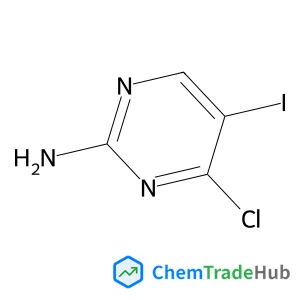
![6-Bromo-3-ethyl-3H-imidazo[4,5-b]pyridine structure](https://static.chemtradehub.com/structs/103/1033202-59-3-2a8f.webp "6-Bromo-3-ethyl-3H-imidazo[4,5-b]pyridine structure")
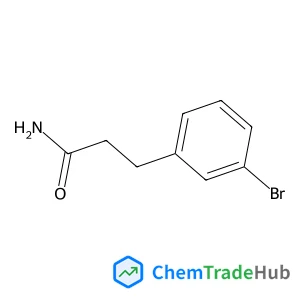
![[3-(2,6-Dichlorophenyl)-5-isopropyl-1,2-oxazol-4-yl]methanol structure](https://static.chemtradehub.com/structs/278/278597-30-1-5c79.webp "[3-(2,6-Dichlorophenyl)-5-isopropyl-1,2-oxazol-4-yl]methanol structure")




