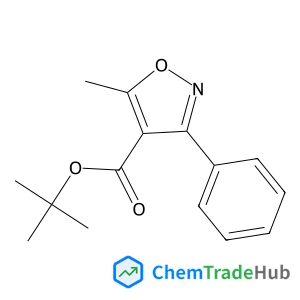
2-Methyl-2-propanyl 5-methyl-3-phenyl-1,2-oxazole-4-carboxylate
CAS Number:
211429-79-7
Molecular Formula:
C15H17NO3
Ross H. McKenzie
Entanglement is sometimes regarded as the quintessential measure of the quantum nature of a system and its significance for the understanding of coupled electronic and vibrational motions in molecules has been conjectured. Previously, we considered the entanglement developed in a spatially localized diabatic basis representation of the electronic states, considering design rules for qubits in a low-temperature chemical quantum computer. We extend this to consider the entanglement developed during high-energy processes. We also consider the entanglement developed using adiabatic electronic basis, providing a novel way for interpreting effects of the breakdown of the Born–Oppenheimer (BO) approximation. We consider: (i) BO entanglement in the ground-state wavefunction relevant to equilibrium thermodynamics, (ii) BO entanglement associated with low-energy wavefunctions relevant to infrared and tunneling spectroscopies, (iii) BO entanglement in high-energy eigenfunctions relevant to chemical reaction processes, and (iv) BO entanglement developed during reactive wavepacket dynamics. A two-state single-mode diabatic model descriptive of a wide range of chemical phenomena is used for this purpose. The entanglement developed by BO breakdown correlates simply with the diameter of the cusp introduced by the BO approximation, and a hierarchy appears between the various BO-breakdown correction terms, with the first-derivative correction being more important than the second-derivative correction which is more important than the diagonal correction. This simplicity is in contrast to the complexity of BO-breakdown effects on thermodynamic, spectroscopic, and kinetic properties. Further, processes poorly treated at the BO level that appear adequately treated using the Born–Huang adiabatic approximation are found to have properties that can only be described using a non-adiabatic description. For the entanglement developed between diabatic electronic states and the nuclear motion, qualitatively differently behavior is found compared to traditional properties of the density matrix and hence entanglement provides new information about system properties. For chemical reactions, this type of entanglement simply builds up as the transition-state region is crossed. It is robust to small changes in parameter values and is therefore more attractive for making quantum qubits than is the related fragile ground-state entanglement, provided that coherent motion at the transition state can be sustained.
Pierre Y. Dapsens, Cecilia Mondelli, Bright T. Kusema, René Verel, Javier Pérez-Ramírez
DOI: 10.1039/C3GC42353K
Xi Chen, Shu Ling Chew, Francesca M. Kerton, Ning Yan
DOI: 10.1039/C3GC42436G
Ying Liang, Heng-Shan Wang, Ying-Ming Pan
DOI: 10.1039/C3GC42499E
Paramita Das, Arghya Dutta, Asim Bhaumik, Chhanda Mukhopadhyay
DOI: 10.1039/C3GC42095G
Haonan Chen, Wujie Dai, Yi Chen, Qing Xu, Jianhui Chen, Yajuan Zhao, Mingde Ye
DOI: 10.1039/C3GC42310G
V. V. Ordomsky, A. Y. Khodakov
DOI: 10.1039/C3GC42319K
P. Cintas, S. Tagliapietra, E. Calcio Gaudino, G. Palmisano, G. Cravotto
DOI: 10.1039/C3GC41955J
Jennifer Neumann, Stephanie Steudte, Chul-Woong Cho, Jorg Thöming
DOI: 10.1039/C3GC41997E
Michael Ferguson, Nicola Giri, Xu Huang, David Apperley, Stuart L. James
DOI: 10.1039/C3GC42141D
Calvin Mukarakate, Xiaodong Zhang, Alexander R. Stanton, David J. Robichaud, Peter N. Ciesielski, Kara Malhotra, Bryon S. Donohoe, Erica Gjersing, Robert J. Evans, David S. Heroux, Ryan Richards, Kristiina Iisa, Mark R. Nimlos
DOI: 10.1039/C3GC42065E
When handling 4-Methyl-6-(trifluoromethyl)quinoline (CAS: 40716-16-3), safety go...
4-(3,5-Difluorophenyl)aniline is an aromatic organic compound with the CAS numbe...
5-{[4-(Trifluoromethyl)phenyl]sulfanyl}-1,2,3-thiadiazole-4-carboxylic acid can ...
The market for 4-Benzylaniline hydrochloride (CAS: 6317-57-3) is steadily growin...
[3-(Diethylsulfamoyl)phenyl]boronic acid is generally considered safe when handl...
3-Bromo-2,5-dimethoxyaniline is mainly used in the pharmaceutical and chemical i...
N-Methyl-1-(5-methyl-1H-indol-3-yl)methanamine (CAS: 915922-67-7) is subject to ...
This compound is primarily used in the pharmaceutical industry for the synthesis...
2-Methyl-2-propanyl [(1S,3R)-3-aminocyclohexyl]carbamate (CAS: 1298101-47-9) sho...
Ethyl 2-bromo-4,4,4-trifluorobutanoate (CAS: 367-33-9) is utilized in the pharma...

Physical Chemistry Chemical Physics (PCCP) is an international journal co-owned by 19 physical chemistry and physics societies from around the world. This journal publishes original, cutting-edge research in physical chemistry, chemical physics and biophysical chemistry. To be suitable for publication in PCCP, articles must include significant innovation and/or insight into physical chemistry; this is the most important criterion that reviewers and Editors will judge against when evaluating submissions. The journal has a broad scope and welcomes contributions spanning experiment, theory, computation and data science. Topical coverage includes spectroscopy, dynamics, kinetics, statistical mechanics, thermodynamics, electrochemistry, catalysis, surface science, quantum mechanics, quantum computing and machine learning. Interdisciplinary research areas such as polymers and soft matter, materials, nanoscience, energy, surfaces/interfaces, and biophysical chemistry are welcomed if they demonstrate significant innovation and/or insight into physical chemistry. Joined experimental/theoretical studies are particularly appreciated when complementary and based on up-to-date approaches.