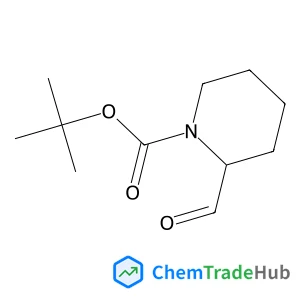
2-Methyl-2-propanyl (2R)-2-formyl-1-piperidinecarboxylate
CAS Number:
134526-69-5
Molecular Formula:
C11H19NO3
Thomas Trantzschel, Johannes Bernarding, Markus Plaumann, Denise Lego, Torsten Gutmann, Tomasz Ratajczyk, Sonja Dillenberger, Gerd Buntkowsky, Joachim Bargon, Ute Bommerich
Hyperpolarization (HP) techniques are increasingly important in magnetic resonance imaging (MRI) and spectroscopy (MRS). HP methods have the potential to overcome the fundamentally low sensitivity of magnetic resonance (MR). A breakthrough of HP-MR in life sciences and medical applications is still limited by the small number of accessible, physiologically relevant substrates. Our study presents a new approach to extend PHIP to substrates that primarily cannot be hyperpolarized due to a steady intramolecular re-arrangement, the so-called keto–enol tautomerism. To overcome this obstacle we exploited the fact that instead of the instable enol form the corresponding stable ester can be used as a precursor molecule. This strategy now enables the hydrogenation which is required to apply the standard PHIP procedure. As the final step a hydrolysis is necessary to release the hyperpolarized target molecule. Using this new approach ethanol was successfully hyperpolarized for the first time. It may therefore be assumed that the outlined multi-step procedure can be used for other keto–enol tautomerized substances thereby opening the application of PHIP to a multitude of molecules relevant to analyzing metabolic pathways.
Zhengyan Zhao, Wei Liu, Yantao Shi, Heming Zhang, Xuedan Song, Wenzhe Shang, Ce Hao
DOI: 10.1039/D0CP05570K
Weizhou Wang, Martin Dračínský
DOI: 10.1039/D0CP06280D
Xiao-Juan Ye, Jie Xu, Yan-Dong Guo, Chun-Sheng Liu
DOI: 10.1039/D0CP00187B
Mohammad Ebrahim Izadi, Kristof M. Bal, Ali Maghari, Erik C. Neyts
DOI: 10.1039/D0CP04542J
R. Saha, C. Welch, G. H. Mehl, J. Feng, C. Zhu, J. Gleeson
DOI: 10.1039/D0CP06633H
E. Engelage, H. Hijazi, M. Gartmann, L.-M. Chamoreau, B. Schöllhorn, S. M. Huber, C. Fave
DOI: 10.1039/D0CP06612E
Daniela Millan, Mafalda R. Almeida, Ana F. C. S. Rufino, João A. P. Coutinho, Mara G. Freire
DOI: 10.1039/D0CP06086K
Jacob C. Saldinger, Paolo Elvati
DOI: 10.1039/D0CP03529G
X. W. Sheng, K. T. Tang
DOI: 10.1039/D1CP90032C
6-(3-Fluorophenyl)picolinic acid is generally considered safe for laboratory use...
(3R)-3-Pyrrolidinol is used in the pharmaceutical industry as a precursor for dr...
When handling (4R,5R)-4,5-Diethoxycarbonyl-2,2-dimethyldioxolane (CAS: 59779-75-...
1-(6-Chloroimidazo[1,2-b]pyridazin-3-yl)ethanone is often synthesized via a mult...
The market for N-Ethyl-3,4-dimethylbenzylamine (CAS: 39180-83-1) remains steady,...
Tert-butyl 3-(pyrrolidin-1-yl)azetidine-1-carboxylate is a chemical compound wit...
1-Bromo-3-chloro-2,4-dimethoxybenzene (CAS: 1228956-93-1) falls under the classi...
The safety of 8-Bromo-2-methyl-3,4-dihydroisoquinolin-1(2H)-one (CAS: 1368622-07...
Benzyl [(3S)-2,6-dioxo-3-piperidinyl]carbamate is generally safe when handled wi...
1-{[4-(4,4,5,5-Tetramethyl-1,3,2-dioxaborolan-2-yl)phenyl]sulfonyl}pyrrolidine s...

Physical Chemistry Chemical Physics (PCCP) is an international journal co-owned by 19 physical chemistry and physics societies from around the world. This journal publishes original, cutting-edge research in physical chemistry, chemical physics and biophysical chemistry. To be suitable for publication in PCCP, articles must include significant innovation and/or insight into physical chemistry; this is the most important criterion that reviewers and Editors will judge against when evaluating submissions. The journal has a broad scope and welcomes contributions spanning experiment, theory, computation and data science. Topical coverage includes spectroscopy, dynamics, kinetics, statistical mechanics, thermodynamics, electrochemistry, catalysis, surface science, quantum mechanics, quantum computing and machine learning. Interdisciplinary research areas such as polymers and soft matter, materials, nanoscience, energy, surfaces/interfaces, and biophysical chemistry are welcomed if they demonstrate significant innovation and/or insight into physical chemistry. Joined experimental/theoretical studies are particularly appreciated when complementary and based on up-to-date approaches.
![2-Methyl-2-propanyl [(2S)-1-hydroxy-3-(4-hydroxyphenyl)-2-propanyl]carbamate structure](https://static.chemtradehub.com/structs/833/83345-46-4-eec2.webp "2-Methyl-2-propanyl [(2S)-1-hydroxy-3-(4-hydroxyphenyl)-2-propanyl]carbamate structure")