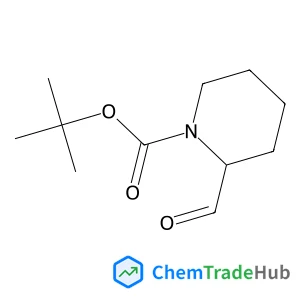
2-Methyl-2-propanyl (2R)-2-formyl-1-piperidinecarboxylate
CAS Number:
134526-69-5
Molecular Formula:
C11H19NO3
Xueyan Cao, Rui Guo, Mingwu Shen, Mengen Zhang, Meifang Zhu
We report here a general approach to using multifunctional poly(amidoamine) (PAMAM) dendrimer-based platform to encapsulate an anticancer drug doxorubicin (DOX) for targeted cancer therapy. In this approach, generation 5 (G5) PAMAM dendrimers modified with fluorescein isothiocyanate (FI) and folic acid (FA) via covalent conjugation, and with remaining terminal amines being acetylated (G5.NHAc-FI-FA) were used to complex DOX for targeted delivery of the drug to cancer cells overexpressing high-affinity folic acid receptors (FAR). We show that the formed G5.NHAc-FI-FA/DOX complexes with each dendrimer encapsulating approximately one DOX molecule are water soluble and stable. In vitro release studies show that DOX complexed with the multifunctional dendrimers can be released in a sustained manner. 3-(4,5-Dimethylthiazol-2-yl)-2,5-diphenyltetrazolium bromide cell viability assay in conjunction with cell morphology observation demonstrates that the G5.NHAc-FI-FA/DOX complexes can specifically target and display specific therapeutic efficacy to cancer cells overexpressing high-affinity FAR. Findings from this study suggest that multifunctional dendrimers may be used as a general drug carrier to encapsulate various cancer drugs for targeting therapy of different types of cancer.

Contact Lens & Anterior Eye

Physical Chemistry Chemical Physics

European Journal of Organic Chemistry

Molecular Diversity

Advanced Engineering Materials

Mini-Reviews in Medicinal Chemistry

Molecules

Environmental Toxicology and Pharmacology

Angewandte Chemie International Edition

Photochemical & Photobiological Sciences
Gil O. Rutter, David Quigley, Tiffany R. Walsh
DOI: 10.1039/C5CP05652G
Federico A. O. Rasse-Suriani, M. Paula Denofrio, Juan G. Yañuk, M. Micaela Gonzalez, Ezequiel Wolcan, Marco Seifermann, Rosa Erra-Balsells, Franco M. Cabrerizo
DOI: 10.1039/C5CP05866J
Manish Chopra, Niharendu Choudhury
DOI: 10.1039/C5CP90224J
Anne Knorr, Koichi Fumino, Anne-Marie Bonsa
DOI: 10.1039/C5CP03412D
Ana Vila Verde, Mark Santer, Reinhard Lipowsky
DOI: 10.1039/C5CP05726D
Yong Seok Hwang, Valery I. Levitas
DOI: 10.1039/C5CP04443J
R. C. Hoffmann, M. Kaloumenos, D. Spiehl, E. Erdem, S. Repp, S. Weber, J. J. Schneider
DOI: 10.1039/C5CP05166E
Laura Berstis, Kim K. Baldridge
DOI: 10.1039/C5CP01861G
Artur Nenov, Angelo Giussani, Benjamin P. Fingerhut, Ivan Rivalta, Elise Dumont, Shaul Mukamel
DOI: 10.1039/C5CP01167A
Malte Sachs, Michael Gellert, Min Chen, Hans-Jörg Drescher, Stefan Renato Kachel, Han Zhou, Malte Zugermeier, Mihaela Gorgoi, Bernhard Roling, J. Michael Gottfried
DOI: 10.1039/C5CP03837E
3-Fluoro-2-methylbenzylamine is an organic compound with the CAS number 771573-3...
Tert-butyl 2-(oxetan-3-ylidene)acetate is considered safe for its intended uses ...
Proper personal protective equipment (PPE) such as gloves, goggles, and a lab co...
2-Ethyl-4-methyl-1,3-thiazole is commonly synthesized via the reaction of thiour...
This compound should be stored in a cool, dry place away from direct sunlight an...
L-Lysine Acetate Salt (CAS: 52315-92-1) is subject to various regulatory guideli...
6-Fluoro-3-hydroxy-2-pyrazinecarboxamide (CAS: 259793-96-9) is generally conside...
1,1'-Sulfonylbis(1H-imidazole) is a crystalline solid with a molecular weight of...
4-Methyl-7-nitro-1H-indole-3-carbonitrile (CAS: 289483-82-5) is primarily used i...
Waste containing 5-Bromo-3-indolyl-beta-galactoside (CAS: 97753-82-7) should be ...

Polymer Chemistry welcomes submissions in all areas of polymer science that have a strong focus on macromolecular chemistry. Manuscripts may cover a broad range of fields, yet no direct application focus is required.
![2-[({[(2-Methyl-2-propanyl)oxy]carbonyl}amino)methyl]isonicotinic acid structure](https://static.chemtradehub.com/structs/473/473924-63-9-973b.webp "2-[({[(2-Methyl-2-propanyl)oxy]carbonyl}amino)methyl]isonicotinic acid structure")