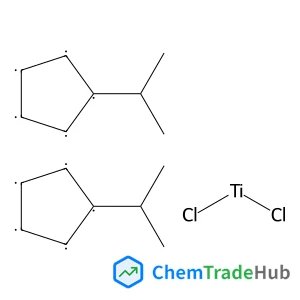
BIS(I-PROPYLCYCLOPENTADIENYL)TITANIUM DICHLORIDE
CAS Number:
12130-65-3
Molecular Formula:
C16H22Cl2Ti
Yoshitaka Aoki, Akihisa Harada, Aiko Nakao, Toyoki Kunitake, Hiroki Habazaki
The finite size effect of proton conductivity of amorphous aluminosilicate thin films, a-AlnSi1−nOx (n = 0.07, 0.1, 0.2, 0.3 and 0.45), prepared by a sol–gel process was investigated by experimental and numerical techniques. High-resolution TEM clarified that a-AlnSi1−nOx films had the heterogeneous nanoscale microstructures comprised of the ion-conducting, condensed glass microdomain and the poor-conductive, uncondensed glass microdomain. σ of the films with n ≤ 0.1 exponentially increased upon decreasing thickness in the sub-100 nm range because the volume fraction of conductive domains was less than the percolation threshold and cluster size scaling of the conductive domain was operative. The numerical simulation suggested that conductance of the condensed domain was higher than that of the uncondensed domain by 2 orders of magnitude. Volume fractions of the condensed domain increased with increasing Al/Si molar ratio and were over the percolation threshold (24.5%) with n ≥ 0.2. However, conductance of the condensed domain decreased with increasing Al/Si ratio with n ≥ 0.2 because the aluminosilicate glass framework made of 4-fold-connected MO4 tetrahedra was deformed by forming the octahedral AlO6 moieties, as checked by Al K-edge XAS. It was found that the optimal Al/Si composition in terms of the conductance of the condensed domain is not in coincidence with that in terms of the average conductivity of the films.
DOI: 10.1039/D3NJ04311H
Li Xu, Yi Qian, Lei Bao, Wei Wang, Nengmei Deng, Li Zhang, Guanglin Wang, Xucheng Fu, Wei Fu
DOI: 10.1039/D3NJ04521H
Jammu Ravi, N. R. Jawahar
DOI: 10.1039/D3NJ02840B
Lijia Yao, Bingquan Chen, Hailong Wu, Yuanjing Cui, Guodong Qian
DOI: 10.1039/D3TB01869E
Peng Tang, Liang Wang, Wanyi Xie, Xiaohan Chen, Yunjiao Wang, Ting Weng, Rong Tian, Shuo Zhou, Zuobin Wang
DOI: 10.1039/D3TB01875J
Faqi Yu, Ruiyang Fan, Yansheng Zhao, Yijun Chen, Xiuqi Kong
DOI: 10.1039/D3TB02232C
Marian Rosaly Davolos
DOI: 10.1039/D3NJ03161F
DOI: 10.1039/D3NJ03674J
6-(3-Fluorophenyl)picolinic acid is generally considered safe for laboratory use...
(3R)-3-Pyrrolidinol is used in the pharmaceutical industry as a precursor for dr...
When handling (4R,5R)-4,5-Diethoxycarbonyl-2,2-dimethyldioxolane (CAS: 59779-75-...
1-(6-Chloroimidazo[1,2-b]pyridazin-3-yl)ethanone is often synthesized via a mult...
The market for N-Ethyl-3,4-dimethylbenzylamine (CAS: 39180-83-1) remains steady,...
Tert-butyl 3-(pyrrolidin-1-yl)azetidine-1-carboxylate is a chemical compound wit...
1-Bromo-3-chloro-2,4-dimethoxybenzene (CAS: 1228956-93-1) falls under the classi...
The safety of 8-Bromo-2-methyl-3,4-dihydroisoquinolin-1(2H)-one (CAS: 1368622-07...
Benzyl [(3S)-2,6-dioxo-3-piperidinyl]carbamate is generally safe when handled wi...
1-{[4-(4,4,5,5-Tetramethyl-1,3,2-dioxaborolan-2-yl)phenyl]sulfonyl}pyrrolidine s...

Physical Chemistry Chemical Physics (PCCP) is an international journal co-owned by 19 physical chemistry and physics societies from around the world. This journal publishes original, cutting-edge research in physical chemistry, chemical physics and biophysical chemistry. To be suitable for publication in PCCP, articles must include significant innovation and/or insight into physical chemistry; this is the most important criterion that reviewers and Editors will judge against when evaluating submissions. The journal has a broad scope and welcomes contributions spanning experiment, theory, computation and data science. Topical coverage includes spectroscopy, dynamics, kinetics, statistical mechanics, thermodynamics, electrochemistry, catalysis, surface science, quantum mechanics, quantum computing and machine learning. Interdisciplinary research areas such as polymers and soft matter, materials, nanoscience, energy, surfaces/interfaces, and biophysical chemistry are welcomed if they demonstrate significant innovation and/or insight into physical chemistry. Joined experimental/theoretical studies are particularly appreciated when complementary and based on up-to-date approaches.
![(1R,6R)-6-({[(2-Methyl-2-propanyl)oxy]carbonyl}amino)-3-cyclohexene-1-carboxylic acid structure](https://static.chemtradehub.com/structs/865/865689-24-3-5fef.webp "(1R,6R)-6-({[(2-Methyl-2-propanyl)oxy]carbonyl}amino)-3-cyclohexene-1-carboxylic acid structure")