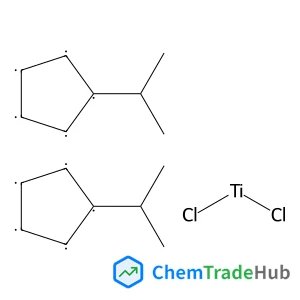
BIS(I-PROPYLCYCLOPENTADIENYL)TITANIUM DICHLORIDE
CAS Number:
12130-65-3
Molecular Formula:
C16H22Cl2Ti
Peng Tang, Liang Wang, Wanyi Xie, Xiaohan Chen, Yunjiao Wang, Ting Weng, Rong Tian, Shuo Zhou, Zuobin Wang
Nanopore sensing is at the forefront of the technological revolution of the protein research field and has been widely used in molecular diagnosis and molecular dynamics, as well as for various sequencing applications. However, direct protein sensing with biological nanopores is still challenging owing to the large molecular size. Here, we propose an aptamer-assisted nanopore strategy for direct protein sensing and demonstrate its proof-of-concept utilities by experiments with SARS-Cov-2 nucleocapsid protein (NP), the most abundantly expressed viral protein, that is widely used in clinical diagnosis for COVID-19. NP binds with an oligonucleotide-tailed aptamer to form a protein–DNA complex which induces a discriminative two-level pattern of current blockades. We reveal the potential molecular interaction mechanism for the characteristic blockades and identify the salt gradient condition as the dominant factor of the phenomenon. Furthermore, we achieve a high sensitivity of 10 pM for NP detection within one hour and make a preliminary exploration on clinical diagnosis. This work promises a new platform for rapid and label-free protein detection.
Mathias Bourg, Martin Urbanski
DOI: 10.1039/C7CP02943H
Ibério de P. R. Moreira, Francesc Illas
DOI: 10.1039/C7CP04145D
Dejan Cibrev, Massimo Tallarida, Chittaranjan Das, Teresa Lana-Villarreal, Dieter Schmeisser, Roberto Gómez
DOI: 10.1039/C7CP03958A
Cuiping Wang, Cong Li, Jiajia Han, Lihui Yan, Bin Deng, Xingjun Liu
DOI: 10.1039/C7CP03775A
Wei Pan, Hao Wen, Dehai Liang
DOI: 10.1039/C7CP04066K
Jun Li, Changjian Xie, Hua Guo
DOI: 10.1039/C7CP04578F
M. Oujja, S. Psilodimitrakopoulos, E. Carrasco, M. Sanz, A. Philippidis, A. Selimis, P. Pouli, G. Filippidis, M. Castillejo
DOI: 10.1039/C7CP02509B
J. M. Carnerero, A. Sánchez-Coronilla, E. I. Martín, A. Jimenez-Ruiz, R. Prado-Gotor
DOI: 10.1039/C7CP03692B
E. Suturina, E. Reijerse, W. Lubitz
DOI: 10.1039/C7CP03680A
I. Palacio, A. L. Pinardi, J. I. Martínez, A. Preobrajenski, A. Cossaro, A. Jancarik, I. Stará, I. Starý, J. Méndez, J. A. Martín-Gago, M. F. López
DOI: 10.1039/C7CP03955G
6-(3-Fluorophenyl)picolinic acid is generally considered safe for laboratory use...
(3R)-3-Pyrrolidinol is used in the pharmaceutical industry as a precursor for dr...
When handling (4R,5R)-4,5-Diethoxycarbonyl-2,2-dimethyldioxolane (CAS: 59779-75-...
1-(6-Chloroimidazo[1,2-b]pyridazin-3-yl)ethanone is often synthesized via a mult...
The market for N-Ethyl-3,4-dimethylbenzylamine (CAS: 39180-83-1) remains steady,...
Tert-butyl 3-(pyrrolidin-1-yl)azetidine-1-carboxylate is a chemical compound wit...
1-Bromo-3-chloro-2,4-dimethoxybenzene (CAS: 1228956-93-1) falls under the classi...
The safety of 8-Bromo-2-methyl-3,4-dihydroisoquinolin-1(2H)-one (CAS: 1368622-07...
Benzyl [(3S)-2,6-dioxo-3-piperidinyl]carbamate is generally safe when handled wi...
1-{[4-(4,4,5,5-Tetramethyl-1,3,2-dioxaborolan-2-yl)phenyl]sulfonyl}pyrrolidine s...
Journal of Materials Chemistry A, B & C cover high quality studies across all fields of materials chemistry. The journals focus on those theoretical or experimental studies that report new understanding, applications, properties and synthesis of materials. The journals have a strong history of publishing quality reports of interest to interdisciplinary communities and providing an efficient and rigorous service through peer review and publication. The journals are led by an international team of Editors-in-Chief and Associate Editors who are all active researchers in their fields. Journal of Materials Chemistry A, B & C are separated by the intended application of the material studied. Broadly, applications in energy and sustainability are of interest to Journal of Materials Chemistry A, applications in biology and medicine are of interest to Journal of Materials Chemistry B, and applications in optical, magnetic and electronic devices are of interest to Journal of Materials Chemistry C. More than one Journal of Materials Chemistry journal may be suitable for certain fields and researchers are encouraged to submit their paper to the journal that they feel best fits for their particular article. Example topic areas within the scope of Journal of Materials Chemistry B are listed below. This list is neither exhaustive nor exclusive. Antifouling coatings Biocompatible materials Bioelectronics Bioimaging Biomimetics Biomineralisation Bionics Biosensors Diagnostics Drug delivery Gene delivery Immunobiology Nanomedicine Regenerative medicine & Tissue engineering Scaffolds Soft robotics Stem cells Therapeutic devices image block All articles published in Journal of Materials Chemistry B from 2019 onwards will be indexed in MEDLINE®. Articles that primarily focus on providing insight into the underlying science and performance of biomaterials within a biological environment are more suited to our companion journal, Biomaterials Science.
![Methyl 2-[5-(3-Phenoxyphenyl)-2H-tetrazol-2-yl]acetate structure](https://static.chemtradehub.com/structs/130/1305320-60-8-84b4.webp "Methyl 2-[5-(3-Phenoxyphenyl)-2H-tetrazol-2-yl]acetate structure")
![3-[(3R,4R)-3-[(6-aminopyrimidin-4-yl)-methyl-amino]-4-methyl-1-piperidyl]-3-oxo-propanenitrile structure](https://static.chemtradehub.com/structs/164/1640971-60-3-83a4.webp "3-[(3R,4R)-3-[(6-aminopyrimidin-4-yl)-methyl-amino]-4-methyl-1-piperidyl]-3-oxo-propanenitrile structure")