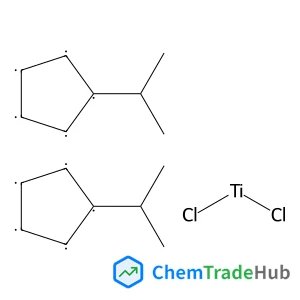
BIS(I-PROPYLCYCLOPENTADIENYL)TITANIUM DICHLORIDE
CAS Number:
12130-65-3
Molecular Formula:
C16H22Cl2Ti
Guotao Wu, Zhitao Xiong, Yuan Ping Feng, Ping Chen
In this study, both experimental ionic conductivity measurements and the first-principles simulations are employed to investigate the Li+ ionic diffusion properties in lithium-based imides (Li2NH, Li2Mg(NH)2 and Li2Ca(NH)2) and lithium amide (LiNH2). The experimental results show that Li+ ions present superionic conductivity in Li2NH (2.54 × 10⁻⁴ S cm−1) and moderate ionic conductivity in Li2Ca(NH)2 (6.40 × 10⁻⁶ S cm−1) at room temperature; while conduction of Li+ ions is hardly detectable in Li2Mg(NH)2 and LiNH2 at room temperature. The simulation results indicate that Li+ ion diffusion in Li2NH may be mediated by Frenkel pair defects or charged vacancies, and the diffusion pathway is more likely via a series of intermediate jumps between octahedral and tetrahedral sites along the [001] direction. The calculated activation energy and pre-exponential factor for Li+ ion conduction in Li2NH are well comparable with the experimentally determined values, showing the consistency of experimental and theoretical investigations. The calculation of the defect formation energy in LiNH2 reveals that Li defects are difficult to create to mediate the Li+ ion diffusion, resulting in the poor Li+ ion conduction in LiNH2 at room temperature.
Jing Chen, Zhixun Luo, Jiannian Yao
DOI: 10.1039/C7CP02538F
Ioannis G. Kevrekidis
DOI: 10.1039/C7CP03260A
H. T. Chin, C. H. Shih, C. C. Ting, J. N. Aoh, M. Hofmann
DOI: 10.1039/C7CP03207B
Daniel L. Z. Caetano, Sidney J. de Carvalho, Ralf Metzler, Andrey G. Cherstvy
DOI: 10.1039/C7CP04040G
Ting Hu, Jian Zhou, Jinming Dong
DOI: 10.1039/C7CP03558F
Pablo de Castro, Peter Sollich
DOI: 10.1039/C7CP04062H
Michael K. M. Ward, David M. Rowley
DOI: 10.1039/C7CP03854B
Nicole L. Ing, Tyler D. Nusca
DOI: 10.1039/C7CP03651E
O. O. Taiwo, D. P. Finegan, J. M. Paz-Garcia, A. J. Bodey, C. Rau, S. A. Hall, D. J. L. Brett, P. R. Shearing
DOI: 10.1039/C7CP02872E
Robert Zaleśny, Marta Chołuj, Justyna Kozłowska, Wojciech Bartkowiak, Josep M. Luis
DOI: 10.1039/C7CP04259K
6-(3-Fluorophenyl)picolinic acid is generally considered safe for laboratory use...
(3R)-3-Pyrrolidinol is used in the pharmaceutical industry as a precursor for dr...
When handling (4R,5R)-4,5-Diethoxycarbonyl-2,2-dimethyldioxolane (CAS: 59779-75-...
1-(6-Chloroimidazo[1,2-b]pyridazin-3-yl)ethanone is often synthesized via a mult...
The market for N-Ethyl-3,4-dimethylbenzylamine (CAS: 39180-83-1) remains steady,...
Tert-butyl 3-(pyrrolidin-1-yl)azetidine-1-carboxylate is a chemical compound wit...
1-Bromo-3-chloro-2,4-dimethoxybenzene (CAS: 1228956-93-1) falls under the classi...
The safety of 8-Bromo-2-methyl-3,4-dihydroisoquinolin-1(2H)-one (CAS: 1368622-07...
Benzyl [(3S)-2,6-dioxo-3-piperidinyl]carbamate is generally safe when handled wi...
1-{[4-(4,4,5,5-Tetramethyl-1,3,2-dioxaborolan-2-yl)phenyl]sulfonyl}pyrrolidine s...

Physical Chemistry Chemical Physics (PCCP) is an international journal co-owned by 19 physical chemistry and physics societies from around the world. This journal publishes original, cutting-edge research in physical chemistry, chemical physics and biophysical chemistry. To be suitable for publication in PCCP, articles must include significant innovation and/or insight into physical chemistry; this is the most important criterion that reviewers and Editors will judge against when evaluating submissions. The journal has a broad scope and welcomes contributions spanning experiment, theory, computation and data science. Topical coverage includes spectroscopy, dynamics, kinetics, statistical mechanics, thermodynamics, electrochemistry, catalysis, surface science, quantum mechanics, quantum computing and machine learning. Interdisciplinary research areas such as polymers and soft matter, materials, nanoscience, energy, surfaces/interfaces, and biophysical chemistry are welcomed if they demonstrate significant innovation and/or insight into physical chemistry. Joined experimental/theoretical studies are particularly appreciated when complementary and based on up-to-date approaches.
![5-Bromo-3-isopropyl-1H-pyrrolo[2,3-b]pyridine structure](https://static.chemtradehub.com/structs/125/1256819-54-1-8620.webp "5-Bromo-3-isopropyl-1H-pyrrolo[2,3-b]pyridine structure")