












Internal energy deposition and ion fragmentation in atmospheric-pressure mid-infrared laser ablation electrospray ionization
Literature Information
Publication Date
2011-12-22
DOI
10.1039/C2CP23411D
Impact Factor
3.676
Authors
Peter Nemes, Hehua Huang, Akos Vertes
View Original
Abstract
Mid-infrared laser ablation of water-rich targets at the maximum of the 2.94 μm absorption band is a two-step process initiated by phase explosion followed by recoil pressure induced material ejection. Particulates and/or droplets ejected by this high temperature high pressure process can be ionized for mass spectrometry by charged droplets from an electrospray. In order to gauge the internal energy introduced in this laser ablation electrospray ionization (LAESI®) process, we apply the survival yield method and compare the results with electrospray ionization (ESI) and matrix-assisted laser desorption ionization (MALDI). The results indicate that LAESI yields ions with internal energies indistinguishable from those produced by ESI. This finding is consistent with the recoil pressure induced ejection of low micrometre droplets that does not significantly change the internal energy of solute molecules.
Related Literature
CuAAC click chemistry: a versatile approach towards PVDF-based block copolymers
I. Terzic, N. L. Meereboer, K. Loos
2018-06-25
Communication
DOI: 10.1039/C8PY00742J
Convenient synthesis of versatile syndiotactic polystyrene materials containing pendant alkenyl groups with a scandium catalyst system
Ke Yang, Hui Niu, Zhenghai Shi, Rui Tan, Tingting Li, Kaihua Shen, Yang Li
2018-06-11
Communication
DOI: 10.1039/C8PY00607E
Self-assembly and multi-stimuli responsive behavior of PAA-b-PAzoMA-b-PNIPAM triblock copolymers
Fei Gao, Yaohui Xing, Yuan Yao, Liuying Sun, Yao Sun, Xiaohua He, Shaoliang Lin
2017-10-31
Paper
DOI: 10.1039/C7PY01591G
The power of the ring: a pH-responsive hydrophobic epoxide monomer for superior micelle stability
Jaeeun Song, L. Palanikumar, Yeongkyu Choi, Inhye Kim, Tae-young Heo, Eungjin Ahn, Soo-Hyung Choi, Eunji Lee, Yuji Shibasaki, Ja-Hyoung Ryu
2017-10-06
Paper
DOI: 10.1039/C7PY01613A
Regioselective living polymerization of allylcyclohexane and precise synthesis of hydrocarbon block copolymers with cyclic units
Jie Gao, Zonghang Ying, Liu Zhong, Heng Liao, Haiyang Gao, Wu Qing
2018-02-07
Paper
DOI: 10.1039/C8PY00047F
Synthesis and characterization of poly(ethene–ketone–arylene–ketone)s containing pendant methylthio groups via metal-free catalyzed copolymerization of aryldiynes with DMSO
Weiqiang Fu, Lichao Dong, Jianbing Shi, Bin Tong, Zhengxu Cai, Junge Zhi, Yuping Dong
2018-07-31
Paper
DOI: 10.1039/C8PY00819A
Renewable polyols for advanced polyurethane foams from diverse biomass resources
Pierre Furtwengler, Luc Avérous
2018-07-24
Review Article
DOI: 10.1039/C8PY00827B
Significantly improved energy density of BaTiO3 nanocomposites by accurate interfacial tailoring using a novel rigid-fluoro-polymer
Sheng Chen, Xuguang Lv, Xianghui Han, Hang Luo, Chris R. Bowen, Dou Zhang
2017-12-08
Paper
DOI: 10.1039/C7PY01914A
You might also like
Compound Q&A
What are the main uses of (3.beta.)-3-Hydroxy-N,N-dimethyl-chol-5-en-24-amide (CAS: 79066-03-8)?
(3.beta.)-3-Hydroxy-N,N-dimethyl-chol-5-en-24-amide (CAS: 79066-03-8) is primari...
79066-03-8(3.beta.)-3-Hydroxy-...
Compound Q&A
What regulatory guidelines apply to 5-(aminomethyl)-2-methoxyphenol (CAS: 89702-89-6)?
5-(Aminomethyl)-2-methoxyphenol (CAS: 89702-89-6) is classified under GHS as a s...
89702-89-65-(aminomethyl)-2-me...
Compound Q&A
What is Thieno[2,3-c]pyridin-7(6H)-one (CAS: 28981-13-7)?
Thieno[2,3-c]pyridin-7(6H)-one (CAS: 28981-13-7) is a heterocyclic organic compo...
28981-13-7Thieno[2,3-c]pyridin...
Compound Q&A
Is 1-[(6-Methoxy-3-pyridinyl)methyl]-4-piperidinamine dihydrochloride (CAS: 1185311-28-7) safe?
1-[(6-Methoxy-3-pyridinyl)methyl]-4-piperidinamine dihydrochloride is generally ...
1185311-28-71-[(6-Methoxy-3-pyri...
Compound Q&A
What regulatory guidelines apply to [(2E)-3-Phenyl-2-propen-1-yl]phosphonic acid (CAS: 146404-58-2)?
[(2E)-3-Phenyl-2-propen-1-yl]phosphonic acid (CAS: 146404-58-2) is regulated und...
146404-58-2[(2E)-3-Phenyl-2-pro...
Compound Q&A
What regulatory guidelines apply to 6-Bromo-7-methoxyquinoline (CAS: 1620515-86-7)?
6-Bromo-7-methoxyquinoline (CAS: 1620515-86-7) falls under the scope of the Glob...
1620515-86-76-Bromo-7-methoxyqui...
Compound Q&A
What industries use (2R)-1-(1-Benzofuran-2-yl)-N-propyl-2-pentanamine (CAS: 260550-89-8)?
This compound is primarily used in the pharmaceutical industry for the developme...
260550-89-8(2R)-1-(1-Benzofuran...
Compound Q&A
What are the main uses of 1-Ethyl-7-[2-methyl-6-(4H-1,2,4-triazol-3-yl)-3-pyridinyl]-3,5-dihydropyrazino[2,3-b]pyrazin-2(1H)-one (CAS: 1228013-15-7)?
1-Ethyl-7-[2-methyl-6-(4H-1,2,4-triazol-3-yl)-3-pyridinyl]-3,5-dihydropyrazino[2...
1228013-15-71-Ethyl-7-[2-methyl-...
Compound Q&A
Are there alternatives to {5-(Acryloylamino)-2-[(dimethylamino)methyl]phenyl}boronic acid (CAS: 1217500-78-1) in synthesis?
Alternative reagents such as 2-[(dimethylamino)methyl]phenylboronic acid or rela...
1217500-78-1{5-(Acryloylamino)-2...
Compound Q&A
What is 3-(Piperidin-4-yloxy)pyridine (CAS: 310881-48-2)?
3-(Piperidin-4-yloxy)pyridine (CAS: 310881-48-2) is an organic compound with the...
310881-48-23-(Piperidin-4-yloxy...
Source Journal
Physical Chemistry Chemical Physics

CiteScore:
5.5
Self-citation Rate:
10.3%
Articles per Year:
3036
Physical Chemistry Chemical Physics (PCCP) is an international journal co-owned by 19 physical chemistry and physics societies from around the world. This journal publishes original, cutting-edge research in physical chemistry, chemical physics and biophysical chemistry. To be suitable for publication in PCCP, articles must include significant innovation and/or insight into physical chemistry; this is the most important criterion that reviewers and Editors will judge against when evaluating submissions. The journal has a broad scope and welcomes contributions spanning experiment, theory, computation and data science. Topical coverage includes spectroscopy, dynamics, kinetics, statistical mechanics, thermodynamics, electrochemistry, catalysis, surface science, quantum mechanics, quantum computing and machine learning. Interdisciplinary research areas such as polymers and soft matter, materials, nanoscience, energy, surfaces/interfaces, and biophysical chemistry are welcomed if they demonstrate significant innovation and/or insight into physical chemistry. Joined experimental/theoretical studies are particularly appreciated when complementary and based on up-to-date approaches.
Recommended Compounds
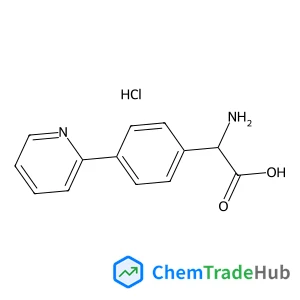
2-Amino-2-(4-(pyridin-2-YL)phenyl)acetic acid hydrochloride
CAS Number:
1135818-89-1
Molecular Formula:
C13H13ClN2O2
![(3E)-3-[4-Hydroxy-3,5-bis(2-methyl-2-propanyl)benzylidene]dihydro-2(3H)-furanone structure](https://static.chemtradehub.com/structs/102/102271-49-8-cba7.webp "(3E)-3-[4-Hydroxy-3,5-bis(2-methyl-2-propanyl)benzylidene]dihydro-2(3H)-furanone structure")
(3E)-3-[4-Hydroxy-3,5-bis(2-methyl-2-propanyl)benzylidene]dihydro-2(3H)-furanone
CAS Number:
102271-49-8
Molecular Formula:
C19H26O3
Recommended Suppliers




Disclaimer
This page provides academic journal information for reference and research purposes only. We are not affiliated with any journal publishers and do not handle publication submissions. For publication-related inquiries, please contact the respective journal publishers directly.
If you notice any inaccuracies in the information displayed, please contact us at support@chemtradehub.com. We will promptly review and address your concerns.