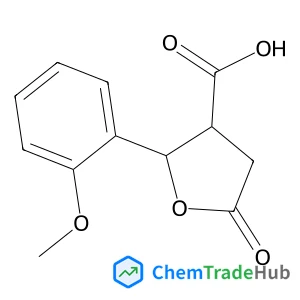
trans-2-(2-Methoxyphenyl)-5-oxotetrahydrofuran-3-carboxylic acid
CAS Number:
99226-02-5
Molecular Formula:
C12H12O5
Luhui Zhang, Enzheng Shi, Zhen Li, Peixu Li, Yi Jia, Chunyan Ji, Jinquan Wei, Kunlin Wang, Hongwei Zhu, Dehai Wu, Anyuan Cao
Previous fiber-shaped solar cells are based on polymeric materials or dye-sensitized wide band-gap oxides. Here, we show that efficient fiber solar cells can be made from semiconducting nanostructures (e.g.CdSe) with smaller band-gap as the light absorption material. We directly grow a vertical array of CdSe nanowires uniformly around a core metal wire and make the device by covering the top of nanowires with a carbon nanotube (CNT) film as the porous transparent electrode. The CdSe–CNT fiber solar cells show power conversion efficiencies of 1–2% under AM 1.5 illumination after the nanowires are infiltrated with redox electrolyte. We do not use a secondary metal wire (e.g.Pt) as in conventional fiber-shaped devices, instead, the end part of the CNT film is condensed into a conductive yarn to serve as the secondary electrode. In addition, our CdSe nanowire-based photoelectrochemical fiber solar cells maintain good flexibility and stable performance upon rotation and bending to large angles.
Jacek Mlynarski, Joanna Jankowska, Bartosz Rakiel
DOI: 10.1039/B509505K
Yasuhiro Shiraishi, Yugo Teshima, Takayuki Hirai
DOI: 10.1039/B508172F
Ella Lai-Ming Wong, Guo-Su Fang, Chi-Ming Che, Nianyong Zhu
DOI: 10.1039/B507687K
Ismael El Drubi Vega, Philip A. Gale, Mark E. Light, Stephen J. Loeb
DOI: 10.1039/B510506D
Sunita Thyagarajan, Kenneth D. Karlin, Steven E. Rokita
DOI: 10.1039/B509690A
Héctor de la Riva, Aranzazu Pintado-Alba, Mark Nieuwenhuyzen, Christopher Hardacre, M. Cristina Lagunas
DOI: 10.1039/B508863A
Emanuel Ionescu, Barbara Gehrhus, Peter B. Hitchcock, Martin Nieger, Rainer Streubel
DOI: 10.1039/B509567K
Joshua R. Dunetz, Rocco P. Ciccolini, Morgan Fröling, Scott M. Paap, Andrew J. Allen, Jefferson W. Tester, Rick L. Danheiser
DOI: 10.1039/B508151C
Marianne Steurer, Karin Tiedl, Yaping Wang, Walter Weissensteiner
DOI: 10.1039/B508761A
Xin-Long Wang, Chao Qin, En-Bo Wang, Zhong-Min Su, Lin Xu, Stuart R. Batten
DOI: 10.1039/B506398A
6-(3-Fluorophenyl)picolinic acid is generally considered safe for laboratory use...
(3R)-3-Pyrrolidinol is used in the pharmaceutical industry as a precursor for dr...
When handling (4R,5R)-4,5-Diethoxycarbonyl-2,2-dimethyldioxolane (CAS: 59779-75-...
1-(6-Chloroimidazo[1,2-b]pyridazin-3-yl)ethanone is often synthesized via a mult...
The market for N-Ethyl-3,4-dimethylbenzylamine (CAS: 39180-83-1) remains steady,...
Tert-butyl 3-(pyrrolidin-1-yl)azetidine-1-carboxylate is a chemical compound wit...
1-Bromo-3-chloro-2,4-dimethoxybenzene (CAS: 1228956-93-1) falls under the classi...
The safety of 8-Bromo-2-methyl-3,4-dihydroisoquinolin-1(2H)-one (CAS: 1368622-07...
Benzyl [(3S)-2,6-dioxo-3-piperidinyl]carbamate is generally safe when handled wi...
1-{[4-(4,4,5,5-Tetramethyl-1,3,2-dioxaborolan-2-yl)phenyl]sulfonyl}pyrrolidine s...

Physical Chemistry Chemical Physics (PCCP) is an international journal co-owned by 19 physical chemistry and physics societies from around the world. This journal publishes original, cutting-edge research in physical chemistry, chemical physics and biophysical chemistry. To be suitable for publication in PCCP, articles must include significant innovation and/or insight into physical chemistry; this is the most important criterion that reviewers and Editors will judge against when evaluating submissions. The journal has a broad scope and welcomes contributions spanning experiment, theory, computation and data science. Topical coverage includes spectroscopy, dynamics, kinetics, statistical mechanics, thermodynamics, electrochemistry, catalysis, surface science, quantum mechanics, quantum computing and machine learning. Interdisciplinary research areas such as polymers and soft matter, materials, nanoscience, energy, surfaces/interfaces, and biophysical chemistry are welcomed if they demonstrate significant innovation and/or insight into physical chemistry. Joined experimental/theoretical studies are particularly appreciated when complementary and based on up-to-date approaches.
![(2E)-4-[(1R,2S,8R,19S,21R)-14-Hydroxy-11-isopropenyl-8,23,23-trimethyl-5-(3-methyl-2-buten-1-yl)-16,20-dioxo-3,7,22-trioxaheptacyclo[17.4.1.1~8,12~.0~2,17~.0~2,21~.0~4,15~.0~6,13~]pentacosa-4(15),5,13
,17-tetraen-21-yl]-2-methyl-2-butenoic acid structure](https://static.chemtradehub.com/structs/173/173867-04-4-d2d3.webp "(2E)-4-[(1R,2S,8R,19S,21R)-14-Hydroxy-11-isopropenyl-8,23,23-trimethyl-5-(3-methyl-2-buten-1-yl)-16,20-dioxo-3,7,22-trioxaheptacyclo[17.4.1.1~8,12~.0~2,17~.0~2,21~.0~4,15~.0~6,13~]pentacosa-4(15),5,13
,17-tetraen-21-yl]-2-methyl-2-butenoic acid structure")