


Aliphatic polycarbonates and poly(ester carbonate)s from fatty acid derived monomers
Literature Information
Publication Date
2011-10-10
DOI
10.1039/C1PY00326G
Impact Factor
5.582
Authors
Benoit Gadenne, Carine Alfos
View Original
Abstract
Fatty acid derivatives were efficiently used as starting materials for the synthesis of polycarbonates and poly(ester carbonate)s. A novel AB-type self-condensable monomer, ethyl(9-hydroxy-10-methoxyoctadecyl)carbonate (EHMOC) and a dicarbonate monomer, 4-[(ethoxycarbonyl)oxy]butyl-12-[(ethoxycarbonyl)oxy]octadec-9-enoate (EOBEOE) were prepared from oleyl alcohol and ricinoleic acid, respectively. Of these, EHMOC was polymerized by the alcohol–carbonate exchange self-polycondensation approach, while EOBEOE was polycondensed with various biobased diols to give polycarbonates and poly(ester carbonate)s, respectively. The monomers and polymers were well characterized by FTIR and 1H-NMR spectroscopy. The 13C-NMR spectroscopy revealed the formation of randomly distributed sequences in the poly(ester carbonate)s due to the carbonate interchange reaction. An unexpected formation of polyricinoleate was observed and confirmed by NMR and MALDI-TOF spectroscopy. Most of the polymers displayed good thermal stability with the temperature at 10% weight loss in the range 273–325 °C. Due to the presence of aliphatic segments, these materials exhibit very low glass transition temperature.
Recommended Journals

Journal of Medical Biochemistry

Angewandte Chemie International Edition

Mini-Reviews in Medicinal Chemistry

Foundations of Chemistry

Current Pharmaceutical Biotechnology

European Journal of Organic Chemistry

Advanced Engineering Materials

CrystEngComm

Environmental Toxicology and Pharmacology

Coloration Technology
Related Literature
Thermal phase behavior and ion hopping in a 1,2,4-triazolium perfluorobutanesulfonate protic organic ionic plastic crystal
Anirban Mondal, Anurag Prakash Sunda, Sundaram Balasubramanian
2015-12-09
Paper
DOI: 10.1039/C5CP05701A
Correction: Quantifying transient interactions between amide groups and the guanidinium cation
V. Balos, M. Bonn, J. Hunger
2015-12-14
Correction
DOI: 10.1039/C5CP90226F
Fmoc–RGDS based fibrils: atomistic details of their hierarchical assembly
David Zanuy, Jordi Poater, Miquel Solà, Ian W. Hamley
2015-11-24
Paper
DOI: 10.1039/C5CP04269K
Exceptional H2 sorption characteristics in a Mg2+-based metal–organic framework with small pores: insights from experimental and theoretical studies
Tony Pham, Katherine A. Forrest, Eduardo H. L. Falcão, Juergen Eckert, Brian Space
2015-12-17
Paper
DOI: 10.1039/C5CP05906B
Growth mechanisms of Pd nanofilms electrodeposited onto Au(111): an in situ grazing incidence X-ray diffraction study
Maurizio De Santis
2015-12-07
Paper
DOI: 10.1039/C5CP05985B
Chemical and photochemical properties of chloroharmine derivatives in aqueous solutions
Federico A. O. Rasse-Suriani, M. Paula Denofrio, Juan G. Yañuk, M. Micaela Gonzalez, Ezequiel Wolcan, Marco Seifermann, Rosa Erra-Balsells, Franco M. Cabrerizo
2015-11-23
Paper
DOI: 10.1039/C5CP05866J
Fabrication of superhydrophilic–underwater superoleophobic inorganic anti-corrosive membranes for high-efficiency oil/water separation
Luyan Liu, Chen Chen, Siyu Yang, Hua Xie, MaoGang Gong, Xiaoliang Xu
2015-11-24
Paper
DOI: 10.1039/C5CP06305A
The effect of iron re-deposition on the corrosion of impurity-containing magnesium
Daniel Höche, Carsten Blawert, Sviatlana V. Lamaka, Nico Scharnagl, Chamini Mendis
2015-11-26
Paper
DOI: 10.1039/C5CP05577F
Synthesis of ceria based superhydrophobic coating on Ni20Cr substrate via cathodic electrodeposition
F. Pedraza, S. A. Mahadik, B. Bouchaud
2015-11-06
Paper
DOI: 10.1039/C5CP04723D
You might also like
Compound Q&A
What is 3-Fluoro-2-methylbenzylamine (CAS: 771573-36-5)?
3-Fluoro-2-methylbenzylamine is an organic compound with the CAS number 771573-3...
771573-36-53-Fluoro-2-methylben...
Compound Q&A
Is Tert-butyl 2-(oxetan-3-ylidene)acetate (CAS: 1207175-03-8) safe?
Tert-butyl 2-(oxetan-3-ylidene)acetate is considered safe for its intended uses ...
1207175-03-8Tert-butyl 2-(oxetan...
Compound Q&A
What precautions should be taken when handling 4-Acetyl-2-fluorobenzonitrile (CAS: 214760-18-6)?
Proper personal protective equipment (PPE) such as gloves, goggles, and a lab co...
214760-18-64-Acetyl-2-fluoroben...
Compound Q&A
How is 2-Ethyl-4-methyl-1,3-thiazole (CAS: 15679-12-6) typically synthesized?
2-Ethyl-4-methyl-1,3-thiazole is commonly synthesized via the reaction of thiour...
15679-12-62-Ethyl-4-methyl-1,3...
Compound Q&A
How should 5',5''-([2,2'-Bithiophene]-5,5'-diyl)bis(([1,1':3',1''-terphenyl]-4,4''-dicarboxylic acid)) (CAS: 1227780-71-3) be stored?
This compound should be stored in a cool, dry place away from direct sunlight an...
1227780-71-35',5''''-([2,2'-Bith...
Compound Q&A
What regulatory guidelines apply to L-Lysine Acetate Salt (CAS: 52315-92-1)?
L-Lysine Acetate Salt (CAS: 52315-92-1) is subject to various regulatory guideli...
52315-92-1L-LYSINE ACETATE SAL...
Compound Q&A
Is 6-Fluoro-3-hydroxy-2-pyrazinecarboxamide (CAS: 259793-96-9) safe?
6-Fluoro-3-hydroxy-2-pyrazinecarboxamide (CAS: 259793-96-9) is generally conside...
259793-96-96-Fluoro-3-hydroxy-2...
Compound Q&A
What are the physical and chemical properties of 1,1'-Sulfonylbis(1H-imidazole) (CAS: 7189-69-7)?
1,1'-Sulfonylbis(1H-imidazole) is a crystalline solid with a molecular weight of...
7189-69-71,1'-Sulfonylbis(1H-...
Compound Q&A
What industries use 4-methyl-7-nitro-1H-indole-3-carbonitrile (CAS: 289483-82-5)?
4-Methyl-7-nitro-1H-indole-3-carbonitrile (CAS: 289483-82-5) is primarily used i...
289483-82-54-methyl-7-nitro-1H-...
Compound Q&A
How should waste containing 5-Bromo-3-indolyl-beta-galactoside (CAS: 97753-82-7) be handled?
Waste containing 5-Bromo-3-indolyl-beta-galactoside (CAS: 97753-82-7) should be ...
97753-82-75-Bromo-3-indolyl-be...
Source Journal
Polymer Chemistry

CiteScore:
8.6
Self-citation Rate:
7.3%
Articles per Year:
457
Polymer Chemistry welcomes submissions in all areas of polymer science that have a strong focus on macromolecular chemistry. Manuscripts may cover a broad range of fields, yet no direct application focus is required.
Recommended Compounds
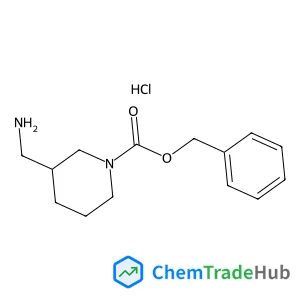
Benzyl 3-(aminomethyl)piperidine-1-carboxylate hydrochloride
CAS Number:
1186663-23-9
Molecular Formula:
C14H21ClN2O2
Recommended Suppliers




Disclaimer
This page provides academic journal information for reference and research purposes only. We are not affiliated with any journal publishers and do not handle publication submissions. For publication-related inquiries, please contact the respective journal publishers directly.
If you notice any inaccuracies in the information displayed, please contact us at support@chemtradehub.com. We will promptly review and address your concerns.