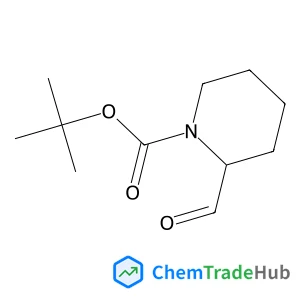
2-Methyl-2-propanyl (2R)-2-formyl-1-piperidinecarboxylate
CAS Number:
134526-69-5
Molecular Formula:
C11H19NO3
A graphical abstract is available for this content

Crystallography Reports

Saudi Pharmaceutical Journal

Chemistry Education Research and Practice

Current Opinion in Solid State & Materials Science

Russian Journal of Organic Chemistry

Russian Journal of Bioorganic Chemistry

Journal of Saudi Chemical Society

Journal of Natural Medicines

Russian Journal of General Chemistry

Drug Discovery Today
Helge Pfeiffer, Hans Binder, Gotthard Klose, Karel Heremans
DOI: 10.1039/B313445H
A. A. Pavlychev, X. O. Brykalova, R. Flesch, E. Rühl
DOI: 10.1039/B517967J
Ayako Ikezawa, Hiroki Tobimatsu, Hiroshi Irie, Kazuhito Hashimoto
DOI: 10.1039/B314692H
Sander F. Wuister, Floris van Driel, Andries Meijerink
DOI: 10.1039/B211953F
H. Fricke, A. Gerlach, M. Gerhards
DOI: 10.1039/B600154H
Cinzia Finazzo, Carlos Calle, Stefan Stoll, Sabine Van Doorslaer, Arthur Schweiger
DOI: 10.1039/B516184C
Yang Shaogui, Quan Xie, Li Xinyong, Liu Yazi, Chen Shuo, Chen Guohua
DOI: 10.1039/B308336E
I. L. Bradeanu, R. Flesch, N. Kosugi, A. A. Pavlychev
DOI: 10.1039/B517199G
6-(3-Fluorophenyl)picolinic acid is generally considered safe for laboratory use...
(3R)-3-Pyrrolidinol is used in the pharmaceutical industry as a precursor for dr...
When handling (4R,5R)-4,5-Diethoxycarbonyl-2,2-dimethyldioxolane (CAS: 59779-75-...
1-(6-Chloroimidazo[1,2-b]pyridazin-3-yl)ethanone is often synthesized via a mult...
The market for N-Ethyl-3,4-dimethylbenzylamine (CAS: 39180-83-1) remains steady,...
Tert-butyl 3-(pyrrolidin-1-yl)azetidine-1-carboxylate is a chemical compound wit...
1-Bromo-3-chloro-2,4-dimethoxybenzene (CAS: 1228956-93-1) falls under the classi...
The safety of 8-Bromo-2-methyl-3,4-dihydroisoquinolin-1(2H)-one (CAS: 1368622-07...
Benzyl [(3S)-2,6-dioxo-3-piperidinyl]carbamate is generally safe when handled wi...
1-{[4-(4,4,5,5-Tetramethyl-1,3,2-dioxaborolan-2-yl)phenyl]sulfonyl}pyrrolidine s...

Physical Chemistry Chemical Physics (PCCP) is an international journal co-owned by 19 physical chemistry and physics societies from around the world. This journal publishes original, cutting-edge research in physical chemistry, chemical physics and biophysical chemistry. To be suitable for publication in PCCP, articles must include significant innovation and/or insight into physical chemistry; this is the most important criterion that reviewers and Editors will judge against when evaluating submissions. The journal has a broad scope and welcomes contributions spanning experiment, theory, computation and data science. Topical coverage includes spectroscopy, dynamics, kinetics, statistical mechanics, thermodynamics, electrochemistry, catalysis, surface science, quantum mechanics, quantum computing and machine learning. Interdisciplinary research areas such as polymers and soft matter, materials, nanoscience, energy, surfaces/interfaces, and biophysical chemistry are welcomed if they demonstrate significant innovation and/or insight into physical chemistry. Joined experimental/theoretical studies are particularly appreciated when complementary and based on up-to-date approaches.