












Versatile synthesis of temperature-sensitive polypeptides by click grafting of oligo(ethylene glycol)
Literature Information
Publication Date
2011-08-22
DOI
10.1039/C1PY00281C
Impact Factor
5.582
Authors
Chaoliang He, Xiuli Zhuang, Xuesi Chen
View Original
Abstract
A series of novel temperature-sensitive polypeptides were synthesized by ring opening polymerization (ROP) of γ-propargyl-L-glutamateN-carboxyanhydride (PLG-NCA) and subsequent click reaction between the pendant alkyne groups and 1-(2-methoxyethoxy)-2-azidoethane (MEO2-N3) or 1-(2-(2-methoxyethoxy)ethoxy)-2-azidoethane (MEO3-N3). The efficient click grafting and structure of the resultant copolymers were verified by 1H NMR, 13C NMR and GPC. All the copolymers hold α-helix conformation, and could self-assemble into amphiphilic nanoparticles in aqueous solution with hydrodynamic radii (Rh) of 32.3–62.8 nm. The graft copolymers exhibited sharp temperature-dependent phase transitions, and the LCST could be adjusted from 22.3 to 74.1 °C by varying the molecular weight, the length of the OEG side chain, the polymer concentration and salt concentration. MTT assays revealed that the graft copolymers exhibited no detectable cytotoxicity at all test concentrations up to 1 mg mL−1. In vitrodegradation tests demonstrated that the graft copolymers could be degraded by proteinase K. The drug release behaviors from the PPLG112-g-MEO2 nanoparticles were evaluated at 37 °C and 15 °C using doxorubicin (DOX) as a model drug. The drug release behavior displayed thermosensitivity, and a sustained release profile was observed at physiological temperature. These results suggested that the novel biodegradable and biocompatible polypeptide derivatives with adjustable temperature sensitivity could be a promising material for biomedical applications.
Recommended Journals
Related Literature
Proton transport mechanism of imidazole, triazole and phosphoric acid mixtures from ab initio molecular dynamics simulations
Swagata Pahari, Sudip Roy
2015-10-22
Paper
DOI: 10.1039/C5CP05735C
How exciton-vibrational coherences control charge separation in the photosystem II reaction center
Vladimir I. Novoderezhkin, Elisabet Romero, Rienk van Grondelle
2015-03-31
Paper
DOI: 10.1039/C5CP00582E
LiNi0.5Mn1.5O4 high-voltage cathode coated with Li4Ti5O12: a hard X-ray photoelectron spectroscopy (HAXPES) study
Malte Sachs, Michael Gellert, Min Chen, Hans-Jörg Drescher, Stefan Renato Kachel, Han Zhou, Malte Zugermeier, Mihaela Gorgoi, Bernhard Roling, J. Michael Gottfried
2015-11-06
Paper
DOI: 10.1039/C5CP03837E
Measurement and modelling of reactive transport in geological barriers for nuclear waste containment
Qingrong Xiong, Claudia Joseph, Katja Schmeide, Andrey P. Jivkov
2015-10-26
Paper
DOI: 10.1039/C5CP05243B
Enhanced field-emission of silver nanoparticle–graphene oxide decorated ZnO nanowire arrays
Guojing Wang, Jiecui Liao, Chienhua Chen, Shasha Lv, Chuanqing Shi
2015-11-02
Paper
DOI: 10.1039/C5CP05036G
The role of copper in the thermal conductivity of thermoelectric oxychalcogenides: do lone pairs matter?
P. Vaqueiro, R. A. R. Al Orabi, G. Guélou, A. V. Powell, R. I. Smith, J.-P. Song, D. Wee, M. Fornari
2015-11-06
Paper
DOI: 10.1039/C5CP06192J
Spectral lineshapes in nonlinear electronic spectroscopy
Artur Nenov, Angelo Giussani, Benjamin P. Fingerhut, Ivan Rivalta, Elise Dumont, Shaul Mukamel
2015-06-02
Paper
DOI: 10.1039/C5CP01167A
Vibrational control of electron-transfer reactions: a feasibility study for the fast coherent transfer regime
P. Antoniou, Z. Ma, P. Zhang
2015-04-02
Paper
DOI: 10.1039/C5CP00610D
Spatial frequency heterodyne imaging of aqueous phase transitions inside multi-walled carbon nanotubes
F. M. Schunk, D. Rand, C. Rose-Petruck
2015-10-26
Paper
DOI: 10.1039/C5CP04508H
Pure and almost pure NIR emission of Tm and Tm,Yb–CeO2 under UV, X-ray and NIR up-conversion excitation: key roles of level selective antenna sensitization and charge-compensation
Daniel Avram, Bogdan Cojocaru, Adriana Urda, Ion Tiseanu, Mihaela Florea, Carmen Tiseanu
2015-09-15
Communication
DOI: 10.1039/C5CP03458B
You might also like
Compound Q&A
What is 3-Fluoro-2-methylbenzylamine (CAS: 771573-36-5)?
3-Fluoro-2-methylbenzylamine is an organic compound with the CAS number 771573-3...
771573-36-53-Fluoro-2-methylben...
Compound Q&A
Is Tert-butyl 2-(oxetan-3-ylidene)acetate (CAS: 1207175-03-8) safe?
Tert-butyl 2-(oxetan-3-ylidene)acetate is considered safe for its intended uses ...
1207175-03-8Tert-butyl 2-(oxetan...
Compound Q&A
What precautions should be taken when handling 4-Acetyl-2-fluorobenzonitrile (CAS: 214760-18-6)?
Proper personal protective equipment (PPE) such as gloves, goggles, and a lab co...
214760-18-64-Acetyl-2-fluoroben...
Compound Q&A
How is 2-Ethyl-4-methyl-1,3-thiazole (CAS: 15679-12-6) typically synthesized?
2-Ethyl-4-methyl-1,3-thiazole is commonly synthesized via the reaction of thiour...
15679-12-62-Ethyl-4-methyl-1,3...
Compound Q&A
How should 5',5''-([2,2'-Bithiophene]-5,5'-diyl)bis(([1,1':3',1''-terphenyl]-4,4''-dicarboxylic acid)) (CAS: 1227780-71-3) be stored?
This compound should be stored in a cool, dry place away from direct sunlight an...
1227780-71-35',5''''-([2,2'-Bith...
Compound Q&A
What regulatory guidelines apply to L-Lysine Acetate Salt (CAS: 52315-92-1)?
L-Lysine Acetate Salt (CAS: 52315-92-1) is subject to various regulatory guideli...
52315-92-1L-LYSINE ACETATE SAL...
Compound Q&A
Is 6-Fluoro-3-hydroxy-2-pyrazinecarboxamide (CAS: 259793-96-9) safe?
6-Fluoro-3-hydroxy-2-pyrazinecarboxamide (CAS: 259793-96-9) is generally conside...
259793-96-96-Fluoro-3-hydroxy-2...
Compound Q&A
What are the physical and chemical properties of 1,1'-Sulfonylbis(1H-imidazole) (CAS: 7189-69-7)?
1,1'-Sulfonylbis(1H-imidazole) is a crystalline solid with a molecular weight of...
7189-69-71,1'-Sulfonylbis(1H-...
Compound Q&A
What industries use 4-methyl-7-nitro-1H-indole-3-carbonitrile (CAS: 289483-82-5)?
4-Methyl-7-nitro-1H-indole-3-carbonitrile (CAS: 289483-82-5) is primarily used i...
289483-82-54-methyl-7-nitro-1H-...
Compound Q&A
How should waste containing 5-Bromo-3-indolyl-beta-galactoside (CAS: 97753-82-7) be handled?
Waste containing 5-Bromo-3-indolyl-beta-galactoside (CAS: 97753-82-7) should be ...
97753-82-75-Bromo-3-indolyl-be...
Source Journal
Polymer Chemistry

CiteScore:
8.6
Self-citation Rate:
7.3%
Articles per Year:
457
Polymer Chemistry welcomes submissions in all areas of polymer science that have a strong focus on macromolecular chemistry. Manuscripts may cover a broad range of fields, yet no direct application focus is required.
Recommended Compounds
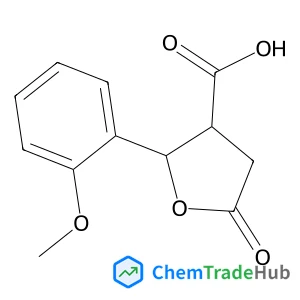
trans-2-(2-Methoxyphenyl)-5-oxotetrahydrofuran-3-carboxylic acid
CAS Number:
99226-02-5
Molecular Formula:
C12H12O5
Recommended Suppliers





Disclaimer
This page provides academic journal information for reference and research purposes only. We are not affiliated with any journal publishers and do not handle publication submissions. For publication-related inquiries, please contact the respective journal publishers directly.
If you notice any inaccuracies in the information displayed, please contact us at support@chemtradehub.com. We will promptly review and address your concerns.