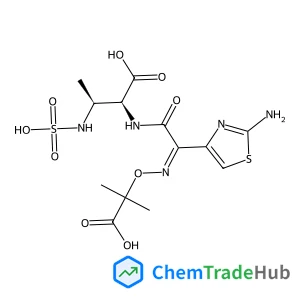
Aztreonam USP Related Compound A (Open-ring Aztreonam)
CAS Number:
87500-74-1
Molecular Formula:
C13H19N5O9S2
Shinichi Itsuno, Md. Masud Parvez, Naoki Haraguchi
Incorporation of a chiral quaternary ammonium salt into a polymer allows for the preparation of a polymeric chiral organocatalyst that can be utilized in various asymmetric transformations in organic synthesis. Chiral quaternary ammonium salts are among the most important and frequently used organocatalysts. There is an increased focus on new strategies for the incorporation of chiral quaternary ammonium salts into polymers. We have found that ionic-bond formation between a quaternary nitrogen and a sulfonate anion can be successfully used to link an organocatalyst to a polymer support. Stable ionic bonds formed by quaternary ammonium sulfonate can also be used in main-chain chiral polymer synthesis. The potential applications of the ionic-bond formation method in the construction of new chiral macromolecular architectures are discussed herein.

Physical Chemistry Chemical Physics

Coloration Technology

Molecules

Foundations of Chemistry

Angewandte Chemie International Edition

Mini-Reviews in Medicinal Chemistry

European Journal of Organic Chemistry

Photochemical & Photobiological Sciences

Journal of Enzyme inhibition and Medicinal Chemistry

Environmental Toxicology and Pharmacology
Andrew D. Ballantyne, Gregory C. H. Forrest, Gero Frisch, Jennifer M. Hartley, Karl S. Ryder
DOI: 10.1039/C5CP05748E
Maurizio De Santis
DOI: 10.1039/C5CP05985B
Vladimir I. Novoderezhkin, Elisabet Romero, Rienk van Grondelle
DOI: 10.1039/C5CP00582E
Arya Shafiefarhood, Joseph Clay Hamill, Luke Michael Neal, Fanxing Li
DOI: 10.1039/C5CP05583K
Dan Xu, Yao-Hong Xue, Yan-Bo Sun
DOI: 10.1039/C5CP05449D
Marc Nadal-Ferret, Ricard Gelabert, Miquel Moreno
DOI: 10.1039/C5CP01067E
Min-Sik Park, Jeonghun Kim, Ki Jae Kim, Jong-Won Lee, Jung Ho Kim
DOI: 10.1039/C5CP05936D
Malte Sachs, Michael Gellert, Min Chen, Hans-Jörg Drescher, Stefan Renato Kachel, Han Zhou, Malte Zugermeier, Mihaela Gorgoi, Bernhard Roling, J. Michael Gottfried
DOI: 10.1039/C5CP03837E
Qingrong Xiong, Claudia Joseph, Katja Schmeide, Andrey P. Jivkov
DOI: 10.1039/C5CP05243B
Ya-Nan Yu, Shi-Yu Lu, Shu-Juan Bao, Qiang-Qiang Sun, Sheng-Hui Liao
DOI: 10.1039/C5CP05790F
3-Fluoro-2-methylbenzylamine is an organic compound with the CAS number 771573-3...
Tert-butyl 2-(oxetan-3-ylidene)acetate is considered safe for its intended uses ...
Proper personal protective equipment (PPE) such as gloves, goggles, and a lab co...
2-Ethyl-4-methyl-1,3-thiazole is commonly synthesized via the reaction of thiour...
This compound should be stored in a cool, dry place away from direct sunlight an...
L-Lysine Acetate Salt (CAS: 52315-92-1) is subject to various regulatory guideli...
6-Fluoro-3-hydroxy-2-pyrazinecarboxamide (CAS: 259793-96-9) is generally conside...
1,1'-Sulfonylbis(1H-imidazole) is a crystalline solid with a molecular weight of...
4-Methyl-7-nitro-1H-indole-3-carbonitrile (CAS: 289483-82-5) is primarily used i...
Waste containing 5-Bromo-3-indolyl-beta-galactoside (CAS: 97753-82-7) should be ...

Polymer Chemistry welcomes submissions in all areas of polymer science that have a strong focus on macromolecular chemistry. Manuscripts may cover a broad range of fields, yet no direct application focus is required.