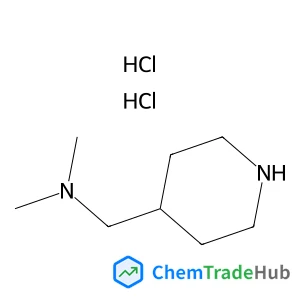
N,N-dimethyl(piperidin-4-yl)methanamine hydrochloride
CAS Number:
172281-72-0
Molecular Formula:
C8H20Cl2N2
A graphical abstract is available for this content
Christopher W. Dilbeck, Barbara J. Finlayson-Pitts
DOI: 10.1039/C3CP51237A
Sergei D. Ivanov, Alexander Witt, Dominik Marx
DOI: 10.1039/C3CP44523B
Hashem Shahroosvand, Fahimeh Nasouti, Ahmad Sousaraei, Ezeddin Mohajerani, Amir Khabbazi
DOI: 10.1039/C3CP51141C
Cheng-Tar Wu, Jin Qu, Joseph Elliott, Kai Man Kerry Yu, Shik Chi Edman Tsang
DOI: 10.1039/C3CP51619A
Ángel Berenguer-Murcia, Ramiro R. Ruiz-Rosas, Jaime García-Aguilar, Khanin Nueangnoraj, Hirotomo Nishihara, Emilia Morallón, Takashi Kyotani, Diego Cazorla-Amorós
DOI: 10.1039/C3CP51945G
Jens Niklas, Kristy L. Mardis, Brian P. Banks, Gregory M. Grooms, Andreas Sperlich, Vladimir Dyakonov, Serge Beaupré, Mario Leclerc, Tao Xu, Luping Yu, Oleg G. Poluektov
DOI: 10.1039/C3CP51477C
M. Hafeez, S. Rehman, U. Manzoor, M. A. Khan, A. S. Bhatti
DOI: 10.1039/C3CP50534K
V. G. Khamaganov, J. N. Crowley
DOI: 10.1039/C3CP50291K
Siv G. Aalbergsjø, Eli O. Hole, Einar Sagstuen
DOI: 10.1039/C3CP50789K
Ethyl 4-chlorothieno[2,3-b]pyridine-5-carboxylate (CAS: 59713-58-5) can be synth...
5-Methyl-1H-indole-3-carbaldehyde (CAS: 52562-50-2) is subject to various regula...
(1,3-Dimethyl-2,4-dioxo-1,2,3,4-tetrahydro-5-pyrimidinyl)boronic acid is a white...
Waste containing Sulfocostunolide A (CAS: 1016983-51-9) should be handled with c...
When handling Murraxocin (CAS: 88478-44-8), ensure proper personal protective eq...
Formvar (CAS: 63148-64-1) is an alkyd resin characterized by a high molecular we...
(S)-4-benzyl-2-((benzyloxy)methyl)morpholine is generally safe when handled with...
Methyl 1-(5-bromo-2-pyrimidinyl)cyclopropanecarboxylate (CAS: 1447607-69-3) is p...
2-Methyl-1-phenyl-1-propanamine hydrochloride (CAS: 24290-47-9) is generally con...
3-(4-Bromophenyl)-2-methylpropanoic acid is synthesized through a multi-step pro...

Physical Chemistry Chemical Physics (PCCP) is an international journal co-owned by 19 physical chemistry and physics societies from around the world. This journal publishes original, cutting-edge research in physical chemistry, chemical physics and biophysical chemistry. To be suitable for publication in PCCP, articles must include significant innovation and/or insight into physical chemistry; this is the most important criterion that reviewers and Editors will judge against when evaluating submissions. The journal has a broad scope and welcomes contributions spanning experiment, theory, computation and data science. Topical coverage includes spectroscopy, dynamics, kinetics, statistical mechanics, thermodynamics, electrochemistry, catalysis, surface science, quantum mechanics, quantum computing and machine learning. Interdisciplinary research areas such as polymers and soft matter, materials, nanoscience, energy, surfaces/interfaces, and biophysical chemistry are welcomed if they demonstrate significant innovation and/or insight into physical chemistry. Joined experimental/theoretical studies are particularly appreciated when complementary and based on up-to-date approaches.