


V-doped SnS2: a new intermediate band material for a better use of the solar spectrum
Literature Information
Publication Date
2011-10-13
DOI
10.1039/C1CP22664A
Impact Factor
3.676
Authors
Perla Wahnón, José C. Conesa, Pablo Palacios, Raquel Lucena, Irene Aguilera, Yohanna Seminovski, Fernando Fresno
View Original
Abstract
Intermediate band materials can boost photovoltaic efficiency through an increase in photocurrent without photovoltage degradation thanks to the use of two sub-bandgap photons to achieve a full electronic transition from the valence band to the conduction band of a semiconductor structure. After having reported in previous works several transition metal-substituted semiconductors as able to achieve the electronic structure needed for this scheme, we propose at present carrying out this substitution in sulfides that have bandgaps of around 2.0 eV and containing octahedrally coordinated cations such as In or Sn. Specifically, the electronic structure of layered SnS2 with Sn partially substituted by vanadium is examined here with first principles quantum methods and seen to give favourable characteristics in this respect. The synthesis of this material in nanocrystalline powder form is then undertaken and achieved using solvothermal chemical methods. The insertion of vanadium in SnS2 is found to produce an absorption spectrum in the UV-Vis-NIR range that displays a new sub-bandgap feature in agreement with the quantum calculations. A photocatalytic reaction-based test verifies that this sub-bandgap absorption produces highly mobile electrons and holes in the material that may be used for the solar energy conversion, giving experimental support to the quantum calculations predictions.
Recommended Journals

Electroanalysis

NDT & E International

Journal of Asian Natural Products Research

Biocatalysis and Biotransformation

Atomization and Sprays

Critical Reviews in Solid State and Materials Sciences

Topics in Catalysis

Bioorganic & Medicinal Chemistry

Herald of the Russian Academy of Sciences

Medicinal Chemistry Research
Related Literature
Copper-catalyzed trifluoromethylthiolation-peroxidation of alkenes and allenes
Yuanjin Chen, Yangyang Ma, Liangkui Li, Mingshuo Cui, Zhiping Li
2020-06-02
Research Article
DOI: 10.1039/D0QO00533A
Asymmetric organocatalytic double 1,6-addition: rapid access to chiral chromans with molecular complexity
Sourav Roy, Suman Pradhan, Krishan Kumar, Indranil Chatterjee
2020-04-28
Research Article
DOI: 10.1039/D0QO00354A
Reversibly photoswitchable alkoxy azobenzenes connected benzenetricarboxamide discotic liquid crystals with perpetual long range columnar assembly
Sudha Devi, Indu Bala, Santosh Prasad Gupta, Pravesh Kumar, Santanu Kumar Pal, Sugumar Venkataramani
2018-10-08
Paper
DOI: 10.1039/C8OB01579A
Direct (het)arylation of tetrahydroisoquinolines via a metal and oxidant free C(sp3)–H functionalization enabled three component reaction
Surajit Haldar, Chandan K. Jana
2018-11-26
Communication
DOI: 10.1039/C8OB02309C
Design, synthesis and glycosidase inhibition studies of novel triazole fused iminocyclitol-δ-lactams
Venkatesan Santhanam, Pradeep Pant, B. Jayaram, Namakkal G. Ramesh
2019-01-03
Paper
DOI: 10.1039/C8OB03084G
Synthesis of polysubstituted 5-trifluoromethyl isoxazoles via denitrogenative cyclization of vinyl azides with trifluoroacetic anhydride
Wei Wu, Qiaoling Chen, Yishi Tian, Yihui Xu, Yangjie Huang, Yi You, Zhiqiang Weng
2020-06-08
Research Article
DOI: 10.1039/D0QO00243G
Access to SCN-containing thiazolines via electrochemical regioselective thiocyanothiocyclization of N-allylthioamides
Yan-An Zhang, Zhong Ding, Peng Liu, Wei-Si Guo, Li-Rong Wen, Ming Li
2020-04-09
Research Article
DOI: 10.1039/D0QO00300J
Iridium-catalyzed arylation of sulfoxonium ylides and arylboronic acids: a straightforward preparation of α-aryl ketones
Zi-Xuan Shen, Tong Che, Mei Zhong, Jia-Lin Song, Hua-Jie Kang, Hui Xie
2020-05-27
Research Article
DOI: 10.1039/D0QO00543F
You might also like
Compound Q&A
What industries use (1R,3S)-1,3-Cyclopentanediol (CAS: 16326-97-9)?
(1R,3S)-1,3-Cyclopentanediol finds applications in various industries. In the ph...
16326-97-9(1R,3S)-1,3-Cyclopen...
Compound Q&A
What precautions should be taken when handling N'-[4-(Dimethylamino)phenyl]-N,N-dimethyl-1,4-benzenediamine (CAS: 637-31-0)?
When handling N'-[4-(Dimethylamino)phenyl]-N,N-dimethyl-1,4-benzenediamine, it i...
637-31-0N'-[4-(Dimethylamino...
Compound Q&A
Are there alternatives to 5-(2,4-Difluorophenyl)-2-methoxypyrimidine (CAS: 1352318-16-1) in synthesis?
There are several alternatives to 5-(2,4-Difluorophenyl)-2-methoxypyrimidine in ...
1352318-16-15-(2,4-Difluoropheny...
Compound Q&A
What regulatory guidelines apply to 1-(3-Methoxyphenoxy)propan-2-ol (CAS: 382141-68-6)?
1-(3-Methoxyphenoxy)propan-2-ol (CAS: 382141-68-6) must comply with the Globally...
382141-68-61-(3-Methoxyphenoxy)...
Compound Q&A
Is Tetrodotoxin Citrate (CAS: 18660-81-6) safe?
Tetrodotoxin Citrate is extremely dangerous and should be handled with extreme c...
18660-81-6Tetrodotoxin Citrate
Compound Q&A
What are the main uses of 2-Methyl-2-propanyl [(1R,3S)-3-hydroxycyclopentyl]carbamate (CAS: 225641-84-9)?
2-Methyl-2-propanyl [(1R,3S)-3-hydroxycyclopentyl]carbamate (CAS: 225641-84-9) i...
225641-84-92-Methyl-2-propanyl ...
Compound Q&A
How should waste containing 4-(2-Hydroxyhexafluoroisopropyl)Benzoic Acid (CAS: 16261-80-6) be handled?
Waste containing 4-(2-Hydroxyhexafluoroisopropyl)Benzoic Acid (CAS: 16261-80-6) ...
16261-80-64-(2-Hydroxyhexafluo...
Compound Q&A
How is 2-Methyl-2-proanyl {(2S)-1-[(benzyloxy)amino]-3-hydroxy-3-methyl-1-oxo-2-butanyl}carbamate (CAS: 102507-19-7) typically synthesized?
2-Methyl-2-proanyl {(2S)-1-[(benzyloxy)amino]-3-hydroxy-3-methyl-1-oxo-2-butanyl...
102507-19-72-Methyl-2-propanyl ...
Compound Q&A
What is Benzeneethanamine, α-ethyl-, hydrochloride (1:1) (CAS: 20735-15-3)?
Benzeneethanamine, α-ethyl-, hydrochloride (1:1) is an organic compound with the...
20735-15-3Benzeneethanamine, α...
Compound Q&A
Are there alternatives to 3-{(E)-[4-(Dimethylamino)phenyl]diazenyl}benzoic acid (CAS: 20691-84-3) in synthesis?
In the synthesis of compounds similar to 3-{(E)-[4-(Dimethylamino)phenyl]diazeny...
20691-84-33-{(E)-[4-(Dimethyla...
Source Journal
Physical Chemistry Chemical Physics

CiteScore:
5.5
Self-citation Rate:
10.3%
Articles per Year:
3036
Physical Chemistry Chemical Physics (PCCP) is an international journal co-owned by 19 physical chemistry and physics societies from around the world. This journal publishes original, cutting-edge research in physical chemistry, chemical physics and biophysical chemistry. To be suitable for publication in PCCP, articles must include significant innovation and/or insight into physical chemistry; this is the most important criterion that reviewers and Editors will judge against when evaluating submissions. The journal has a broad scope and welcomes contributions spanning experiment, theory, computation and data science. Topical coverage includes spectroscopy, dynamics, kinetics, statistical mechanics, thermodynamics, electrochemistry, catalysis, surface science, quantum mechanics, quantum computing and machine learning. Interdisciplinary research areas such as polymers and soft matter, materials, nanoscience, energy, surfaces/interfaces, and biophysical chemistry are welcomed if they demonstrate significant innovation and/or insight into physical chemistry. Joined experimental/theoretical studies are particularly appreciated when complementary and based on up-to-date approaches.
Recommended Compounds
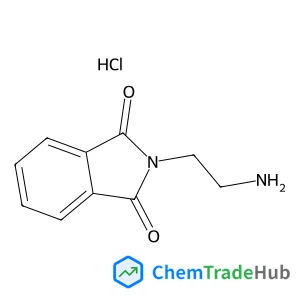
2-(2-Aminoethyl)-1H-isoindole-1,3(2H)-dione hydrochloride (1:1)
CAS Number:
30250-67-0
Molecular Formula:
C10H11ClN2O2
Recommended Suppliers






Disclaimer
This page provides academic journal information for reference and research purposes only. We are not affiliated with any journal publishers and do not handle publication submissions. For publication-related inquiries, please contact the respective journal publishers directly.
If you notice any inaccuracies in the information displayed, please contact us at support@chemtradehub.com. We will promptly review and address your concerns.