












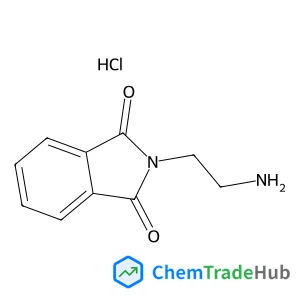
2-(2-Aminoethyl)-1H-isoindole-1,3(2H)-dione hydrochloride (1:1)
CAS Number:
30250-67-0
Molecular Formula:
C10H11ClN2O2
Surajit Haldar, Chandan K. Jana
An unprecedented method for the direct arylation and heteroarylation of tetrahydroisoquinolines under metal and oxidant free conditions is reported. The arylation reactions occurred via a C(sp3)–H functionalization enabled three component condensation of tetrahydroisoquinolines, 9-fluorenone imine, and arenes without involving a pre-functionalization/pre-derivatization step. A wide range of arenes and heteroarenes participated in the reaction to provide structurally diverse arylated tetrahydroisoquinolines with good to excellent yields.
Cyril Poriel, Yann Ferrand, Paul le Maux, Joëlle Raul-Berthelot, Gerard Simonneaux
DOI: 10.1039/B301717F
Hai-Feng Ji, Yu Feng, Xiaohe Xu, Vemana Purushotham, Thomas Thundat, Gilbert M. Brown
DOI: 10.1039/B408997A
Ping Yin, Song Gao, Li-Min Zheng, Zheming Wang, Xin-Quan Xin
DOI: 10.1039/B212674E
Stefan Schieffer, John Pescatore, Richard Ulsh, Robert S. H. Liu
DOI: 10.1039/B411306N
Tae-Jin Park, Yuanbing Mao
DOI: 10.1039/B409988E
Donald H. McCullough, III, Steven L. Regen
DOI: 10.1039/B410027C
Barbara Binotti, Carla Carfagna, Cristiano Zuccaccia, Alceo Macchioni
DOI: 10.1039/B411214H
Nobuhito Imanaka, Yasuhiro Kato
DOI: 10.1039/B300691C
Jianzhong Yang, Andrew R. Barron
DOI: 10.1039/B411118D
Xian-Zheng Zhang, Chih-Chang Chu
DOI: 10.1039/B301423A
(1R,3S)-1,3-Cyclopentanediol finds applications in various industries. In the ph...
When handling N'-[4-(Dimethylamino)phenyl]-N,N-dimethyl-1,4-benzenediamine, it i...
There are several alternatives to 5-(2,4-Difluorophenyl)-2-methoxypyrimidine in ...
1-(3-Methoxyphenoxy)propan-2-ol (CAS: 382141-68-6) must comply with the Globally...
Tetrodotoxin Citrate is extremely dangerous and should be handled with extreme c...
2-Methyl-2-propanyl [(1R,3S)-3-hydroxycyclopentyl]carbamate (CAS: 225641-84-9) i...
Waste containing 4-(2-Hydroxyhexafluoroisopropyl)Benzoic Acid (CAS: 16261-80-6) ...
2-Methyl-2-proanyl {(2S)-1-[(benzyloxy)amino]-3-hydroxy-3-methyl-1-oxo-2-butanyl...
Benzeneethanamine, α-ethyl-, hydrochloride (1:1) is an organic compound with the...
In the synthesis of compounds similar to 3-{(E)-[4-(Dimethylamino)phenyl]diazeny...

Organic & Biomolecular Chemistry (OBC) publishes original and high impact research and reviews in organic chemistry. We welcome research that shows new or significantly improved protocols or methodologies in total synthesis, synthetic methodology or physical and theoretical organic chemistry as well as research that shows a significant advance in the organic chemistry or molecular design aspects of chemical biology, catalysis, supramolecular and macromolecular chemistry, theoretical chemistry, mechanism-oriented physical organic chemistry, medicinal chemistry or natural products. Articles published in the journal should report new work which makes a highly-significant impact in the field. Routine and incremental work is generally not suitable for publication in the journal. More details about key areas of our scope are below. In all cases authors should include in their article clear rationale for why their research has been carried out.
![N,N'-1,2-Ethanediylbis[2-(vinylsulfonyl)acetamide] structure](https://static.chemtradehub.com/structs/667/66710-66-5-b556.webp "N,N'-1,2-Ethanediylbis[2-(vinylsulfonyl)acetamide] structure")
![Ethyl 3-((6-(4,5-dihydro-1H-benzo[d]azepin-3(2H)-yl)-2-(pyridin-2-yl)pyrimidin-4-yl)amino)propanoate structure](https://static.chemtradehub.com/structs/137/1373423-53-0-496a.webp "Ethyl 3-((6-(4,5-dihydro-1H-benzo[d]azepin-3(2H)-yl)-2-(pyridin-2-yl)pyrimidin-4-yl)amino)propanoate structure")




