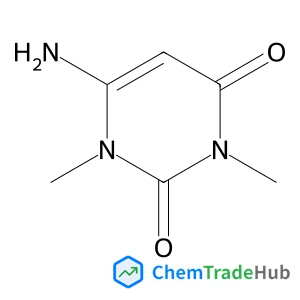
6-amino-1,3-dimethyl-1,2,3,4-tetrahydropyrimidine-2,4-dione
CAS Number:
6642-31-5
Molecular Formula:
C6H9N3O2
Harald Plank, Evelin Fisslthaler, Boril Chernev, Armin Zankel, Elena Tchernychova, Alexander Blümel, Emil J. W. List, Werner Grogger, Peter Pölt
Irradiation damage, caused by the use of beams in the electron microscopes, leads to undesired physical/chemical material property changes or uncontrollable modification of structures that are being processed. Particularly, soft matter such as polymers or biological materials is highly susceptible and very much prone to react on irradiation by electron and ion beams. The effect is even higher when materials are subjected to energetic species such as ions that possess high momentum and relatively low mean path due to their mass. Especially when Ga+ ions (used as the ion source in Focused Ion Beam (FIB) instruments) are considered, the end-effect might even be the total loss of the material’s properties. This paper will discuss the possible types of degradation mechanisms and defect formations that can take place during ion and electron beam irradiation of the conjugated polymers: e.g. polyfluorene (PF) and poly-3-hexylthiophene (P3HT) thin films. For the investigation of the irradiation induced degradation mechanisms in this study, complementary analytical techniques such as Raman Spectroscopy (RS), Infrared Spectroscopy (IR), Electron Energy Loss Spectroscopy (EELS), Atomic Force Microscopy (AFM), and Fluorescence Microscopy including Photoluminescence (PL) and Electroluminescence (EL) Microscopy were applied.

Journal of Peptide Science

Chemical Communications

Acta Materialia

Saudi Pharmaceutical Journal

Current Opinion in Colloid & Interface Science

Chemistry Education Research and Practice

Russian Journal of Organic Chemistry

Crystallography Reports

Russian Journal of Applied Chemistry

Organic Process Research & Development
Maitraye Sen, Alonso J. Arguelles, Stephen D. Stamatis, Salvador García-Muñoz, Stanley Kolis
DOI: 10.1039/D1RE00222H
DOI: 10.1039/D1RE90017J
Tomohiro Ichitsuka, Tatsuya Fujii, Marina Kobune, Takashi Makino, Shin-ichiro Kawasaki
DOI: 10.1039/D1RE00378J
Francesca Greco, Inam Arif, Ruth Botting, Cristina Fante, Luigi Quintieri, Chiara Clementi, Oddone Schiavon, Gianfranco Pasut
DOI: 10.1039/C2PY20876H
Hari P. Paudel, Wei Shi, David Hopkinson, Janice A. Steckel, Yuhua Duan
DOI: 10.1039/D0RE00416B
Anne-Laure Wirotius, Katell Bathany, Emmanuel Ibarboure, Olivia Condassamy, Sébastien Lecommandoux
DOI: 10.1039/C2PY21044D
Yanhong Xu, Shihui Wen, Jingyi Zhu, Linfeng Zheng, Mingwu Shen, Jinglong Zhao, Guixiang Zhang
DOI: 10.1039/C2PY20993D
Torsten Klement, Schirin Hanf, Fabian Wolff, Norbert Kockmann, Stephan A. Schunk, Thorsten Röder
DOI: 10.1039/D0RE00466A
Ye-Jin Hwang, Nishit M. Murari, Samson A. Jenekhe
DOI: 10.1039/C3PY00325F
Neha Yedala, Niket S. Kaisare
DOI: 10.1039/D1RE00382H
4-Nitrophenyl phosphate disodium salt hexahydrate is primarily used as a substra...
2-(Trifluoromethyl)-1,3-oxazole-4-carboxylic Acid (CAS: 1060816-01-4) is widely ...
2-Fluoro-4-biphenylcarboxylic acid should be stored in a cool, dry place at room...
Prednisolone-21-Carboxylic Acid is primarily used in the pharmaceutical industry...
4-(Hydrazinomethyl)-1,2,3-benzenetriol (CAS: 3614-72-0) should be stored in a co...
4-Amino-1-methyl-1H-pyrazole-5-carboxylic acid hydrochloride (CAS: 92534-70-8) i...
Dehydropachymic acid (CAS: 77012-31-8) is regulated by various agencies. It fall...
The market and research trends for 6-[(2,2-Dimethylpropanoyl)amino]nicotinic aci...
1,10-Phenanthroline-2,9-dicarbaldehyde should be stored in a cool, dry place awa...
5-Carbamoyl-11-oxo-10,11-dihydro-5H-dibenzo[b,f]azepin-10-yl acetate can be synt...

Physical Chemistry Chemical Physics (PCCP) is an international journal co-owned by 19 physical chemistry and physics societies from around the world. This journal publishes original, cutting-edge research in physical chemistry, chemical physics and biophysical chemistry. To be suitable for publication in PCCP, articles must include significant innovation and/or insight into physical chemistry; this is the most important criterion that reviewers and Editors will judge against when evaluating submissions. The journal has a broad scope and welcomes contributions spanning experiment, theory, computation and data science. Topical coverage includes spectroscopy, dynamics, kinetics, statistical mechanics, thermodynamics, electrochemistry, catalysis, surface science, quantum mechanics, quantum computing and machine learning. Interdisciplinary research areas such as polymers and soft matter, materials, nanoscience, energy, surfaces/interfaces, and biophysical chemistry are welcomed if they demonstrate significant innovation and/or insight into physical chemistry. Joined experimental/theoretical studies are particularly appreciated when complementary and based on up-to-date approaches.