












New n-type polymer semiconductors based on naphthalene diimide and selenophene derivatives for organic field-effect transistors
Literature Information
Publication Date
2013-04-11
DOI
10.1039/C3PY00325F
Impact Factor
5.582
Authors
Ye-Jin Hwang, Nishit M. Murari, Samson A. Jenekhe
View Original
Abstract
n-Type conjugated polymers based on naphthalene diimide (NDI) and various selenophene derivatives have been synthesized, characterized and evaluated as semiconductors for n-channel organic field-effect transistors (OFETs). The new poly(naphthalene diimides) (PNDIs) have weight average molecular weights of 12–107 kDa with a polydispersity of 1.1–2.6. These PNDIs combined a constant electron affinity of 3.9 eV with an optical band gap that varies from 1.7 eV in PNDISS to 1.4 eV in ePNDIBS due to intramolecular charge transfer. X-ray diffraction analysis of films of the polymers revealed a lamellar crystalline structure in which the lamellar interchain distance varied from 2.45 nm in PNDISS to 2.75 nm in PNDIBDS while the π-stacking distance varied from 0.397 nm in PNDIBDS to 0.443 nm in PNDISS. Average field-effect electron mobility of 0.008 to 0.24 cm2 V−1 s−1 with high on/off current ratio (104 to 106) was observed from the bottom gate/top contact n-channel OFETs. A 3.4-fold enhancement in electron mobility was observed in phenyl end-capped and high molecular weight ePNDIBS whereas such end-capping had no effect on the electron mobility in PNDISS and PNDIBDS.
Related Literature
Solvent polarity effect on intramolecular electron transfer in a corrole–naphthalene bisimide dyad
Lucia Flamigni, Dagmara Wyrostek, Roman Voloshchuk, Daniel T. Gryko
2009-11-12
Paper
DOI: 10.1039/B916525H
Solving the spectroscopic phase: imaging excited wave packets and extracting excited state potentials from fluorescence data
Xuan Li, Cian Menzel-Jones, David Avisar
2010-11-10
Paper
DOI: 10.1039/C0CP01417F
Folding oligomers of difluorinated thienylfurans: a DFT study
2009-11-17
Paper
DOI: 10.1039/B916415D
Empirically corrected DFT and semi-empirical methods for non-bonding interactions
Michael E. Foster, Karl Sohlberg
2009-11-07
Perspective
DOI: 10.1039/B912859J
A suggested periodic table up to Z ≤ 172, based on Dirac–Fock calculations on atoms and ions
Pekka Pyykkö
2010-10-22
Paper
DOI: 10.1039/C0CP01575J
Chemically reactive species remain alive inside carbon nanotubes: a density functional theory study
Takashi Yumura
2010-10-29
Paper
DOI: 10.1039/C0CP00796J
Impedance spectroscopy of H and OH adsorption on stepped single-crystal platinumelectrodes in alkaline and acidic media
K. J. P. Schouten, M. J. T. C. van der Niet, M. T. M. Koper
2010-07-07
Paper
DOI: 10.1039/C0CP00104J
Using one-step perturbation to predict the folding equilibrium of differently stereochemically substituted β-peptides
Wilfred F. van Gunsteren
2010-10-29
Paper
DOI: 10.1039/C0CP00833H
You might also like
Compound Q&A
What are the main uses of 4-Nitrophenyl phosphate disodium salt hexahydrate (CAS: 333338-18-4)?
4-Nitrophenyl phosphate disodium salt hexahydrate is primarily used as a substra...
333338-18-44-Nitrophenyl phosph...
Compound Q&A
What are the main uses of 2-(Trifluoromethyl)-1,3-oxazole-4-carboxylic Acid (CAS: 1060816-01-4)?
2-(Trifluoromethyl)-1,3-oxazole-4-carboxylic Acid (CAS: 1060816-01-4) is widely ...
1060816-01-42-(Trifluoromethyl)-...
Compound Q&A
How should 2-Fluoro-4-biphenylcarboxylic acid (CAS: 137045-30-8) be stored?
2-Fluoro-4-biphenylcarboxylic acid should be stored in a cool, dry place at room...
137045-30-82-Fluoro-4-biphenylc...
Compound Q&A
What industries use Prednisolone-21-Carboxylic Acid (CAS: 61549-70-0)?
Prednisolone-21-Carboxylic Acid is primarily used in the pharmaceutical industry...
61549-70-0Prednisolone-21-Carb...
Compound Q&A
How should 4-(Hydrazinomethyl)-1,2,3-benzenetriol (CAS: 3614-72-0) be stored?
4-(Hydrazinomethyl)-1,2,3-benzenetriol (CAS: 3614-72-0) should be stored in a co...
3614-72-04-(Hydrazinomethyl)-...
Compound Q&A
What industries use 4-Amino-1-methyl-1H-pyrazole-5-carboxylic acid hydrochloride (CAS: 92534-70-8)?
4-Amino-1-methyl-1H-pyrazole-5-carboxylic acid hydrochloride (CAS: 92534-70-8) i...
92534-70-84-Amino-1-methyl-1H-...
Compound Q&A
What regulatory guidelines apply to dehydropachymic acid (CAS: 77012-31-8)?
Dehydropachymic acid (CAS: 77012-31-8) is regulated by various agencies. It fall...
77012-31-8Dehydropachymic acid
Compound Q&A
What is the market or research trend for 6-[(2,2-Dimethylpropanoyl)amino]nicotinic acid (CAS: 898561-66-5)?
The market and research trends for 6-[(2,2-Dimethylpropanoyl)amino]nicotinic aci...
898561-66-56-[(2,2-Dimethylprop...
Compound Q&A
How should 1,10-Phenanthroline-2,9-dicarbaldehyde (CAS: 57709-62-3) be stored?
1,10-Phenanthroline-2,9-dicarbaldehyde should be stored in a cool, dry place awa...
57709-62-31,10-Phenanthroline-...
Compound Q&A
How is 5-Carbamoyl-11-oxo-10,11-dihydro-5H-dibenzo[b,f]azepin-10-yl acetate (CAS: 113952-21-9) typically synthesized?
5-Carbamoyl-11-oxo-10,11-dihydro-5H-dibenzo[b,f]azepin-10-yl acetate can be synt...
113952-21-95-Carbamoyl-11-oxo-1...
Source Journal
Polymer Chemistry

CiteScore:
8.6
Self-citation Rate:
7.3%
Articles per Year:
457
Polymer Chemistry welcomes submissions in all areas of polymer science that have a strong focus on macromolecular chemistry. Manuscripts may cover a broad range of fields, yet no direct application focus is required.
Recommended Compounds

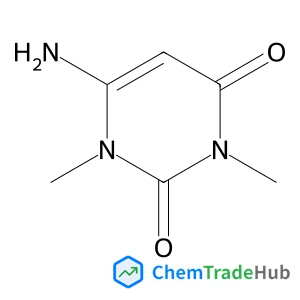
6-amino-1,3-dimethyl-1,2,3,4-tetrahydropyrimidine-2,4-dione
CAS Number:
6642-31-5
Molecular Formula:
C6H9N3O2
![1,1',1'',1'''-[Disulfanediylbis(carbonothioylnitrilo)]tetraethane structure](https://static.chemtradehub.com/structs/97-/97-77-8-f3e4.webp "1,1',1'',1'''-[Disulfanediylbis(carbonothioylnitrilo)]tetraethane structure")
1,1',1'',1'''-[Disulfanediylbis(carbonothioylnitrilo)]tetraethane
CAS Number:
97-77-8
Molecular Formula:
C10H20N2S4
Recommended Suppliers






Disclaimer
This page provides academic journal information for reference and research purposes only. We are not affiliated with any journal publishers and do not handle publication submissions. For publication-related inquiries, please contact the respective journal publishers directly.
If you notice any inaccuracies in the information displayed, please contact us at support@chemtradehub.com. We will promptly review and address your concerns.