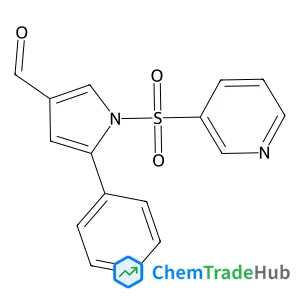
5-Phenyl-1-(pyridin-3-ylsulfonyl)-1H-pyrrole-3-carbaldehyde
CAS Number:
881676-90-0
Molecular Formula:
C16H12N2O3S
A graphical abstract is available for this content
Gokhan Sagdic, Ozgun Daglar, Ufuk Saim Gunay, Emrah Cakmakci, Gurkan Hizal, Umit Tunca, Hakan Durmaz
DOI: 10.1039/D1PY00726B
Junle Zhang, Mengya Li, Yanjie He, Xiaomeng Zhang, Zhe Cui, Peng Fu, Minying Liu, Xiaoguang Qiao, Qingxiang Zhao, Xinchang Pang
DOI: 10.1039/D1PY00088H
Jianjun Li, Jiaqi Chen, Jiang Wu, Handan Lei, Yuting Tian
DOI: 10.1039/D1PY00493J
Xabier Lopez de Pariza, Nicolas Zivic, Fernando Ruipérez, Timothy E. Long, Haritz Sardon
DOI: 10.1039/D1PY00734C
Peter Černoch, Alessandro Jager, Zulfiya Černochová, Vladimir Sincari, Lindomar J. C. Albuquerque, Rafal Konefal, Ewa Pavlova, Fernando C. Giacomelli, Eliezer Jager
DOI: 10.1039/D1PY00141H
Yunkai Dai, Zhitao Hu, Xiaoying Wang, Xingliang Liu, Yuanchao Li, Yi Shi, Yongming Chen
DOI: 10.1039/D1PY00106J
Ayano Ishida, Shunichi Fujii, Akifumi Sumida, Tasuku Kamitani, Saori Minami, Kenji Urayama, Hiroaki Imoto
DOI: 10.1039/D1PY00346A
Vincent Bouad, Marc Guerre, Sami Zeliouche, Bruno Améduri, Cédric Totée, Gilles Silly, Rinaldo Poli, Vincent Ladmiral
DOI: 10.1039/D0PY01753A
(1R,3S)-1,3-Cyclopentanediol finds applications in various industries. In the ph...
When handling N'-[4-(Dimethylamino)phenyl]-N,N-dimethyl-1,4-benzenediamine, it i...
There are several alternatives to 5-(2,4-Difluorophenyl)-2-methoxypyrimidine in ...
1-(3-Methoxyphenoxy)propan-2-ol (CAS: 382141-68-6) must comply with the Globally...
Tetrodotoxin Citrate is extremely dangerous and should be handled with extreme c...
2-Methyl-2-propanyl [(1R,3S)-3-hydroxycyclopentyl]carbamate (CAS: 225641-84-9) i...
Waste containing 4-(2-Hydroxyhexafluoroisopropyl)Benzoic Acid (CAS: 16261-80-6) ...
2-Methyl-2-proanyl {(2S)-1-[(benzyloxy)amino]-3-hydroxy-3-methyl-1-oxo-2-butanyl...
Benzeneethanamine, α-ethyl-, hydrochloride (1:1) is an organic compound with the...
In the synthesis of compounds similar to 3-{(E)-[4-(Dimethylamino)phenyl]diazeny...
Analytical Methods welcomes early applications of new analytical and bioanalytical methods and technology demonstrating the potential for societal impact. We require that methods and technology reported in the journal are sufficiently innovative, robust, accurate, and compared to other available methods for the intended application. Developments with interdisciplinary approaches are particularly welcome. Systems should be proven with suitably complex and analytically challenging samples. We encourage developments within, but not limited to, the following technologies and applications: global health, point-of-care and molecular diagnostics biosensors and bioengineering drug development and pharmaceutical analysis applied microfluidics and nanotechnology omics studies, such as proteomics, metabolomics or glycomics environmental, agricultural and food science neuroscience biochemical and clinical analysis forensic analysis industrial process and method development