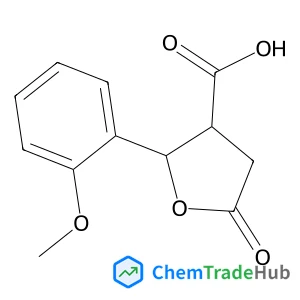
trans-2-(2-Methoxyphenyl)-5-oxotetrahydrofuran-3-carboxylic acid
CAS Number:
99226-02-5
Molecular Formula:
C12H12O5
F. J. Aoiz, M. Brouard, S. D. S. Gordon, B. Nichols, V. Walpole
The concept of the steric effect in molecular collisions is central to chemistry. In this Perspective article we review some of the progress made in studying the steric effect in inelastic and reactive collisions involving relatively small isolated atomic and molecular species. We overview the theoretical framework used to quantify the steric effect, and outline some of the key experimental approaches that can be employed to study the dynamics and mechanism of collisions involving oriented and aligned molecules. We illustrate the discussion by highlighting a few recent studies of inelastic and reactive scattering. Finally, we conclude with some reflections on possible future directions of interest.

Russian Journal of Applied Chemistry

Current Opinion in Solid State & Materials Science

Nature Medicine

Russian Journal of Coordination Chemistry

Russian Journal of Organic Chemistry

Russian Journal of Bioorganic Chemistry

Acta Materialia

Journal of Peptide Science

Journal of Natural Medicines

Crystallography Reports
Daniel Matuszak, Gregory L. Aranovich, Marc D. Donohue
DOI: 10.1039/B516036G
Hendrik Dathe, Andreas Jentys, Peter Haider, Ellen Schreier, Rolf Fricke, Johannes A. Lercher
DOI: 10.1039/B515678E
Cinzia Finazzo, Carlos Calle, Stefan Stoll, Sabine Van Doorslaer, Arthur Schweiger
DOI: 10.1039/B516184C
Francisco Fabregat-Santiago, Hyacinthe Randriamahazaka, Arie Zaban, Jorge Garcia-Cañadas, G. Garcia-Belmonte, Juan Bisquert
DOI: 10.1039/B600452K
DOI: 10.1039/B515179A
DOI: 10.1039/B517774J
Akiyoshi Kuzume, Enrique Herrero, Juan M. Feliu, Richard J. Nichols, David J. Schiffrin
DOI: 10.1039/B311393K
A. Dollet, S. de Persis, F. Teyssandier
DOI: 10.1039/B313965D
A. S. Shalabi, I. A. Z. Al-Ansari, K. Kh. Al-Naimi, M. A. Kamel, A. M. El-Mahdy, H. O. Taha, M. M. Shalaby
DOI: 10.1039/B311839H
6-(3-Fluorophenyl)picolinic acid is generally considered safe for laboratory use...
(3R)-3-Pyrrolidinol is used in the pharmaceutical industry as a precursor for dr...
When handling (4R,5R)-4,5-Diethoxycarbonyl-2,2-dimethyldioxolane (CAS: 59779-75-...
1-(6-Chloroimidazo[1,2-b]pyridazin-3-yl)ethanone is often synthesized via a mult...
The market for N-Ethyl-3,4-dimethylbenzylamine (CAS: 39180-83-1) remains steady,...
Tert-butyl 3-(pyrrolidin-1-yl)azetidine-1-carboxylate is a chemical compound wit...
1-Bromo-3-chloro-2,4-dimethoxybenzene (CAS: 1228956-93-1) falls under the classi...
The safety of 8-Bromo-2-methyl-3,4-dihydroisoquinolin-1(2H)-one (CAS: 1368622-07...
Benzyl [(3S)-2,6-dioxo-3-piperidinyl]carbamate is generally safe when handled wi...
1-{[4-(4,4,5,5-Tetramethyl-1,3,2-dioxaborolan-2-yl)phenyl]sulfonyl}pyrrolidine s...

Physical Chemistry Chemical Physics (PCCP) is an international journal co-owned by 19 physical chemistry and physics societies from around the world. This journal publishes original, cutting-edge research in physical chemistry, chemical physics and biophysical chemistry. To be suitable for publication in PCCP, articles must include significant innovation and/or insight into physical chemistry; this is the most important criterion that reviewers and Editors will judge against when evaluating submissions. The journal has a broad scope and welcomes contributions spanning experiment, theory, computation and data science. Topical coverage includes spectroscopy, dynamics, kinetics, statistical mechanics, thermodynamics, electrochemistry, catalysis, surface science, quantum mechanics, quantum computing and machine learning. Interdisciplinary research areas such as polymers and soft matter, materials, nanoscience, energy, surfaces/interfaces, and biophysical chemistry are welcomed if they demonstrate significant innovation and/or insight into physical chemistry. Joined experimental/theoretical studies are particularly appreciated when complementary and based on up-to-date approaches.