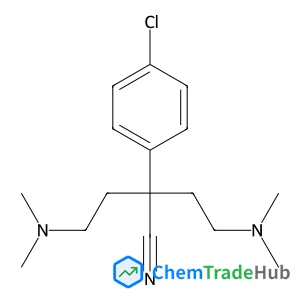
2-(4-Chlorophenyl)-4-(dimethylamino)-2-(2-(dimethylamino)ethyl)butanenitrile
CAS Number:
1246816-57-8
Molecular Formula:
C16H24ClN3
Francis Kirby B. Burnea, Kyoung Chul Ko
Cross-conjugated molecules are an interesting class of conjugated systems possessing a spatially separated HOMO and LUMO. Most previous studies have taken advantage of this property by using it in organic semiconductor applications. Herein, we undertake a new investigation on the use of this type of molecule, in particular benzo[1,2-d;4,5-d′]bisoxazole (BBO), as a coupler for organic diradicals. BBO has two sites available for adding a substituent and a spin center (SC) which are along its 4,8- and 2,6-axes. Functionalizations using electron donating (ED) and electron withdrawing (EW) groups were imposed to tune its FMOs and it was found that the longer 2,6-axis is an ideal site with a broader LUMO range via substituent effects. Diradicalization of these BBOs using nitronyl nitroxide (NN) and nitroxide (NO) as SCs was done using the remaining available axis. The calculated J values are linearly dependent on the LUMO energy of the coupler, but with 4,8-NH2-2,6-SC as an outlier. This exceptional case is related to 4,8-NH2-2,6-SC having the lowest BBO-NN dihedral angle. Moreover, the diradicals 4,8-X-2,6-SC (with X = H, NH2, CH3) have higher J values than 2,6-X-4,8-SC (with X = H, NH2, CH3), which is counterintuitive because the latter have a shorter coupling path. These diradicals are positioned to the right of the intersection of their trend lines, which implies that diradicals with LUMO values to the right of this intersection have the tendency to attain J values that are higher than those diradicals with a shorter coupling path. 4,8-NH2-2,6-SC even surpasses the projected JMax values which we associate with the highest attainable J values due to LUMO tuning via substituent effects. These results provide useful insights, especially into the interplay between the LUMO and the dihedral angle and how these affect magnetism in diradicals. In conclusion, we found that BBO can be a good candidate as an effective coupler for diradicals with tunable J values via incorporation of ED and EW groups. This first approach to studying the application of cross-conjugated molecules as couplers also paves the way for new candidates for the development of more effective diradical systems.
Bryan E. Metze, Riley A. Roberts, Aleksandra Nilova, David R. Stuart
DOI: 10.1039/D3SC05429B
Andrey V. Zaytsev, Amit Sil, Glib V. Baryshnikov, J. A. Gareth Williams, Fernando B. Dias, Valery N. Kozhevnikov
DOI: 10.1039/D3SC04450E
Ana Alcalde-Ordóñez, Natalia Barreiro-Piñeiro, Bríonna McGorman, Jacobo Gómez-González, David Bouzada, Francisco Rivadulla, M. Eugenio Vázquez, Andrew Kellett, José Martínez-Costas, Miguel Vázquez López
DOI: 10.1039/D3SC03303A
Mohammed Sharique, Bianca Matsuo, Albert Granados, Saegun Kim, Mahwish Arshad, Hyunjung Oh, Victoria E. Wu, Minxue Huang, Adam Csakai, Lisa A. Marcaurelle, Gary A. Molander
DOI: 10.1039/D3SC03731B
Jonathan E. Tsang, David A. Nathanson
DOI: 10.1039/D3SC04424F
Andy S. Anker, Keith T. Butler, Kirsten M. Ø. Jensen
DOI: 10.1039/D3SC05081E
Aleksandr Denisenko, Pavel Garbuz, Yelyzaveta Makovetska, Dmytro Lesyk, Rodion Korzh, Iryna V. Sadkova, Pavel K. Mykhailiuk
DOI: 10.1039/D3SC05121H
Clement G. Collins Rice, Louis J. Morris, Jean-Charles Buffet, Zoë R. Turner, Dermot O'Hare
DOI: 10.1039/D3SC04861F
When handling 4-(2-Furylmethyl)thiomorpholine 1,1-dioxide (CAS: 79206-94-3), it ...
When handling 4-Chloro-N-[2-(4-morpholinyl)ethyl]benzamide (CAS: 71320-77-9), it...
Waste containing this compound (CAS: 62921-74-8) should be handled according to ...
Waste containing (S)-Methyl 2-amino-3-cyclohexylpropanoate should be collected i...
This compound can be synthesized using a multi-step process involving the conjug...
There are several alternatives to (2E)-3-(3,4-Dichlorophenyl)acrylic acid in syn...
Ethyl 6-(2-nitrophenyl)imidazo[2,1-b][1,3]thiazole-3-carboxylate (CAS: 925437-84...
Waste containing 2-(1,3-Thiazol-2-yl)ethanamine (CAS: 18453-07-1) should be coll...
Methyl 5-iodo-2-methylbenzoate can be synthesized through the iodination of meth...
5-Chloro[1,2,4]triazolo[1,5-a]pyridine is commonly synthesized via the condensat...

Physical Chemistry Chemical Physics (PCCP) is an international journal co-owned by 19 physical chemistry and physics societies from around the world. This journal publishes original, cutting-edge research in physical chemistry, chemical physics and biophysical chemistry. To be suitable for publication in PCCP, articles must include significant innovation and/or insight into physical chemistry; this is the most important criterion that reviewers and Editors will judge against when evaluating submissions. The journal has a broad scope and welcomes contributions spanning experiment, theory, computation and data science. Topical coverage includes spectroscopy, dynamics, kinetics, statistical mechanics, thermodynamics, electrochemistry, catalysis, surface science, quantum mechanics, quantum computing and machine learning. Interdisciplinary research areas such as polymers and soft matter, materials, nanoscience, energy, surfaces/interfaces, and biophysical chemistry are welcomed if they demonstrate significant innovation and/or insight into physical chemistry. Joined experimental/theoretical studies are particularly appreciated when complementary and based on up-to-date approaches.

![Methyl 4-({[(2-methyl-2-propanyl)oxy]carbonyl}amino)bicyclo[2.2.2]octane-1-carboxylate structure](https://static.chemtradehub.com/structs/943/943845-74-7-b7e5.webp "Methyl 4-({[(2-methyl-2-propanyl)oxy]carbonyl}amino)bicyclo[2.2.2]octane-1-carboxylate structure")