












Temperature dependence of the ultrafast vibrational echo spectroscopy of OD modes in liquid water from first principles simulations
Literature Information
Publication Date
2019-02-25
DOI
10.1039/C8CP07121G
Impact Factor
3.676
Authors
Deepak Ojha, Amalendu Chandra
View Original
Abstract
The rate of vibrational spectral diffusion of OD/OH stretch modes of water is known to be interconnected with the hydrogen bond rearrangement dynamics in aqueous media as found in several recent experiments and molecular simulations. In the present study, the temperature dependence of vibrational spectral diffusion of OD stretch modes in liquid water is investigated from first principles by using the method of ab initio molecular dynamics. Kinetic rates obtained from the frequency time correlation function (FTCF), the slope of the 3-pulse photon echo (S3PE) and local structure correlation functions are used in the Arrhenius equation to determine the energy barrier for hydrogen bond rearrangement in liquid water. The slope of the 3-pulse photon echo is determined within the cumulant and Condon approximations. Although the trend found at the low temperature is slightly non-Arrhenius, the barrier for hydrogen bond rearrangement is found to be around 4.2 kcal mol−1 from all the metrics considered here. It is in good agreement with the hydrogen bond energy determined from different experiments and theoretical studies. Based on the findings, a strong correlation between the vibrational spectral diffusion timescale and hydrogen bond dynamics is identified, which gets even more pronounced at low temperatures. Spatio-temporal correlations between frequency fluctuations and the local hydrogen bond network are also explored.
Related Literature
[60]Fullerene-based liquid crystals acting as acid-sensitive fluorescent probes‡
Laura Pérez, Julie Lenoble, Joaquín Barberá, Pilar de la Cruz, Robert Deschenaux, Fernando Langa
2008-08-22
Communication
DOI: 10.1039/B808730J
Direct observation of time and temperature dependent transition from spherical micelles to vesicles
Hua Wei, Cui-yun Yu, Cong Chang, Chang-yun Quan, Shao-bo Mo, Si-xue Cheng, Xian-zheng Zhang, Ren-xi Zhuo
2008-08-01
Communication
DOI: 10.1039/B811553B
Click chemistry step growth polymerization of novel α-azide-ω-alkyne monomers
Denis Damiron, Thierry Hamaide, Jean-Pierre Pascault, Etienne Fleury, Eric Drockenmuller
2008-07-21
Communication
DOI: 10.1039/B805164J
Is catenation beneficial for hydrogenstorage in metal–organic frameworks?
Patrick Ryan, Linda J. Broadbelt, Randall Q. Snurr
2008-08-01
Communication
DOI: 10.1039/B804343D
Microwave-assisted synthesis of near-infrared fluorescent sphingosine derivatives
Kumar R. Bhushan, Fangbing Liu, Preeti Misra, John V. Frangioni
2008-07-28
Communication
DOI: 10.1039/B807930G
Low reactivity of non-bridging oxygen defects on stoichiometric silica surfaces
Said Hamad
2008-07-14
Communication
DOI: 10.1039/B807291D
Lewis base-catalyzed conjugate reduction and reductive aldol reaction of α,β-unsaturated ketones using trichlorosilane
Masaharu Sugiura, Norimasa Sato, Shunsuke Kotani, Makoto Nakajima
2008-07-17
Communication
DOI: 10.1039/B807529H
Fine control over the morphology and structure of mesoporous silica nanomaterials by a dual-templating approach
Junhui He
2008-07-28
Communication
DOI: 10.1039/B807787H
Hydrogen adsorption in microporous organic framework polymer
Saad Makhseed, Jacob Samuel
2008-07-18
Communication
DOI: 10.1039/B805656K
A simple route for fabricating poly(para-phenylene vinylene) (PPV) particles by using ionic liquids and a solvent evaporation process
Hiroshi Yabu, Atsunori Tajima, Takeshi Higuchi
2008-08-06
Communication
DOI: 10.1039/B809765H
You might also like
Compound Q&A
What precautions should be taken when handling 4-(2-Furylmethyl)thiomorpholine 1,1-dioxide (CAS: 79206-94-3)?
When handling 4-(2-Furylmethyl)thiomorpholine 1,1-dioxide (CAS: 79206-94-3), it ...
79206-94-34-(2-Furylmethyl)thi...
Compound Q&A
What precautions should be taken when handling 4-Chloro-N-[2-(4-morpholinyl)ethyl]benzamide (CAS: 71320-77-9)?
When handling 4-Chloro-N-[2-(4-morpholinyl)ethyl]benzamide (CAS: 71320-77-9), it...
71320-77-94-Chloro-N-[2-(4-mor...
Compound Q&A
How should waste containing 2-[2-(2-Methoxyethoxy)ethoxy]ethyl 4-methylbenzenesulfonate (CAS: 62921-74-8) be handled?
Waste containing this compound (CAS: 62921-74-8) should be handled according to ...
62921-74-82-[2-(2-Methoxyethox...
Compound Q&A
How should waste containing (S)-Methyl 2-amino-3-cyclohexylpropanoate be handled?
Waste containing (S)-Methyl 2-amino-3-cyclohexylpropanoate should be collected i...
40056-18-6(S)-Methyl 2-amino-3...
Compound Q&A
How is 5-({4-[(2S,4R)-4-Hydroxy-2-methyltetrahydro-2H-pyran-4-yl]-2-thienyl}sulfanyl)-1-methyl-1,3-dihydro-2H-indol-2-one (CAS: 166882-70-8) typically synthesized?
This compound can be synthesized using a multi-step process involving the conjug...
166882-70-85-({4-[(2S,4R)-4-Hyd...
Compound Q&A
Are there alternatives to (2E)-3-(3,4-Dichlorophenyl)acrylic acid (CAS: 7312-27-8) in synthesis?
There are several alternatives to (2E)-3-(3,4-Dichlorophenyl)acrylic acid in syn...
7312-27-8(2E)-3-(3,4-Dichloro...
Compound Q&A
How should Ethyl 6-(2-nitrophenyl)imidazo[2,1-b][1,3]thiazole-3-carboxylate (CAS: 925437-84-9) be stored?
Ethyl 6-(2-nitrophenyl)imidazo[2,1-b][1,3]thiazole-3-carboxylate (CAS: 925437-84...
925437-84-9Ethyl 6-(2-nitrophen...
Compound Q&A
How should waste containing 2-(1,3-Thiazol-2-yl)ethanamine (CAS: 18453-07-1) be handled?
Waste containing 2-(1,3-Thiazol-2-yl)ethanamine (CAS: 18453-07-1) should be coll...
18453-07-12-(1,3-Thiazol-2-yl)...
Compound Q&A
How is Methyl 5-iodo-2-methylbenzoate (CAS: 103440-54-6) typically synthesized?
Methyl 5-iodo-2-methylbenzoate can be synthesized through the iodination of meth...
103440-54-6Methyl 5-iodo-2-meth...
Compound Q&A
How is 5-Chloro[1,2,4]triazolo[1,5-a]pyridine (CAS: 1427399-34-5) typically synthesized?
5-Chloro[1,2,4]triazolo[1,5-a]pyridine is commonly synthesized via the condensat...
1427399-34-55-Chloro[1,2,4]triaz...
Source Journal
Physical Chemistry Chemical Physics

CiteScore:
5.5
Self-citation Rate:
10.3%
Articles per Year:
3036
Physical Chemistry Chemical Physics (PCCP) is an international journal co-owned by 19 physical chemistry and physics societies from around the world. This journal publishes original, cutting-edge research in physical chemistry, chemical physics and biophysical chemistry. To be suitable for publication in PCCP, articles must include significant innovation and/or insight into physical chemistry; this is the most important criterion that reviewers and Editors will judge against when evaluating submissions. The journal has a broad scope and welcomes contributions spanning experiment, theory, computation and data science. Topical coverage includes spectroscopy, dynamics, kinetics, statistical mechanics, thermodynamics, electrochemistry, catalysis, surface science, quantum mechanics, quantum computing and machine learning. Interdisciplinary research areas such as polymers and soft matter, materials, nanoscience, energy, surfaces/interfaces, and biophysical chemistry are welcomed if they demonstrate significant innovation and/or insight into physical chemistry. Joined experimental/theoretical studies are particularly appreciated when complementary and based on up-to-date approaches.
Recommended Compounds
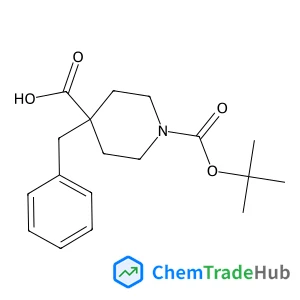
4-Benzyl-1-(tert-butoxycarbonyl)piperidine-4-carboxylic acid
CAS Number:
170838-87-6
Molecular Formula:
C18H25NO4
Recommended Suppliers






Disclaimer
This page provides academic journal information for reference and research purposes only. We are not affiliated with any journal publishers and do not handle publication submissions. For publication-related inquiries, please contact the respective journal publishers directly.
If you notice any inaccuracies in the information displayed, please contact us at support@chemtradehub.com. We will promptly review and address your concerns.