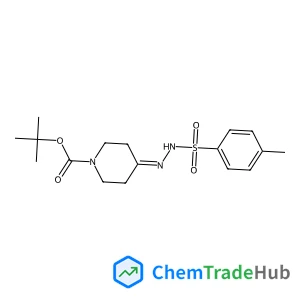
tert-Butyl 4-(2-(p-Tolylsulfonyl)hydrazono)piperidine-1-carboxylate
CAS Number:
1046478-89-0
Molecular Formula:
C17H25N3O4S
Pramod Shanbhag, Pradeep R. Nareddy, Mamta Dadwal, Shaikh M. Mobin, Irishi N. N. Namboothiri
Reaction of nitroalkenes or nitrodienes with methyl vinyl ketone (MVK) or acrylate in the presence of the imidazole–LiCl catalyst system provides Rauhut–Currier (vinylogous Morita–Baylis–Hillman) adducts in moderate yield. Under similar conditions (imidazole–hydroquinone), nitroalkenes and nitrodienes undergo self-dimerization to afford the Rauhut–Currier adducts in varying yields. An alternative self-dimerization–nitro group elimination pathway in the presence tricyclohexylphosphine was observed with heteroaromatic nitroalkenes. A synthetically useful one-pot two step transformation of Rauhut–Currier adducts of nitroalkenes with MVK to 2,3-disubstituted cyclopentenones is also described.
Tengfei Zhang, Zhiwei Tian, Qing Liu
DOI: 10.1039/D0SE00360C
DOI: 10.1039/AN8992400202
Meghali Devi, Monjur H. Barbhuiya, Bishal Das, Bishal Bhuyan, Siddhartha S. Dhar
DOI: 10.1039/D0SE00406E
Andreas Eschenbacher, Alireza Saraeian, Brent H. Shanks, Peter Arendt Jensen, Ulrik Birk Henriksen, Jesper Ahrenfeldt, Anker Degn Jensen
DOI: 10.1039/D0SE00303D
Bo Xiong, Antoine Pallandre, Isabelle le Potier, Pierre Audebert, Elias Fattal, Nicolas Tsapis, Gillian Barratt, Myriam Taverna
DOI: 10.1039/C1AY05598D
Cecilia Solís, María Balaguer, Julio Garcia-Fayos, Elena Palafox, José M. Serra
DOI: 10.1039/D0SE00324G
Di Liu, Haoqiang Ai, Wan Tong Lou, Feifei Li, Kin Ho Lo
DOI: 10.1039/D0SE00518E
(1R,3S)-1,3-Cyclopentanediol finds applications in various industries. In the ph...
When handling N'-[4-(Dimethylamino)phenyl]-N,N-dimethyl-1,4-benzenediamine, it i...
There are several alternatives to 5-(2,4-Difluorophenyl)-2-methoxypyrimidine in ...
1-(3-Methoxyphenoxy)propan-2-ol (CAS: 382141-68-6) must comply with the Globally...
Tetrodotoxin Citrate is extremely dangerous and should be handled with extreme c...
2-Methyl-2-propanyl [(1R,3S)-3-hydroxycyclopentyl]carbamate (CAS: 225641-84-9) i...
Waste containing 4-(2-Hydroxyhexafluoroisopropyl)Benzoic Acid (CAS: 16261-80-6) ...
2-Methyl-2-proanyl {(2S)-1-[(benzyloxy)amino]-3-hydroxy-3-methyl-1-oxo-2-butanyl...
Benzeneethanamine, α-ethyl-, hydrochloride (1:1) is an organic compound with the...
In the synthesis of compounds similar to 3-{(E)-[4-(Dimethylamino)phenyl]diazeny...

Organic & Biomolecular Chemistry (OBC) publishes original and high impact research and reviews in organic chemistry. We welcome research that shows new or significantly improved protocols or methodologies in total synthesis, synthetic methodology or physical and theoretical organic chemistry as well as research that shows a significant advance in the organic chemistry or molecular design aspects of chemical biology, catalysis, supramolecular and macromolecular chemistry, theoretical chemistry, mechanism-oriented physical organic chemistry, medicinal chemistry or natural products. Articles published in the journal should report new work which makes a highly-significant impact in the field. Routine and incremental work is generally not suitable for publication in the journal. More details about key areas of our scope are below. In all cases authors should include in their article clear rationale for why their research has been carried out.
![(2S)-2-{[(9H-Fluoren-9-ylmethoxy)carbonyl]amino}-4-(methylselanyl)butanoic acid structure](https://static.chemtradehub.com/structs/121/1217852-49-7-f252.webp "(2S)-2-{[(9H-Fluoren-9-ylmethoxy)carbonyl]amino}-4-(methylselanyl)butanoic acid structure")
![4-[(3-Chloro-2-fluorophenyl)amino]-7-methoxy-6-quinazolinyl acetate structure](https://static.chemtradehub.com/structs/740/740081-22-5-f58f.webp "4-[(3-Chloro-2-fluorophenyl)amino]-7-methoxy-6-quinazolinyl acetate structure")
![2-{[(1R,2S)-2-Aminocyclohexyl]amino}-4-{[3-(2H-1,2,3-triazol-2-yl)phenyl]amino}-5-pyrimidinecarboxamide structure](https://static.chemtradehub.com/structs/137/1370261-96-3-40df.webp "2-{[(1R,2S)-2-Aminocyclohexyl]amino}-4-{[3-(2H-1,2,3-triazol-2-yl)phenyl]amino}-5-pyrimidinecarboxamide structure")