














Modified mesoporous graphitic carbon nitride: a novel high-performance heterogeneous base catalyst for transesterification reaction
Literature Information
Publication Date
2020-05-06
DOI
10.1039/D0SE00406E
Impact Factor
6.367
Authors
Meghali Devi, Monjur H. Barbhuiya, Bishal Das, Bishal Bhuyan, Siddhartha S. Dhar
View Original
Abstract
Mesoporous graphitic carbon nitride (g-C3N4) was modified with thermal grafting of Oryza sativa (rice) bran ash (OBA) and Triticum aestivum (wheat) bran ash (TBA). These novel catalysts were employed in transesterification reaction for upgrading triglycerides (TAG) of lipids into fatty acid methyl ester (FAME) with alcohol for biodiesel production at room temperature. The catalysts were systematically characterized with analytical techniques such as XRF, XRD, SEM, EDAS, TEM, TGA, XPS, BET and CO2-TPD. These basic green heterogeneous catalytic procedures exclude aqueous quenching, neutralization and saponification steps, tedious catalyst separation, and prevent corrosion in the reactor and engine. Introduction of otherwise decent transesterification catalysts OBA and TBA into graphitic carbon nitride nanosheets significantly enhances activity and reusability in the transesterification process. This increased activity of the nanostructured heterojunctions is attributed to the enhanced basicity, mesoporosity and surface area upon incorporation of OBA/TBA over graphitic carbon nitride nanosheets as confirmed by CO2-TPD and BET analysis. The obtained biodiesel samples were further characterized by 1H NMR and GC MS analysis. The biodiesel samples were tested for important physico-chemical properties to ensure their practical use.
Related Literature
Purpurin derivatives as visible-light photosensitizers for 3D printing and valuable biological applications
Pauline Sautrot-Ba, Vlasta Brezová, Jean-Pierre Malval, Annalisa Chiappone, Louise Breloy, Samir Abbad-Andaloussi, Davy-Louis Versace
2021-03-24
Paper
DOI: 10.1039/D1PY00126D
Modeling ultrasound-induced molecular weight decrease of polymers with multiple scissile azo-mechanophores
Mathieu A. Ayer, Cheyenne H. Liu, Christoph Weder
2021-06-22
Paper
DOI: 10.1039/D1PY00420D
Synthesis of thermo-sensitive polymers with super narrow molecular weight distributions: PET-RAFT polymerization of N-isopropyl acrylamide mediated by cross-linked zinc porphyrins with high active site loadings
Fanfan Li, Yi Yu, Hanyu Lv, Guiting Cai, Yanwu Zhang
2021-03-22
Paper
DOI: 10.1039/D0PY01643H
Structural design of pyrene-functionalized TEMPO-containing polymers for enhanced electrochemical storage performance
Hatice Mutlu, Hongjiao Li, Wolfgang Wenzel
2021-04-06
Paper
DOI: 10.1039/D0PY01421D
Polymerizability of exomethylene monomers based on adamantyl frameworks
Raita Goseki, Shogo Miyai, Satoshi Uchida, Takashi Ishizone
2021-06-02
Paper
DOI: 10.1039/D1PY00500F
NMR investigations of polytrifluoroethylene (PTrFE) synthesized by RAFT
Vincent Bouad, Marc Guerre, Sami Zeliouche, Bruno Améduri, Cédric Totée, Gilles Silly, Rinaldo Poli, Vincent Ladmiral
2021-03-15
Paper
DOI: 10.1039/D0PY01753A
Construction of biodegradable core cross-linked nanoparticles from near infrared dyes encoded in polyprodrug amphiphiles and investigation of their synergistic anticancer activity
Xiaoxu Mao, Shoukui Hu, Ke Shang, Guangwei Yang, Jinhao Yan, Chao Ma, Jun Yin
2021-03-05
Paper
DOI: 10.1039/D1PY00128K
Well-defined hydrogen and organofunctional polysiloxanes with spiro-fused siloxane backbones
Takahiro Kawatsu, Keita Fuchise, Katsuhiko Takeuchi, Jun-Chul Choi, Kazuhiko Sato, Kazuhiro Matsumoto
2021-03-18
Paper
DOI: 10.1039/D0PY01503B
Efficient synthesis of discrete oligo(fluorenediacetylene)s toward chain-length-dependent optical and structural properties
Xianheng Shi, Min Liu, Lishan Li, Jiandong Zhang, Haiyan Li, Zhihao Huang, Wei Zhang, Zhengbiao Zhang, Nianchen Zhou, Xiulin Zhu
2021-03-31
Paper
DOI: 10.1039/D1PY00165E
You might also like
Compound Q&A
What industries use (1R,3S)-1,3-Cyclopentanediol (CAS: 16326-97-9)?
(1R,3S)-1,3-Cyclopentanediol finds applications in various industries. In the ph...
16326-97-9(1R,3S)-1,3-Cyclopen...
Compound Q&A
What precautions should be taken when handling N'-[4-(Dimethylamino)phenyl]-N,N-dimethyl-1,4-benzenediamine (CAS: 637-31-0)?
When handling N'-[4-(Dimethylamino)phenyl]-N,N-dimethyl-1,4-benzenediamine, it i...
637-31-0N'-[4-(Dimethylamino...
Compound Q&A
Are there alternatives to 5-(2,4-Difluorophenyl)-2-methoxypyrimidine (CAS: 1352318-16-1) in synthesis?
There are several alternatives to 5-(2,4-Difluorophenyl)-2-methoxypyrimidine in ...
1352318-16-15-(2,4-Difluoropheny...
Compound Q&A
What regulatory guidelines apply to 1-(3-Methoxyphenoxy)propan-2-ol (CAS: 382141-68-6)?
1-(3-Methoxyphenoxy)propan-2-ol (CAS: 382141-68-6) must comply with the Globally...
382141-68-61-(3-Methoxyphenoxy)...
Compound Q&A
Is Tetrodotoxin Citrate (CAS: 18660-81-6) safe?
Tetrodotoxin Citrate is extremely dangerous and should be handled with extreme c...
18660-81-6Tetrodotoxin Citrate
Compound Q&A
What are the main uses of 2-Methyl-2-propanyl [(1R,3S)-3-hydroxycyclopentyl]carbamate (CAS: 225641-84-9)?
2-Methyl-2-propanyl [(1R,3S)-3-hydroxycyclopentyl]carbamate (CAS: 225641-84-9) i...
225641-84-92-Methyl-2-propanyl ...
Compound Q&A
How should waste containing 4-(2-Hydroxyhexafluoroisopropyl)Benzoic Acid (CAS: 16261-80-6) be handled?
Waste containing 4-(2-Hydroxyhexafluoroisopropyl)Benzoic Acid (CAS: 16261-80-6) ...
16261-80-64-(2-Hydroxyhexafluo...
Compound Q&A
How is 2-Methyl-2-proanyl {(2S)-1-[(benzyloxy)amino]-3-hydroxy-3-methyl-1-oxo-2-butanyl}carbamate (CAS: 102507-19-7) typically synthesized?
2-Methyl-2-proanyl {(2S)-1-[(benzyloxy)amino]-3-hydroxy-3-methyl-1-oxo-2-butanyl...
102507-19-72-Methyl-2-propanyl ...
Compound Q&A
What is Benzeneethanamine, α-ethyl-, hydrochloride (1:1) (CAS: 20735-15-3)?
Benzeneethanamine, α-ethyl-, hydrochloride (1:1) is an organic compound with the...
20735-15-3Benzeneethanamine, α...
Compound Q&A
Are there alternatives to 3-{(E)-[4-(Dimethylamino)phenyl]diazenyl}benzoic acid (CAS: 20691-84-3) in synthesis?
In the synthesis of compounds similar to 3-{(E)-[4-(Dimethylamino)phenyl]diazeny...
20691-84-33-{(E)-[4-(Dimethyla...
Source Journal
Recommended Compounds
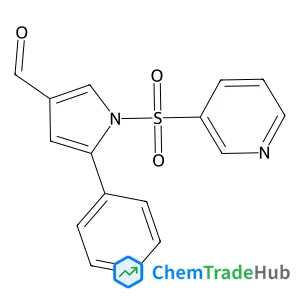
5-Phenyl-1-(pyridin-3-ylsulfonyl)-1H-pyrrole-3-carbaldehyde
CAS Number:
881676-90-0
Molecular Formula:
C16H12N2O3S

Recommended Suppliers





Disclaimer
This page provides academic journal information for reference and research purposes only. We are not affiliated with any journal publishers and do not handle publication submissions. For publication-related inquiries, please contact the respective journal publishers directly.
If you notice any inaccuracies in the information displayed, please contact us at support@chemtradehub.com. We will promptly review and address your concerns.