












High-resolution solid-state 13C μMAS NMR with long coherence life times
Literature Information
Publication Date
2010-11-12
DOI
10.1039/C0CP01929A
Impact Factor
3.676
Authors
Suresh K. Vasa, Hans Janssen, Ernst R. H. Van Eck, Arno P. M. Kentgens
View Original
Abstract
Longer coherence life times (i.e. smaller homogeneous linewidths) can be achieved for carbon resonances which are strongly coupled to protons with high rf field heteronuclear decoupling in micro magic angle spinning NMR. Better proton decoupling enhances the sensitivity and resolution of two-dimensional through-bond correlation experiments for mass-limited samples with uniform carbon labeling.
Related Literature
SAXS on a chip: from dynamics of phase transitions to alignment phenomena at interfaces studied with microfluidic devices
2017-08-07
Perspective
DOI: 10.1039/C7CP02736B
Humidity-induced formation of water channels in supramolecular assemblies of wedge-shaped amphiphiles: the effect of the molecular architecture on the channel topology
A. Dolgopolov, K. N. Grafskaia, D. E. Demco, X. Zhu, M. Möller
2017-02-16
Paper
DOI: 10.1039/C6CP08087A
Enhancement in thermoelectric performance of SiGe nanoalloys dispersed with SiC nanoparticles
M. Jayasimhadri, Bhasker Gahtori, Anil Kumar, A. K. Srivastava, Ajay Dhar
2017-08-31
Paper
DOI: 10.1039/C7CP04240J
Unusual cis-diprotonated forms and fluorescent aggregates of non-peripherally alkoxy-substituted metallophthalocyanines
P. Kasprzycki, L. Sobotta, S. Lijewski, M. Wierzchowski, T. Goslinski, J. Mielcarek, C. Radzewicz, P. Fita
2017-07-24
Paper
DOI: 10.1039/C7CP04321J
A simple bulk modulus model for crystal materials based on the bond valence model
Xiao Liu, Hao Wang, Weimin Wang, Zhengyi Fu
2017-07-27
Paper
DOI: 10.1039/C7CP03739B
Regulation of transport properties by polytypism: a computational study on bilayer MoS2
Swastika Banerjee, Cheol Seong Hwang, Jung-Hae Choi, Seung-Cheol Lee
2017-07-20
Communication
DOI: 10.1039/C7CP02973J
Self-thermophoretic motion of controlled assembled micro-/nanomotors
Xiankun Lin, Tieyan Si, Zhiguang Wu, Qiang He
2017-05-22
Perspective
DOI: 10.1039/C7CP02561K
Free-standing reduced graphene oxide/MnO2–reduced graphene oxide–carbon nanotube nanocomposite flexible membrane as an anode for improving lithium-ion batteries
Yong Li, Daixin Ye, Bin Shi, Wen Liu, Rui Guo, Haijuan Pei, Jingying Xie
2016-12-19
Paper
DOI: 10.1039/C6CP07784F
Comment on “Brownian diffusion of a particle at an air/liquid interface: elastic (not viscous) response of the surface”
G. Boniello, A. Stocco, C. Blanc, M. Nobili
2017-07-28
Comment
DOI: 10.1039/C7CP02970E
On the role of topology in regulating transcriptional cascades
Alireza Mashaghi
2017-09-08
Paper
DOI: 10.1039/C7CP02671D
You might also like
Compound Q&A
What are the main uses of 4-Nitrophenyl phosphate disodium salt hexahydrate (CAS: 333338-18-4)?
4-Nitrophenyl phosphate disodium salt hexahydrate is primarily used as a substra...
333338-18-44-Nitrophenyl phosph...
Compound Q&A
What are the main uses of 2-(Trifluoromethyl)-1,3-oxazole-4-carboxylic Acid (CAS: 1060816-01-4)?
2-(Trifluoromethyl)-1,3-oxazole-4-carboxylic Acid (CAS: 1060816-01-4) is widely ...
1060816-01-42-(Trifluoromethyl)-...
Compound Q&A
How should 2-Fluoro-4-biphenylcarboxylic acid (CAS: 137045-30-8) be stored?
2-Fluoro-4-biphenylcarboxylic acid should be stored in a cool, dry place at room...
137045-30-82-Fluoro-4-biphenylc...
Compound Q&A
What industries use Prednisolone-21-Carboxylic Acid (CAS: 61549-70-0)?
Prednisolone-21-Carboxylic Acid is primarily used in the pharmaceutical industry...
61549-70-0Prednisolone-21-Carb...
Compound Q&A
How should 4-(Hydrazinomethyl)-1,2,3-benzenetriol (CAS: 3614-72-0) be stored?
4-(Hydrazinomethyl)-1,2,3-benzenetriol (CAS: 3614-72-0) should be stored in a co...
3614-72-04-(Hydrazinomethyl)-...
Compound Q&A
What industries use 4-Amino-1-methyl-1H-pyrazole-5-carboxylic acid hydrochloride (CAS: 92534-70-8)?
4-Amino-1-methyl-1H-pyrazole-5-carboxylic acid hydrochloride (CAS: 92534-70-8) i...
92534-70-84-Amino-1-methyl-1H-...
Compound Q&A
What regulatory guidelines apply to dehydropachymic acid (CAS: 77012-31-8)?
Dehydropachymic acid (CAS: 77012-31-8) is regulated by various agencies. It fall...
77012-31-8Dehydropachymic acid
Compound Q&A
What is the market or research trend for 6-[(2,2-Dimethylpropanoyl)amino]nicotinic acid (CAS: 898561-66-5)?
The market and research trends for 6-[(2,2-Dimethylpropanoyl)amino]nicotinic aci...
898561-66-56-[(2,2-Dimethylprop...
Compound Q&A
How should 1,10-Phenanthroline-2,9-dicarbaldehyde (CAS: 57709-62-3) be stored?
1,10-Phenanthroline-2,9-dicarbaldehyde should be stored in a cool, dry place awa...
57709-62-31,10-Phenanthroline-...
Compound Q&A
How is 5-Carbamoyl-11-oxo-10,11-dihydro-5H-dibenzo[b,f]azepin-10-yl acetate (CAS: 113952-21-9) typically synthesized?
5-Carbamoyl-11-oxo-10,11-dihydro-5H-dibenzo[b,f]azepin-10-yl acetate can be synt...
113952-21-95-Carbamoyl-11-oxo-1...
Source Journal
Physical Chemistry Chemical Physics

CiteScore:
5.5
Self-citation Rate:
10.3%
Articles per Year:
3036
Physical Chemistry Chemical Physics (PCCP) is an international journal co-owned by 19 physical chemistry and physics societies from around the world. This journal publishes original, cutting-edge research in physical chemistry, chemical physics and biophysical chemistry. To be suitable for publication in PCCP, articles must include significant innovation and/or insight into physical chemistry; this is the most important criterion that reviewers and Editors will judge against when evaluating submissions. The journal has a broad scope and welcomes contributions spanning experiment, theory, computation and data science. Topical coverage includes spectroscopy, dynamics, kinetics, statistical mechanics, thermodynamics, electrochemistry, catalysis, surface science, quantum mechanics, quantum computing and machine learning. Interdisciplinary research areas such as polymers and soft matter, materials, nanoscience, energy, surfaces/interfaces, and biophysical chemistry are welcomed if they demonstrate significant innovation and/or insight into physical chemistry. Joined experimental/theoretical studies are particularly appreciated when complementary and based on up-to-date approaches.
Recommended Compounds
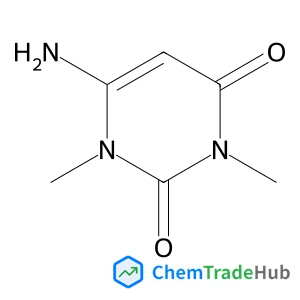
6-amino-1,3-dimethyl-1,2,3,4-tetrahydropyrimidine-2,4-dione
CAS Number:
6642-31-5
Molecular Formula:
C6H9N3O2
Recommended Suppliers




Disclaimer
This page provides academic journal information for reference and research purposes only. We are not affiliated with any journal publishers and do not handle publication submissions. For publication-related inquiries, please contact the respective journal publishers directly.
If you notice any inaccuracies in the information displayed, please contact us at support@chemtradehub.com. We will promptly review and address your concerns.