












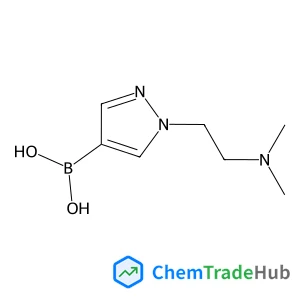
(1-(2-(Dimethylamino)ethyl)-1H-pyrazol-4-yl)boronic acid
CAS Number:
1086063-73-1
Molecular Formula:
C7H14BN3O2
Alexander J. Fleming, Stephen Berkebile, Thomas Ules, Michael G. Ramsey
Pre-nucleation dynamics, nucleation and templated self-assembly of a conjugated planar aromatic molecule are investigated by photoemission electron microscopy (PEEM). The high resolution of individual molecular layers in PEEM, in combination with a numerical simulation, reveals the dynamic behaviour of molecules during the pre-nucleation deposition period and their temperature dependence. The in situ deposition of p-sexiphenyl (6P) molecules on Cu(110) and Cu(110) 2 × 1–O surfaces in ultrahigh vacuum, when monitored by PEEM in real-time allows (a) layer densities, (b) meta-stable layer filling by 6P molecules, (c) dynamic surface redistributions during layer filling and (d) critical density spontaneous dewetting to be accurately measured. The comparison of 6P deposited on Cu(110) to Cu(110) 2 × 1–O enables temperature dependent 6P nucleation processes on Cu(110) to be elucidated from PEEM. The interplay between energetically stable molecular arrangements and kinetically stabilised arrangements is shown to dominate the pre- and post-nucleation processes. In combination with additional data obtained during post-nucleation deposition times, such as surface diffusion anisotropies and nucleation energies, it is concluded that the pre-requisite for 6P nucleation, in a lying down orientation, is the formation of a double tilted layer with at least one layer being meta-stable.
Yundong Zhou, Xiaoen Wang, Haijin Zhu, Michel Armand, Maria Forsyth, George W. Greene, Jennifer M. Pringle, Patrick C. Howlett
DOI: 10.1039/C6CP07415D
Yinlong Du, Ningning Dong, Menghan Zhang, Kai Zhu, Ruiqi Na, Shuling Zhang, Ningwei Sun, Guibin Wang, Jun Wang
DOI: 10.1039/C6CP05920A
DOI: 10.1039/C6CP07834F
A. V. Gorbunov, X. Meng, I. Urbanaviciute, T. Putzeys, M. Wübbenhorst, R. P. Sijbesma
DOI: 10.1039/C6CP08015D
Anton S. Ivanov, Konstantin I. Maslakov, Alexander V. Egorov, Zexiang Shen
DOI: 10.1039/C6CP04657F
Ji-Chuang Hu, Lin-Lin Xu, Hai-Fang Li, David Yubero Valdivielso, André Fielicke, Sheng-Gui He, Jia-Bi Ma
DOI: 10.1039/C6CP06896K
Dongxia Ma, Congjie Zhang, Zhe-Ning Chen, Xin Xu
DOI: 10.1039/C6CP06215F
G. Meneses, C. Widmann, T. Cunha, A. Gil, F. Ferreira da Silva, M. J. Calhorda, P. Limão-Vieira
DOI: 10.1039/C6CP06375F
Zonglin Gu, Phil De Luna, Zaixing Yang
DOI: 10.1039/C6CP05260F
F. Aguilera-Granja, L. C. Balbás, A. Vega
DOI: 10.1039/C6CP06225C
2-(2-Chloroacetamido)-3-phenylpropanoic acid (CAS: 7765-11-9) is generally consi...
2-(Benzyloxy)-5-bromobenzoic acid can be handled safely if appropriate precautio...
(4-Methyl-1,2,5-oxadiazol-3-yl)methanamine hydrochloride is a chemical compound ...
2-(5-Hexylthiophen-2-yl)-4,4,5,5-tetramethyl-1,3,2-dioxaborolane (CAS: 917985-54...
While 4-(8-Methyl-9H-1,3-dioxolo[4,5-h][2,3]benzodiazepin-5-yl)benzenamine (CAS:...
The market for tert-butyl 3-hydroxy-4,5,7,8-tetrahydro-2H-pyrazolo[3,4-d]azepine...
Waste containing 3,5-Diamino-1H-pyrazole-4-carbonitrile (CAS: 6844-58-2) should ...
(6-Fluoro-3-pyridinyl)boronic acid can be synthesized through the reaction of 6-...
Dibenzyl carbonimidoylbiscarbamate (CAS: 10065-79-9) finds applications in vario...
The market for (beta,beta,2,3,4,5,6-~2~H_7_)Phenylalanine (CAS: 74228-83-4) is g...

Physical Chemistry Chemical Physics (PCCP) is an international journal co-owned by 19 physical chemistry and physics societies from around the world. This journal publishes original, cutting-edge research in physical chemistry, chemical physics and biophysical chemistry. To be suitable for publication in PCCP, articles must include significant innovation and/or insight into physical chemistry; this is the most important criterion that reviewers and Editors will judge against when evaluating submissions. The journal has a broad scope and welcomes contributions spanning experiment, theory, computation and data science. Topical coverage includes spectroscopy, dynamics, kinetics, statistical mechanics, thermodynamics, electrochemistry, catalysis, surface science, quantum mechanics, quantum computing and machine learning. Interdisciplinary research areas such as polymers and soft matter, materials, nanoscience, energy, surfaces/interfaces, and biophysical chemistry are welcomed if they demonstrate significant innovation and/or insight into physical chemistry. Joined experimental/theoretical studies are particularly appreciated when complementary and based on up-to-date approaches.

![(1R)-N-((1R)-1-Phenylethyl)-1-[4-(tert-butyldimethylsilyloxymethyl)cyclohexyl]ethan-1-amine structure](https://static.chemtradehub.com/structs/672/672314-45-3-47ef.webp "(1R)-N-((1R)-1-Phenylethyl)-1-[4-(tert-butyldimethylsilyloxymethyl)cyclohexyl]ethan-1-amine structure")




